
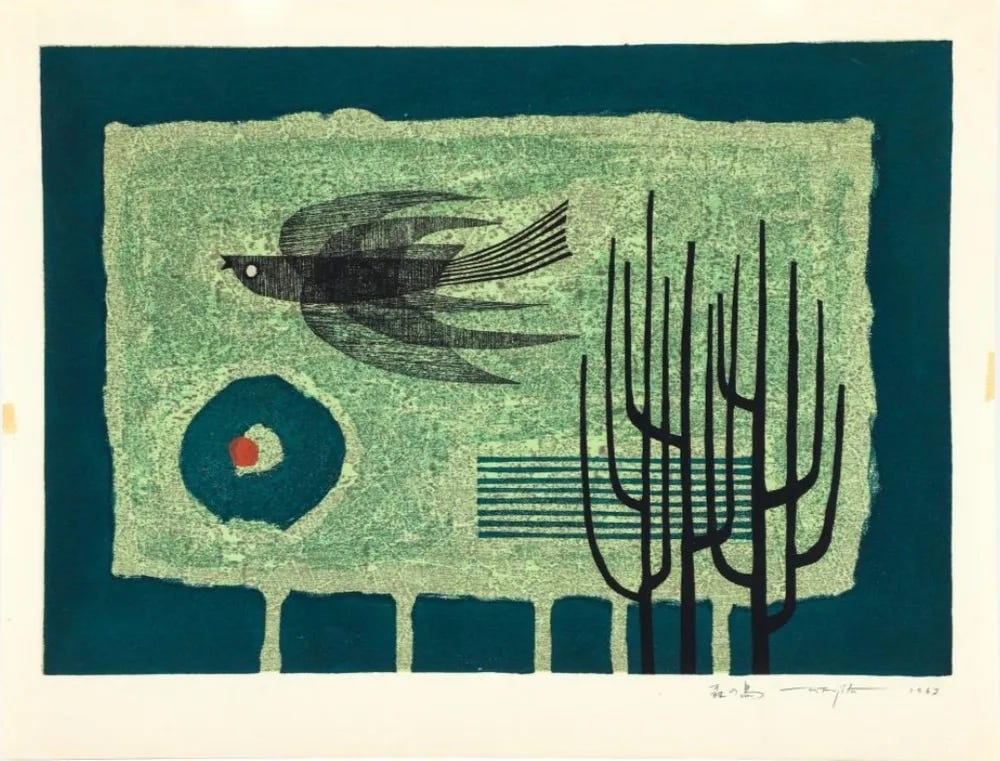
© Fumio Fujita.
'Abstract with Bird,' 1963.
Epigraph: “Attention is the rarest and purest form of generosity.” — Simone Weil
There are corners of the digital world where spectacle has not yet colonized the act of looking. They are small, almost monastic spaces—quiet rooms in a noisy house—where images are offered without commentary, without self‑promotion, without the usual choreography of online identity. Gary Buckley’s Bluesky feed is one of these rooms. It is not a gallery, not a curated exhibition, not a thesis. It is a practice of attention, enacted daily, almost ritually, through the simple act of sharing art.
To enter Buckley’s feed is to feel the presence of someone who trusts the eye more than the algorithm. Sorolla’s Mediterranean light appears beside Wyeth’s stoic Americana; a Japanese woodblock print follows a contemporary acrylic portrait; a cat asleep in a green field sits next to the Brooklyn Bridge rendered in monumental quiet. The selections are eclectic but never chaotic. They feel like the choices of a person who has learned to follow their own sensibility rather than any external demand for novelty.
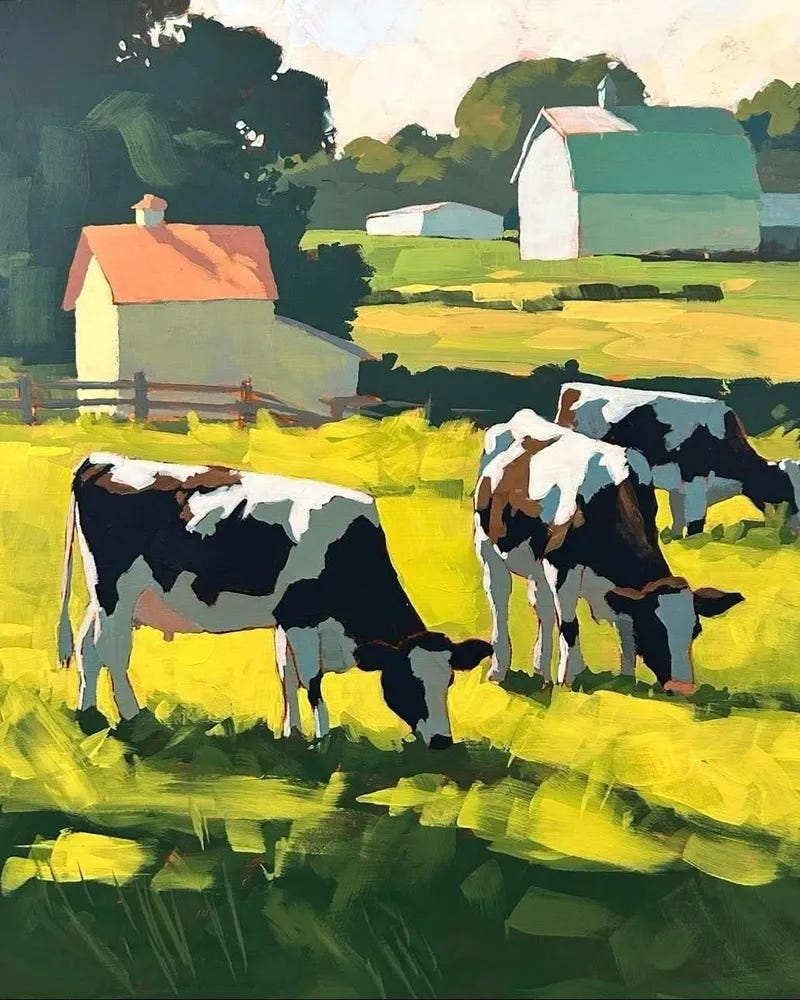
© Jim Musil.
'Grazing Cattle.'
The rhythm of the feed becomes its own kind of pedagogy. A landscape from 1882 sits beside a portrait from 2024, and suddenly you see how light behaves across centuries, how gesture shifts from academic precision to modern looseness, how the human figure remains stubbornly itself. Buckley’s feed doesn’t chase the new; it honors the ongoing. It suggests that art’s central questions—how to hold light, how to witness form, how to attend to the world without spectacle—are perennial.
And then there is the silence. In a digital culture saturated with takes, Buckley’s refusal to interpret or contextualize feels almost radical. No captions, no explanations, no claims to expertise. Just the work, offered plainly. This silence is not emptiness; it is humility. It is a belief that art does not require a thesis to be meaningful, that the viewer’s interiority is enough. In a time when attention is constantly monetized, Buckley’s feed practices a kind of ethical restraint. It trusts the viewer.
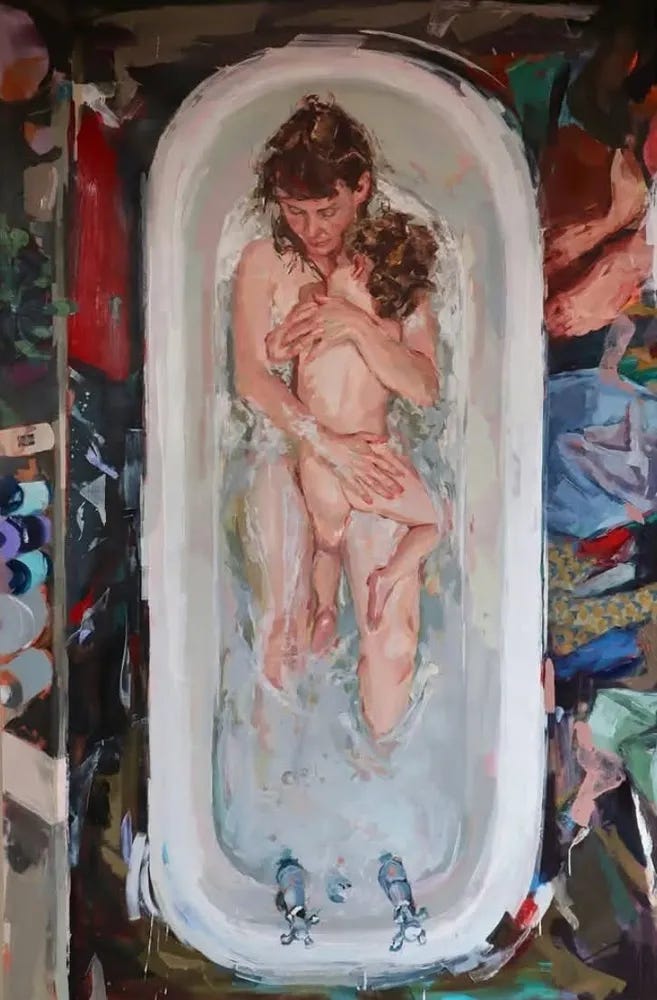
© Helen Bur.
'Untitled.'
Yet the feed is not impersonal. The choices reveal a temperament—an affection for representational painting, for scenes of daily life, for landscapes that hold both serenity and melancholy. Even the occasional political post, dropped in without emphasis, feels like part of the same worldview: attentive, observational, unadorned. Buckley is not trying to persuade; he is trying to witness.
This is where his practice intersects with your ongoing exploration of ethical imagination and anti‑corporate art communities. Buckley’s feed enacts a form of resistance—not loud, not polemical, but steady. In refusing spectacle, he refuses the corporate logic that turns art into content. In refusing commentary, he refuses the demand that every gesture justify itself. In refusing novelty, he refuses the churn of digital consumption. His feed is a small republic of images, governed by attention rather than performance.
What Buckley offers, ultimately, is not a gallery but a way of being with art. A daily ritual of looking, selecting, and sharing. A belief that beauty, skill, strangeness, and quiet can still matter in a world that rewards noise. It is the kind of digital generosity you’ve championed in your newsletter—the idea that art, when shared without agenda, becomes a civic gesture. A way of saying: here is something worth pausing for; let’s look together before the world rushes back in.
Conclusion: The Ethics of Quiet
In the end, Buckley’s feed reminds us that attention is not just a personal virtue but a civic one. To look without consuming, to share without performing, to curate without branding—these are small acts of ethical imagination. They resist the corporate capture of our gaze. They create pockets of interior freedom. They make room for art to be encountered rather than leveraged.
In a digital landscape dominated by spectacle, Buckley offers quiet. In a culture obsessed with novelty, he offers continuity. In a world that monetizes attention, he offers it freely.
And in doing so, he models the kind of presence our newsletter has always tried to cultivate: attentive, generous, unhurried, and resistant to the forces that would turn art—and us—into commodities.
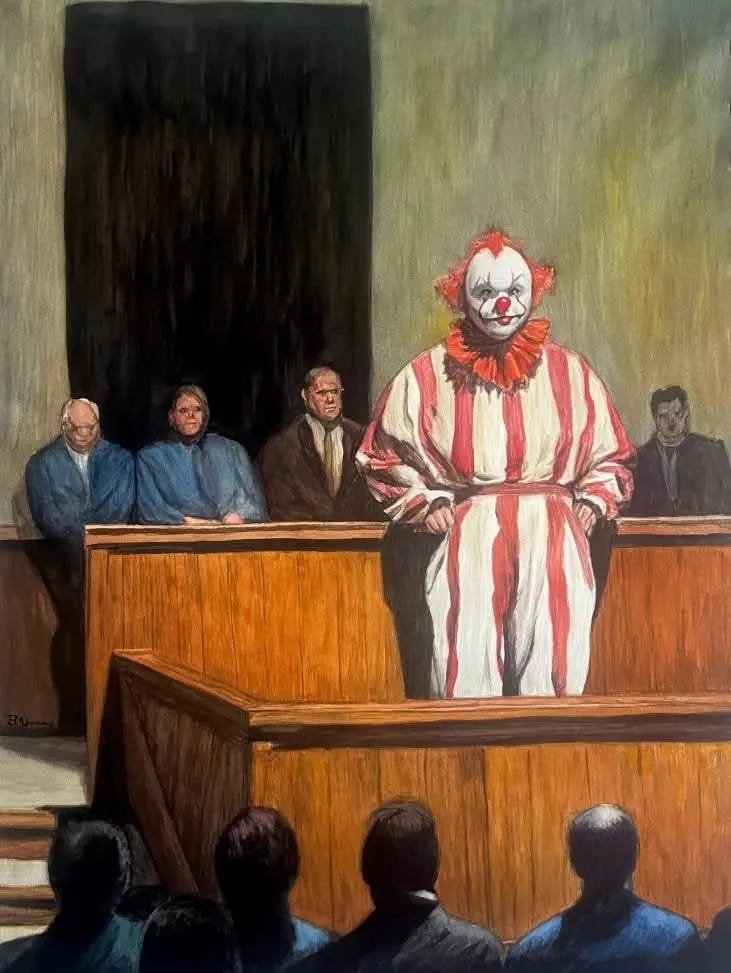
© Benjamin J. Young.
'Circus Act,' 2026.
Gary Buckley