
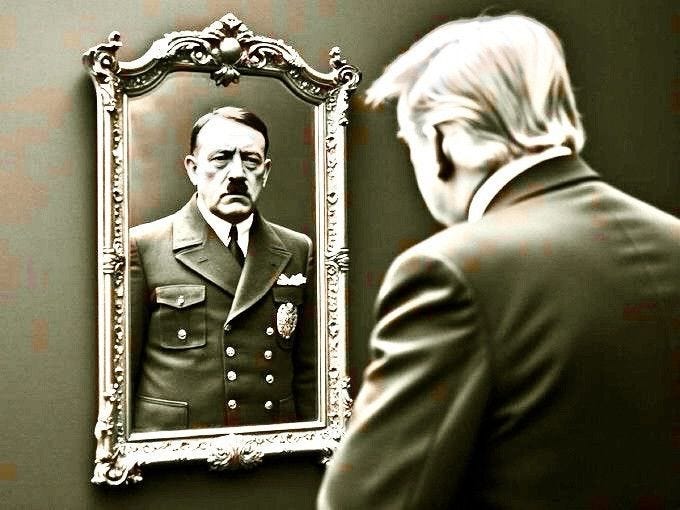
Pulitzer Prize winner issues ‘would-be American Nero’ Trump blistering takedown
American exceptionalism has always been a story of self‑regard. Sometimes it has been aspirational, a way of naming the country’s better angels. Sometimes it has been a shield against accountability. But in the Trump/MAGA/GOP era, the concept doesn’t merely falter. It becomes untenable. It becomes, as the novelist Viet Thanh Nguyen suggests in the article you’re reading, a myth that can only be maintained through denial and cruelty. When he writes that “cruelty is the defining trait of the United States,” he is not inventing a provocation. He is describing a reality that the myth of exceptionalism can no longer conceal.
The Trump movement didn’t break American exceptionalism. It revealed what was already cracked. It exposed how thin the veneer of moral superiority really was, how quickly it could be repurposed into a justification for domination, exclusion, and resentment. Exceptionalism once claimed that America was uniquely committed to liberty and democracy. Under MAGA, it has been reinterpreted as the right to impose one’s will, the right to never be questioned, the right to treat others as threats simply for existing.
The spectacle of cruelty — from family separations to militarized immigration raids to the rhetoric of “vermin” and “poisoning the blood” — is not incidental. It is central. It is the emotional engine of the movement. Exceptionalism becomes absurd when a nation insists on its inherent goodness while celebrating policies that degrade, dehumanize, and terrorize. The contradiction is not subtle. It is glaring. And yet the myth persists, because it is useful. It allows a political movement to claim righteousness while practicing repression. It allows its followers to imagine themselves as victims even as they wield power.
The Supreme Court’s recent decisions, the open nostalgia for a whiter past, the fantasies of unchecked executive authority — these developments make the absurdity of exceptionalism impossible to ignore. If America is uniquely virtuous, why does it require so much force to maintain its identity? Why does its dominant political movement seem animated not by confidence but by grievance? Why does its leader present himself not as a steward of democracy but as a “would‑be American Nero,” as the article puts it, a man who threatens to burn the institutions he cannot control?
Exceptionalism, in its traditional form, cannot survive contact with Trumpism. The movement’s core commitments — hierarchy, resentment, cruelty, domination — are incompatible with any honest claim to moral superiority. The myth collapses because it was never designed to withstand scrutiny. It was designed to justify power.
And yet the collapse of the myth is not only a political event. It is a moral and imaginative one. It forces us to reconsider what patriotism means. It forces us to ask whether love of country can coexist with honesty about its failures. Nguyen argues that the only credible form of patriotism left is the refusal to participate in cruelty. That is a radical reframing of American identity — not as a boast, not as a destiny, but as a responsibility.
The truth is that American exceptionalism was always a story about who gets to define America. Under Trump, that definition has narrowed to a single, brittle demand: loyalty to the leader and hostility toward the Other. The myth has become a weapon. Its absurdity is not accidental. It is strategic.
But myths die. And when they do, they create space for new stories. Stories grounded not in superiority but in humility. Not in domination but in solidarity. Not in cruelty but in conscience.
The question now is whether Americans — especially those who still believe in the country’s democratic promise — can imagine a form of national identity that does not require self‑deception. Whether they can build a civic imagination that does not depend on exceptionalism at all.
Because the myth is gone. What remains is the work of telling the truth, and the work of building something better from it.