
Paul Kenton, Contemporary Artist - Official Website
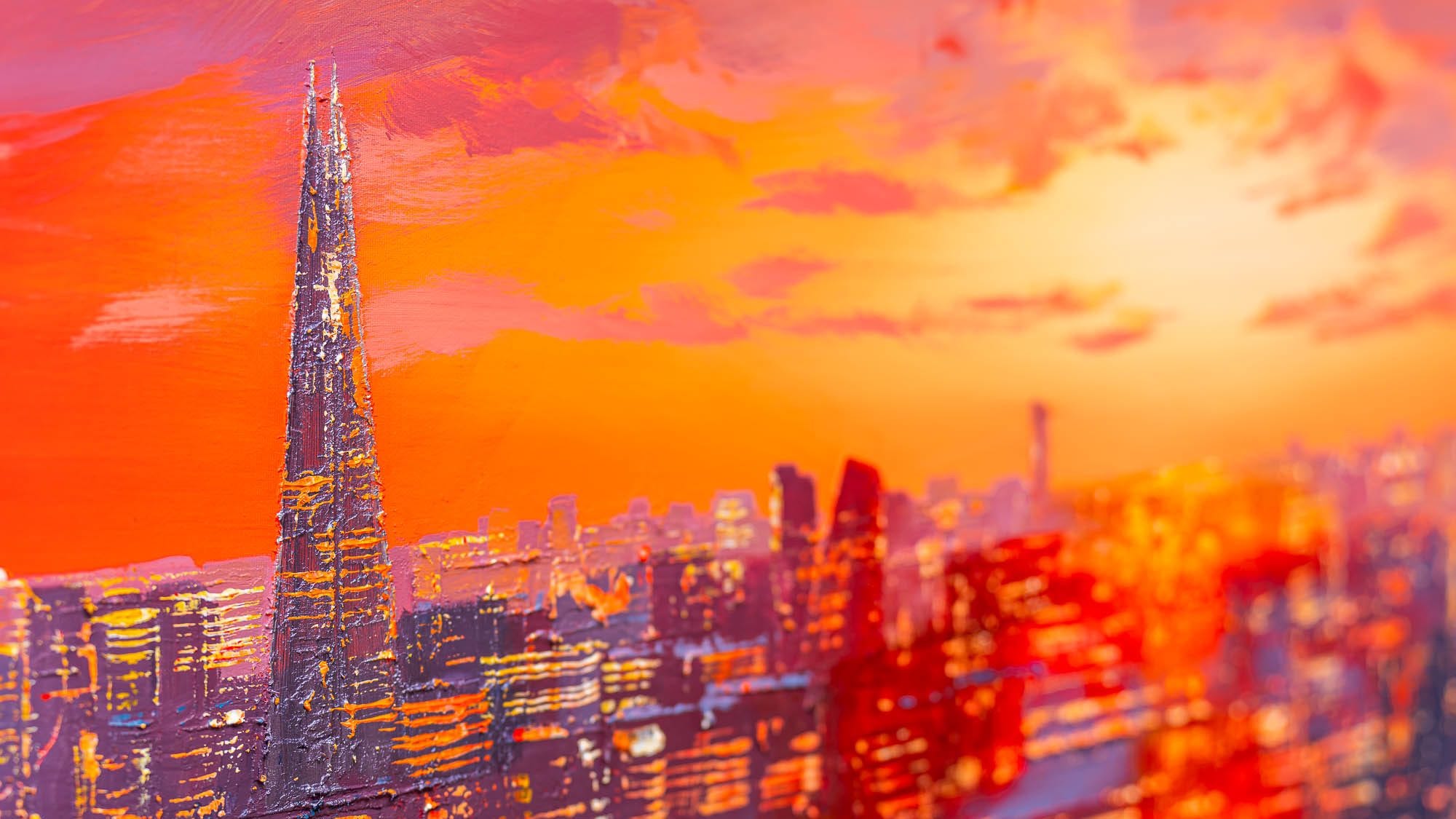
When you look at Paul Kenton’s work, the “verb‑ness” of art becomes almost impossible to ignore. His paintings—especially the cityscapes—aren’t just depictions of places; they’re enactments of perception. They perform the experience of being in a city: the blur of light, the shimmer of movement, the sense that everything is in flux.
🌀 1. Kenton’s surfaces behave like events, not objects
His metallic grounds, poured colors, and dragged lines don’t sit still. They feel like the residue of gestures that haven’t fully settled. The painting becomes a trace of action, a record of energy passing through the artist into the world.
This is Pollock’s legacy refracted through urban light rather than rural landscape:
the canvas as a site of happening.
⚡ 2. The city becomes a verb too
Kenton doesn’t paint “a city” as a stable noun. He paints citying—the ongoing activity of a place becoming itself through motion, light, and human presence. The skyscrapers and streets are less architectural facts than rhythmic pulses.
In that sense, the painting is not a picture of a city; it is the action of a city.
🖐️ 3. The viewer completes the action
When art is a verb, the viewer isn’t a passive observer. Kenton’s reflective surfaces and kinetic compositions require you to move, shift, and re‑orient yourself. You don’t just look at the painting; you enter its motion.
The artwork becomes a collaboration between:
the artist’s gesture
the material’s behavior
the viewer’s perceptual activity
The noun dissolves into a triad of verbs.
🔥 4. Why this matters philosophically
Your statement—art as action—isn’t just a clever distinction. It’s a way of reclaiming agency, presence, and becoming. It aligns with your broader interest in art that expands consciousness rather than stabilizing identity.
Kenton’s work is a perfect example because:
it refuses stasis
it foregrounds process
it makes perception itself the subject
Art becomes a way of doing the world, not representing it.
🌊 5. And yes, it’s still a noun—but only incidentally
The finished painting is a noun in the same way a footprint is a noun:
a frozen remainder of movement.
The real art is the action that produced it and the action it provokes in the viewer.