
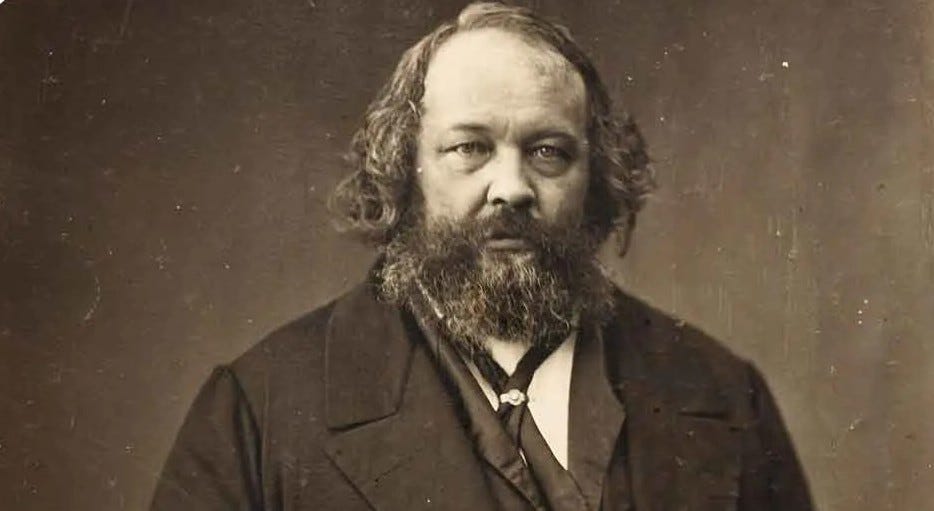
Mikhail Bakunin
The story of the original anarchists, and of Mikhail Bakunin in particular, reads less like a political program and more like a long, unruly argument about human dignity. When you move through their writings, you feel the heat of a century in which monarchy, church, and capital all claimed absolute authority, and a handful of thinkers insisted—sometimes wildly, sometimes beautifully—that ordinary people could govern themselves without being bent to the will of any master.
Bakunin emerges in that landscape as a kind of volcanic presence. He was not a system-builder like Marx, nor a quiet theorist like Kropotkin would later become. He was a man of appetite and contradiction, but also of a fierce, almost spiritual belief that freedom is not granted from above; it is seized, lived, and defended from below. His anarchism was rooted in a simple conviction: that hierarchical power—whether political, economic, or religious—corrupts both the ruler and the ruled. To obey blindly was, for him, a kind of moral diminishment. To resist was a way of reclaiming one’s humanity.
The early anarchists were not naïve about violence or conflict; they lived in a Europe where repression was brutal and dissent was often met with prison or exile. But their core aspiration was not chaos. It was the creation of a society where mutual aid, voluntary cooperation, and local autonomy replaced the coercive machinery of the state. Bakunin believed that people, when freed from domination, naturally gravitate toward solidarity. He imagined federations of communities, workers’ associations, and collective decision-making—messy, imperfect, but fundamentally egalitarian.
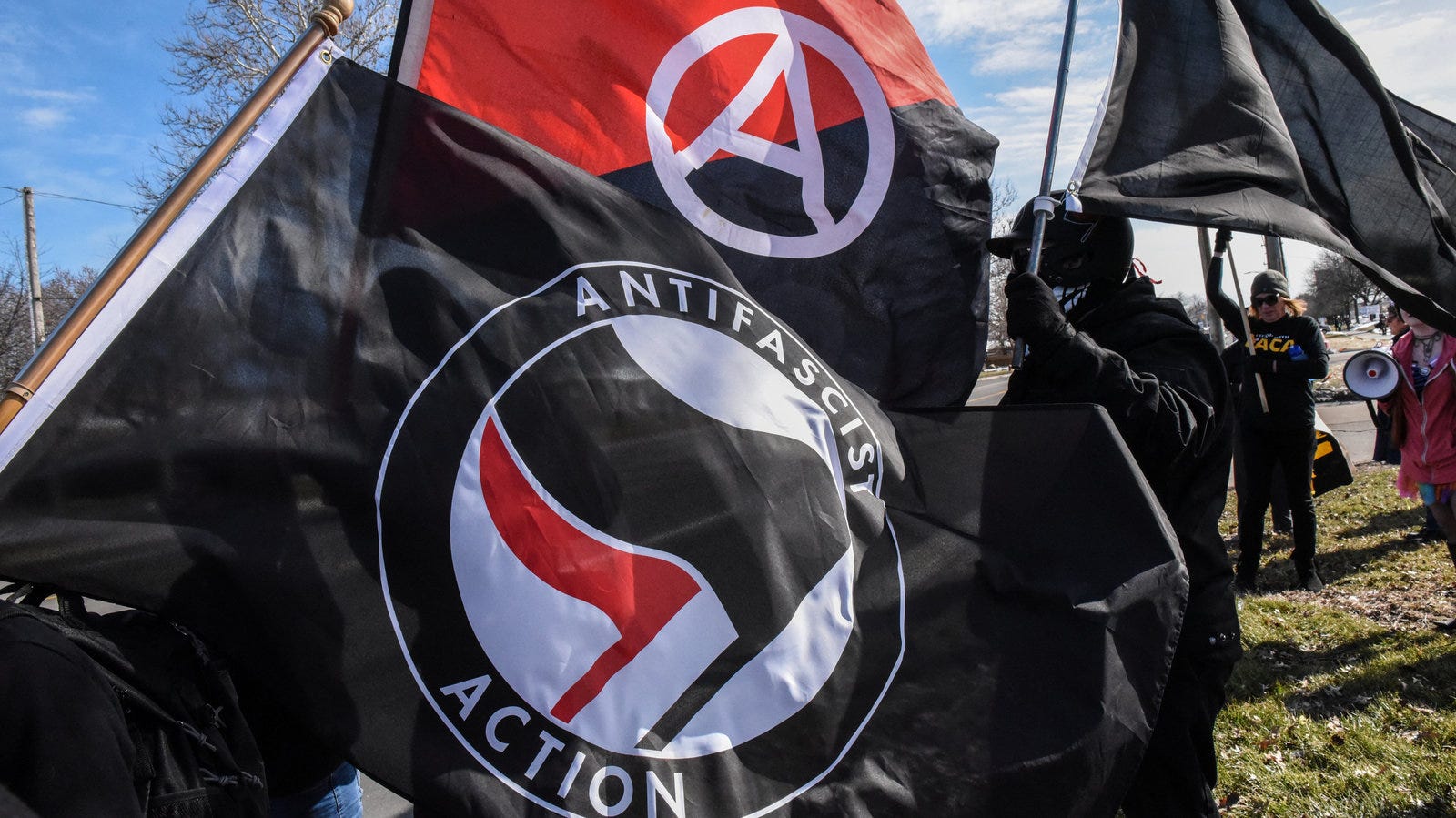
Antifa International
When you look at the positive, non-sensationalized aspects of today’s Antifa movement, you can see an echo of that older tradition. Not in the caricatures that dominate cable news, but in the quieter, more grounded practices: community defense, solidarity networks, resistance to authoritarianism, and the insistence that marginalized people deserve protection from political violence. Antifa, at its best, is not an organization but a posture—a refusal to allow fascist ideology to take root unopposed. It is decentralized, volunteer-driven, and suspicious of hierarchy, much like the anarchist circles of the 19th century.
The alignment is not perfect, of course. Bakunin lived in a world of empires and czars; Antifa operates in a digital, media-saturated landscape where symbolism often overwhelms substance. But the moral through-line is recognizable. Both reject the idea that one must wait for institutions to act justly. Both believe that ordinary people have the right—and sometimes the obligation—to intervene when power is abused. Both see authoritarianism not as an abstract threat but as a lived danger that grows when unchallenged.
And perhaps most importantly, both traditions understand resistance as a communal act. Bakunin’s faith was not in the lone hero but in the collective uprising of people who refuse to be dominated. Antifa’s most constructive work—mutual aid, de-escalation at protests, community safety trainings—operates in that same register. It is not about spectacle; it is about presence, about showing up for one another when institutions fail to do so.
If you strip away the sensationalism, what remains is a shared belief that democracy is not self-sustaining. It requires vigilance, courage, and a willingness to confront the forces that would narrow the circle of human belonging. Bakunin would have recognized that impulse immediately. He might even have smiled at the thought that, more than a century after his death, people still gather in small, loosely organized groups to say: no one gets to rule us by fear.
This story doesn’t end with Bakunin’s thunderclap of a personality. After him, anarchism becomes less a single doctrine and more a long, branching river. Each tributary carries forward some part of his conviction that freedom must be lived from below, but each also tries to solve a problem he left unresolved: how to resist domination without becoming what you resist, how to build something durable without hardening into hierarchy.

Youthful Emma Goldman
In the decades after Bakunin, figures like Kropotkin, Malatesta, and Emma Goldman begin to refine the raw energy of early anarchism into more grounded practices. Kropotkin, with his background in natural science, argues that cooperation—not competition—is the real engine of evolution. Mutual aid becomes not just a moral aspiration but a biological and social principle. Malatesta, ever the pragmatist, insists that anarchism must be a method, not a blueprint: a way of organizing struggle, not a fantasy of a perfect society. Goldman brings in the interior dimension—freedom not only as a political condition but as a lived, psychological one. She writes about love, art, sexuality, and the inner life as arenas where domination must also be resisted.
Across these thinkers, you see a shift: anarchism becomes less about the dramatic overthrow of the state and more about cultivating forms of life that make domination unnecessary. Cooperatives, free schools, syndicalist unions, neighborhood assemblies—small-scale, voluntary, experimental. The revolution becomes something that happens in the grain of everyday life.
This is where the connection to contemporary anti-authoritarian movements becomes clearer. Today’s Antifa, at its best, is not a utopian project but a defensive one. It doesn’t claim to have the blueprint for a new society; it claims that fascism must not be allowed to grow. But around that defensive posture, you find the same constructive instincts that animated the later anarchists: mutual aid networks, community bail funds, street medic trainings, food distribution, tenant organizing. These are not glamorous, and they rarely make the news, but they are the living tissue of anti-authoritarian politics.
The tension between resistance and constructive politics is the oldest tension in anarchist history. Bakunin leaned heavily toward resistance; Kropotkin leaned toward construction. Modern movements oscillate between the two because both are necessary. Resistance without construction burns out or becomes reactive. Construction without resistance gets swallowed by the very systems it hopes to transcend.
What’s interesting today is that many anti-authoritarian groups have learned to braid the two together. A protest might include a de-escalation team, a medic collective, a legal support hotline, and a food distribution table. The act of resisting becomes inseparable from the act of caring. It’s a quiet but profound evolution of Bakunin’s insight: that freedom is not merely the absence of domination but the presence of solidarity.
And in a media environment that rewards spectacle, these movements often choose the opposite—small, local, relational work that doesn’t scale easily, doesn’t monetize, doesn’t trend. That humility, that refusal to become a brand or a hierarchy, is perhaps the most anarchist thing about them.