Epigraph
“Death is the last teacher. It arrives when we are finally old enough to listen.”
There comes a moment, somewhere in the late seventies, when death stops being a rumor. It becomes a presence—not dramatic, not ominous, but steady, like a change in the weather you can feel in your bones before you see it in the sky. And this shift, if met honestly, can be liberating. It can widen one’s interior life rather than constrict it.
We acknowledge it, of course, but we do so the way one acknowledges the existence of Antarctica: real, but not relevant to the day’s errands. We imagine death as an interruption, a theft, a sudden severing of the thread. But approaching eighty, the thread itself becomes visible. You can see its entire arc—its knots, its frayed ends, its improbable strength. You can see how the story coheres. And when the story coheres, the ending loses its terror.
There is a strange mercy in having lived long enough to witness the departures of others. Parents, friends, mentors, sometimes even children. You learn that death rearranges the living but does not erase the dead. Their gestures remain in your own hands. Their phrases slip into your speech. Their ways of seeing the world tint your own. You begin to understand that your disappearance will not be a disappearance at all, but a diffusion—your influence redistributed into the lives of those who carry you forward.
To accept death more fully is also to accept life more fully. The two are inseparable. When you stop clinging to the fantasy of endlessness, the ordinary becomes luminous. A morning cup of coffee is no longer a routine but a ceremony. A walk across the living room becomes a small triumph of continuity. A conversation with a friend becomes a moment of genuine presence rather than a placeholder for some imagined future. The world grows more vivid because you are no longer rushing through it.
There is an ethical clarity that emerges too. Fear of death often disguises itself as ambition, accumulation, self‑importance. But in the late seventies, those disguises fall away. What remains is a simpler question: How can I be fully here while I am here? Accepting death is not resignation; it is a release from frantic self‑defense. It allows kindness to rise without calculation. It lets gratitude become a natural posture rather than a performance. It frees you from the exhausting project of proving that you matter.
And then there is courage—not the heroic kind, but the quiet courage of looking directly at what is true. Death is real. It is coming. And it is not a catastrophe. It is the final transition in a life full of transitions. It is the last act of letting go, something you have been practicing since childhood. To accept death is to accept that you belong to a larger rhythm, one that preceded you and will continue long after you are gone.
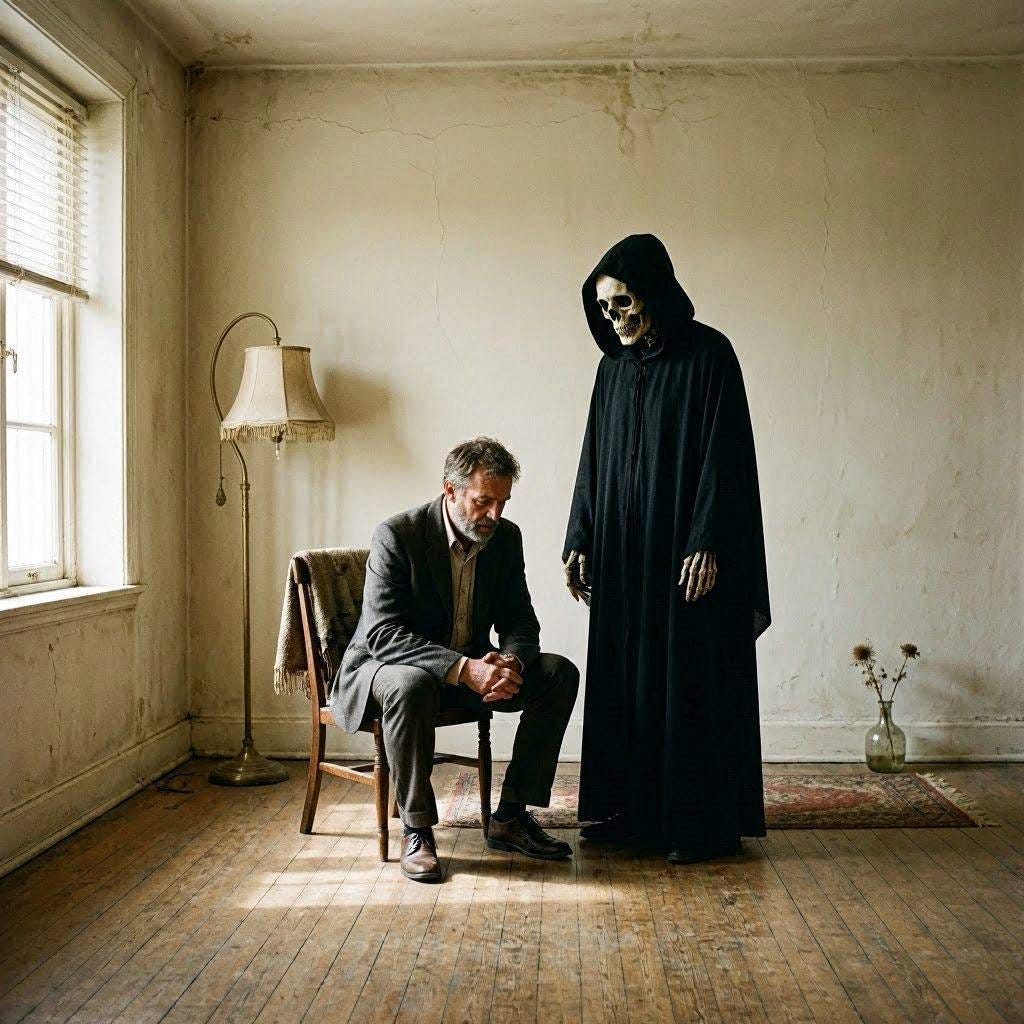
Approaching eighty, death becomes less a threat and more a companion. Not a grim reaper, but a gentle reminder: Pay attention. Be here. Let life be enough. And in that companionship, something unexpected happens. You do not shrink from the world. You expand into it. You become more present, more tender, more awake.
Closing Reflection
To accept death is to accept that your life has been, in its own unrepeatable way, complete. Not perfect, not finished, but whole. And once you feel the wholeness of your own story, fear dissolves. What remains is a kind of quiet gratitude—for the days you were given, for the people who shaped you, for the chance to be alive at all.