
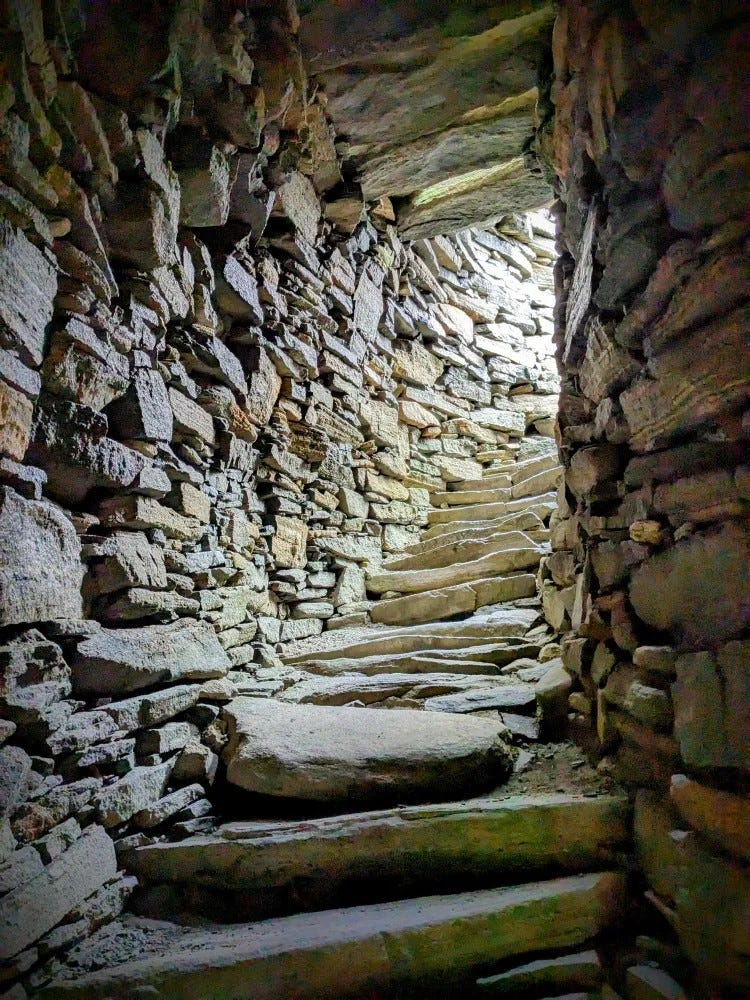
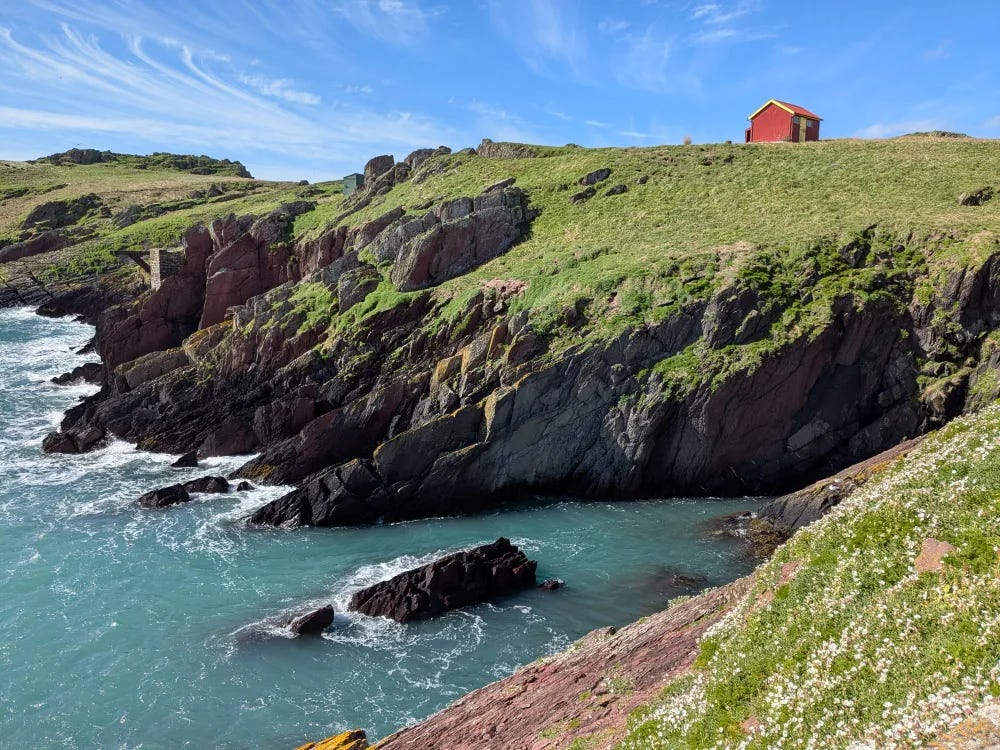
Dr. Toby Driver’s Bluesky presence— the mix of dawn light on Skokholm, Iron Age staircases, storm‑bitten coastlines, hillforts glowing in evening sun, and the gentle, almost devotional tone of his captions — Is a place where art meets science in the best way.
Trueman–Triola Newsletter
Epigraph
“To see the land clearly is to see time clearly.”
— Anonymous field note, aerial survey logbook, 1972
I. The Work of Looking
There is a particular kind of attention that aerial archaeologists cultivate — a blend of patience, humility, and a willingness to be surprised. Dr. Toby Driver’s work, as anyone following his Bluesky feed knows, is not merely technical documentation. It is a practice of seeing in the fullest ethical sense: seeing what is fragile, what is overlooked, what is eroding, what is newly revealed after a storm, and what has been waiting millennia for the right angle of light.
Great landscape photographs become the hinge between this expert seeing and the public imagination. They translate the archaeologist’s long apprenticeship into a form anyone can enter. They make the land legible.
From the air, a hillfort is not just an earthwork — it is a geometry of intention. A promontory fort is not just a cliffside — it is a conversation between ancient mariners and the sea. A Neolithic stone pair is not just two uprights — it is a survival story.
Driver’s images remind us that archaeology is not a discipline of the past. It is a discipline of attention.
II. When the Land Speaks in Patterns
Landscape photography, at its best, reveals relationships that ground‑level vision obscures. In Driver’s work, this often means:
the sweep of a coastline showing how erosion threatens a site,
the faint cropmarks that betray a buried enclosure,
the way a staircase curls inside the wall of a Hebridean broch,
the alignment of stones with ridgelines, watercourses, or celestial paths.
These are not just pretty pictures. They are arguments — visual claims about why a place matters and why it must be cared for.
Aerial archaeology has always depended on this kind of pattern‑seeing. But the photograph gives the pattern a public life. It becomes evidence, memory, and invitation all at once.
III. Witnessing Change, Loss, and the Weather
Driver’s posts from Skokholm Island — the stormy landing stage, the rising sun, the drone surveys in biting wind — show another truth: archaeology is increasingly a race against time.
Climate change is not theoretical in these landscapes. It is visible in every cliff fall, every undermined monastery, every storm‑exposed feature. The CHERISH project, which Driver contributes to, uses aerial photography to document this accelerating loss.
A great landscape photograph can be a warning without being alarmist. It can say: Look. This will not always be here.
But it can also say: Look. This is still here. And it is beautiful.
The ethics of seeing from above include the ethics of witnessing.
IV. Democratizing the Aerial View
One of the quiet revolutions of Driver’s Bluesky presence is how it dissolves the boundary between expert and public. His posts are not didactic. They are invitations.
A mariner’s view of a promontory fort.
A twilight cottage restored by volunteers.
A Roman marching camp revealed by LiDAR.
A simple “Bore da” over a storm‑lit sea.
This is archaeology as shared wonder.
Landscape photography becomes the medium through which the public is welcomed into the work — not as passive consumers of heritage, but as participants in its meaning.
V. The Ethics of “Seeing From Above”
To see from above is to hold a certain power: the power of overview, of context, of detachment. But Driver’s work models a different ethic — one rooted not in detachment but in care.
The aerial view, in his hands, is not a god’s‑eye view.
It is a steward’s‑eye view.
It asks:
What do we owe to the land?
What do we owe to the past?
What do we owe to the future that will inherit what we fail to protect?
The answer, suggested quietly in every photograph, is attention.
Not the extractive attention of surveillance, but the generous attention of witness.
Closing Reflection
Great landscape photographs do not simply illustrate archaeology. They advance it. They expand its audience, deepen its urgency, and restore its sense of wonder. They remind us that the past is not buried; it is written across the skin of the earth, waiting for the right light, the right angle, the right moment of human attentiveness.
Driver’s mission — and the mission of all who look from above — is to help us read that script before it fades.
Great landscape photographs advance Dr. Toby Driver’s aerial‑archaeology mission by making the invisible visible—revealing patterns, histories, and vulnerabilities in the land that cannot be understood from the ground.