
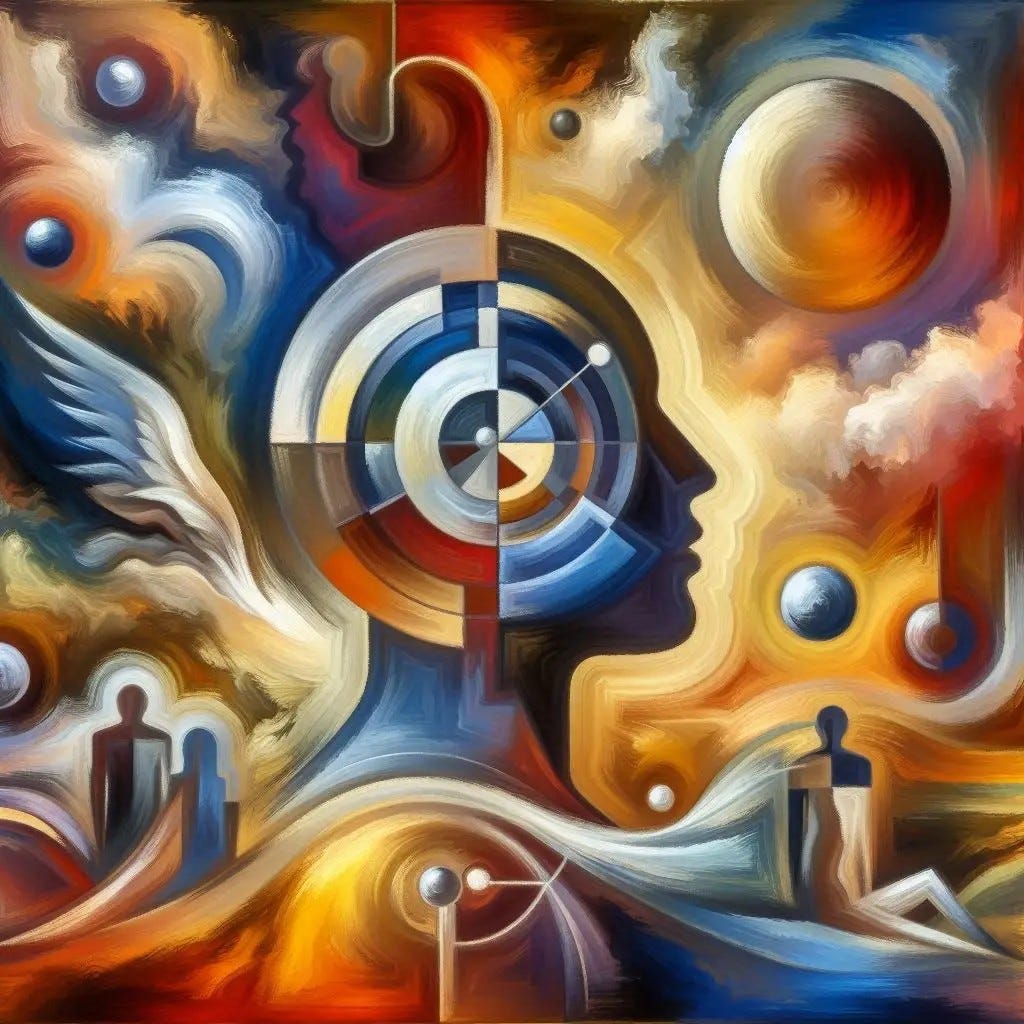
On Being a Self in America Today
In recent conversations, Trueman and Triola have returned again and again to a deceptively simple question: What does it mean to be a self in America today? It is a question that refuses easy answers, not because the self has vanished, but because it has multiplied. The American self now lives in a landscape of competing demands — expressive, political, economic, digital — each insisting on its own version of authenticity.
To be a self in this moment is to inhabit a paradox. The culture promises boundless autonomy, the freedom to curate and reinvent one’s identity at will. Yet the same culture fragments that identity into roles, metrics, and performances. The self becomes both a private interior life and a public project, something felt and something displayed. It is shaped by the long American tradition of self‑making, but also by the pressures of a world that asks for constant visibility and constant reinvention.
And still, beneath the noise, there remains a quieter aspiration — a Whitmanian hope that a person might hold contradictions without shattering, that one might contain multitudes without losing coherence. The American self, for all its fractures, still longs for a kind of wholeness.
This is where the psychological idea of ego integrity enters the conversation, not as a clinical milestone but as an ethical practice. Ego integrity is the capacity to look at one’s life — its triumphs, its wounds, its missteps — and say: This is mine. I can bear it. I can make meaning from it. It resists the cultural pressure to discard past versions of oneself in favor of sleeker, more curated identities. It insists that a life is not a series of reinventions but an arc.
In this sense, ego integrity both aligns with and stands apart from the American self. It aligns because it offers a counterweight to fragmentation, a way of remaining intact amid the crosswinds of modern life. But it stands apart because it asks for acceptance rather than aspiration, coherence rather than expansion. It is, in its own way, a quiet rebellion against the myth of endless self‑creation.
Trueman and Triola often note that the contemporary American self lives between two historical poles. On one side stands Whitman, with his expansive “I” that seeks to gather a nation into its embrace. On the other stands Pollock, dissolving the “I” into the energies of the world. Today’s self is caught between those impulses — the desire to be inclusive and expressive, and the desire to escape the burden of identity altogether.
Ego integrity does not resolve this tension. But it offers a way to inhabit it with grace. It gives the self a spine, a through‑line, a sense that one’s story is not merely a reaction to the world but a meaningful engagement with it. In a culture that often confuses visibility with existence, ego integrity reminds us that the deepest parts of the self are not performed but lived.
Perhaps this is the work of the American self now: not to perfect itself, nor to dissolve itself, but to remain whole while participating honestly in the world. To carry one’s contradictions with dignity. To resist the temptation to become a brand. To cultivate an interior life that does not depend on applause.
In this, Trueman and Triola suggest, lies a modest but profound form of freedom — the freedom to be a self without losing oneself.