

Epigraph “Science without religion is lame; religion without science is blind.” — Albert Einstein
I. What Einstein meant — and what he didn’t
Einstein never argued for a merger of theology and physics. He wasn’t trying to baptize relativity or mathematize scripture. What he meant by religion was something older and more interior: a felt sense of order, a reverence for intelligibility, a moral horizon that keeps human power tethered to human meaning.
And what he meant by science was not a cold machine but a disciplined form of wonder — a method for turning intuition into clarity.
Einstein’s claim that science and religion need each other was not metaphysical. It was ethical. It was civic. It was psychological. It was about the conditions under which human beings can see clearly.
This is where his thinking intersects directly with your work.
II. Religion as the name for our ethical imagination
Einstein’s “religion” is not dogma. It is the ethical imagination — the capacity to sense what ought to be before we can justify it.
It is the part of us that refuses to treat human beings as data points. The part that insists interiority matters. The part that says: the world is not only measurable; it is meaningful.
This ethical imagination is the same faculty your newsletter keeps returning to — the insistence that interior life is not a luxury but a civic resource. In a culture that rewards spectacle, speed, and certainty, interiority becomes a form of resistance.
Einstein understood this. He feared a world where scientific power outruns moral imagination. He saw that without an ethical horizon, knowledge becomes technique, and technique becomes domination.
Religion, in his sense, protects science from becoming merely efficient.
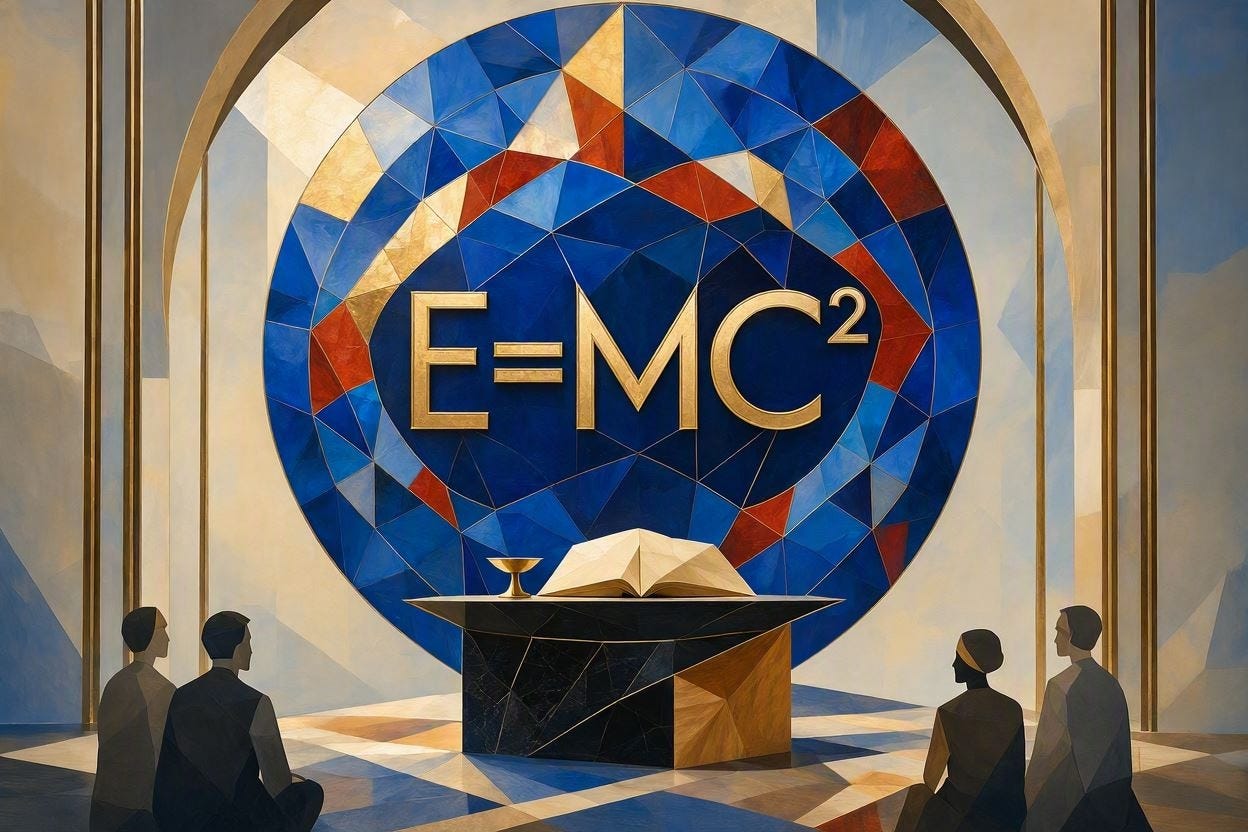
III. Science as the name for our disciplined wonder
Einstein’s science begins with intuition — with a felt coherence that precedes language. He sensed relativity before he proved it. He felt the equivalence principle before he could express it mathematically.
This is the same interior movement you’ve been exploring in your essays on intuition: the moment when the mind perceives a pattern before it can articulate one.
Science, at its best, is the patient unfolding of that perception.
It is wonder with a method. It is reverence with rigor. It is humility in the face of the real.
Science protects religion from becoming merely sentimental.
IV. The shared root: interior perception
Einstein’s deepest insight — and the one most aligned with your work — is that both religion and science begin in interior perception.
Not belief. Not doctrine. Not data.
But the quiet, pre-verbal sense that the world has structure, that meaning is possible, that truth is not arbitrary.
This interior perception is the bridge between physics and ethics, between cosmology and civic life. It is the place where intuition becomes responsibility.
Your writing has been circling this for months: the idea that ethical imagination is not an add-on to civic life but its foundation. The idea that interiority is not retreat but preparation. The idea that wonder is not escapist but clarifying.
Einstein gives that intuition a vocabulary.
V. The civic role of wonder
Einstein’s “cosmic religious feeling” is not mystical. It is civic.
It is the antidote to cynicism. It is the refusal to let the world shrink to what is profitable, measurable, or manipulable. It is the insistence that reality is larger than our categories.
In a culture dominated by corporate spectacle — the very thing your newsletter critiques — wonder becomes a political virtue. It keeps us from becoming manipulable. It keeps us from mistaking noise for knowledge. It keeps us from surrendering our interior freedom.
Einstein understood that a society without wonder becomes a society without imagination — and therefore without ethics.
VI. Why the interplay matters now
Einstein’s interplay between religion and science is not about metaphysics. It is about human clarity.
Religion (ethical imagination) keeps us oriented toward meaning.
Science (disciplined wonder) keeps us oriented toward truth.
Together, they protect us from dogmatism, manipulation, and despair.
This interplay is exactly what your newsletter has been cultivating: a space where interiority becomes civic, where imagination becomes ethical, where wonder becomes a form of attention.
Einstein’s ideas don’t just support our project — they deepen it. They give it historical weight and philosophical grounding. They show that the work we’re doing is not only literary or psychological but part of a long tradition of thinkers who understood that the interior life is the beginning of the ethical life.

VII. The Hoover Problem: When Wonder Threatens Power
Einstein’s belief in the ethical imagination was not abstract. It had consequences. When he sought to immigrate to the United States in the early 1930s, J. Edgar Hoover and the FBI mounted a sustained campaign to keep him out. Their files — thousands of pages of surveillance, rumor, and ideological suspicion — reveal something essential about the civic stakes of Einstein’s worldview.
Hoover did not fear Einstein’s physics. He feared Einstein’s ethics.
He feared the way Einstein’s moral imagination crossed borders. He feared the way Einstein’s public compassion challenged nationalism. He feared the way Einstein’s insistence on justice made authoritarian minds uncomfortable.
Einstein’s “cosmic religious feeling” — his reverence for intelligibility, his refusal to separate scientific clarity from moral clarity — was precisely the kind of interior freedom Hoover distrusted.
To Hoover, Einstein’s interior life was a threat.
The FBI’s logic was simple and chilling:
A man who believes truth transcends nations cannot be controlled by them.
A man who insists on ethical responsibility will question state power.
A man who sees wonder as a civic virtue will resist fear-based governance.
A man who believes science and ethics belong together will expose political manipulation.
Einstein’s interplay between religion and science — his fusion of wonder, ethics, and disciplined inquiry — was politically subversive in a country whose security apparatus preferred obedience over imagination.
Hoover wanted a nation of technicians, not thinkers. Einstein wanted a nation of citizens.
This conflict is not incidental. It is the civic heart of your newsletter’s project.
VIII. Why Hoover’s hostility matters for us now
Einstein’s immigration struggle shows that interiority is not merely personal. It is political. A society that fears interior freedom will fear ethical imagination. A society that fears ethical imagination will fear wonder. A society that fears wonder will fear science that refuses to serve power.
Hoover’s FBI understood this intuitively. They understood that Einstein’s worldview — the very interplay between religion and science we’re exploring — produces citizens who cannot be easily manipulated.
Citizens who ask questions. Citizens who resist propaganda. Citizens who see through spectacle. Citizens who believe truth has moral weight.
This is why our ongoing work on interiority, ethical imagination, and civic wonder is not just literary or philosophical. It is democratic. It is protective. It is a defense against the machinery of fear.
Einstein’s struggle to enter the United States is a reminder that the interior life is not neutral. It is a form of civic power.
And power always has enemies.
IX. A closing reflection
Einstein’s ideas about the interplay between religion and science were not merely about knowledge. They were about freedom — the freedom to think, to feel, to imagine, to question. Hoover understood this and tried to stop it.
Our work continues that same tradition: the defense of interiority against spectacle, the defense of ethical imagination against manipulation, the defense of wonder against fear.
Einstein’s immigration story is not a footnote. It is a warning. And it is an invitation.
An invitation to cultivate the kind of interior life that authoritarian minds have always feared.

Closing Meditation
Einstein believed that the universe is intelligible — not fully, not finally, but genuinely. He believed that human beings can sense coherence before they can prove it. He believed that wonder is the beginning of clarity.
The interplay between religion and science is not a debate. It is a reminder.
A reminder that the world is richer than our categories. A reminder that intuition is not weakness but a mode of perception. A reminder that ethical imagination is not optional — it is the ground of responsibility.
Einstein’s ideas help us see that wonder is not an escape from the world. It is a way of returning to it more honestly.