
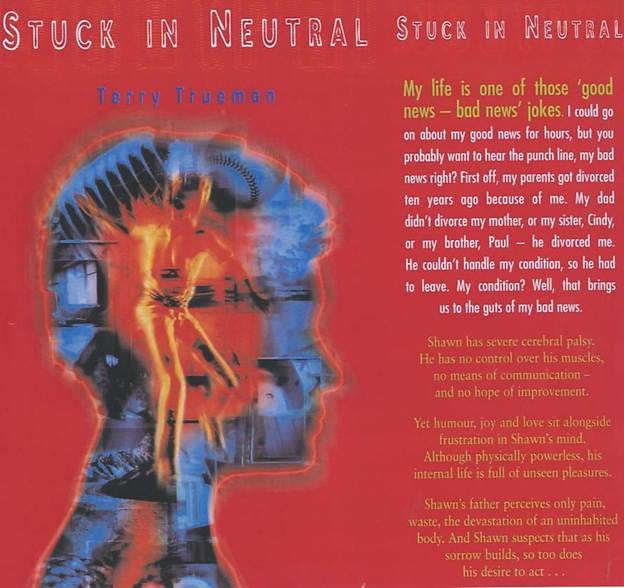
Empathy Under Siege: Terry Trueman’s Fiction in the Landscape of Challenged YA Literature and Anti‑Woke Cultural Politics
By Walter Thomas-Weisman, PhD*
Abstract
This essay examines the works of Terry Trueman—particularly Stuck in Neutral—within the contemporary landscape of challenged young adult (YA) literature in the United States. Drawing on documented censorship efforts, disability‑studies perspectives, and recent scholarship on the political motivations behind book challenges, the essay argues that Trueman’s fiction directly contradicts the anti‑woke sentiments associated with the American right‑wing MAGA movement. Trueman’s novels foreground empathy, interiority, and marginalized experiences, positioning them in opposition to a cultural climate that increasingly rejects inclusive narratives and seeks to sanitize youth literature. By situating Trueman’s work alongside broader trends in YA censorship, this essay demonstrates how his fiction participates in a counter‑tradition of humanistic, ethically complex storytelling that resists ideological simplification.
Introduction: YA Literature, Censorship, and the Politics of Empathy
Young adult literature has become a central battleground in contemporary American culture. As recent scholarship notes, the United States has seen a dramatic rise in book challenges, with 1,269 demands to censor library materials in 2022 alone—nearly double the previous year ijyal.ac.uk. These challenges disproportionately target works that center marginalized identities, including LGBTQ characters, racial minorities, and disabled protagonists ijyal.ac.uk. The ideological motivations behind these challenges align closely with the anti‑woke rhetoric of the MAGA movement, which frames empathy, inclusivity, and social justice as threats to traditional values.
Within this contested landscape, Terry Trueman’s novels—especially Stuck in Neutral—stand out as works that foreground precisely the values that anti‑woke activists seek to suppress. Trueman’s fiction insists on the moral necessity of empathy, the dignity of marginalized lives, and the importance of exposing young readers to difficult realities. These commitments place his work in direct tension with the cultural politics driving contemporary censorship efforts.
I. Trueman’s Narrative Ethic: Interiority, Marginalization, and the Demand for Empathy
At the center of Trueman’s oeuvre is a profound commitment to interiority. Stuck in Neutral is narrated by Shawn McDaniel, a teenager with severe cerebral palsy who cannot move or speak but possesses a rich, articulate inner life. As Trueman explains in an interview with the National Coalition Against Censorship (NCAC), the novel is unique in YA literature because “the entire plot…is based on the protagonist’s inability to communicate” while still being told entirely from his point of view National Coalition Against Censorship.
This narrative choice is not merely stylistic; it is ethical. By granting full interiority to a character whom society routinely misjudges, Trueman forces readers to confront their own assumptions about disability. As he notes, once readers have encountered Shawn’s consciousness, “you can never jump to the conclusion again” that a disabled child is “all messed up” simply because of outward appearance National Coalition Against Censorship.
This insistence on empathy—on seeing the full humanity of those who are easily misunderstood—directly contradicts the anti‑woke rhetoric that frames empathy as weakness or ideological indoctrination. Trueman’s fiction demands that readers imagine the interior lives of marginalized individuals, a practice that anti‑woke commentators increasingly deride as “identity politics” or “woke moralizing.”
II. Confronting Difficult Realities: Trueman and the Politics of “Dark” YA Literature
Trueman’s novels are frequently challenged not because they are gratuitous, but because they refuse to sanitize the difficult realities that many young people face. Stuck in Neutral has been challenged for “obscene” language and for addressing euthanasia, which some parents deemed “not age‑appropriate” National Coalition Against Censorship. This pattern aligns with broader trends in YA censorship, where books dealing with trauma, sexuality, disability, or systemic injustice are disproportionately targeted.
As Trueman argues, shielding teens from “complex, complicated and disturbing aspects of life” is both naïve and harmful National Coalition Against Censorship. Literature, he insists, is precisely the space where young people can safely wrestle with difficult truths.
This position stands in stark contrast to anti‑woke MAGA politics, which seek to remove such narratives from schools under the guise of protecting children. The ideological impulse behind these challenges is not moral protection but political control: an attempt to restrict which stories count as legitimate representations of American life.
Trueman’s fiction, by contrast, asserts that young people deserve honesty, complexity, and emotional truth.
III. Trueman in the Landscape of Challenged YA Literature
To understand the political significance of Trueman’s work, it is necessary to situate it within the broader field of challenged YA literature. The American Library Association’s list of frequently challenged YA books includes works by Sherman Alexie, Laurie Halse Anderson, Maya Angelou, and Stephen Chbosky—authors whose novels foreground marginalized identities, trauma, or social critique American Library Association.
Scholars note that these challenges disproportionately target books that “represent marginalized identities and experiences,” particularly LGBTQ and Black communities ijyal.ac.uk. While disability‑centered narratives are less frequently discussed in this context, Stuck in Neutral demonstrates that disability representation is also vulnerable to censorship, especially when it challenges normative assumptions about quality of life, autonomy, and family ethics.
Trueman’s work thus belongs to a tradition of YA literature that is attacked precisely because it expands the moral and imaginative horizons of young readers.
IV. Anti‑Woke MAGA Ideology and the Rejection of Inclusive Narratives
The anti‑woke movement frames inclusive storytelling as ideological indoctrination. This rhetoric has fueled book bans targeting works that address racism, gender identity, sexuality, and disability. The ideological logic is clear: narratives that humanize marginalized individuals threaten the political project of maintaining cultural hierarchies.
Trueman’s fiction directly contradicts this worldview in several ways:
1. It centers marginalized voices.
Shawn McDaniel’s interiority challenges ableist assumptions and demands recognition of disabled lives as fully human.
2. It insists on empathy as a moral practice.
Anti‑woke rhetoric often derides empathy as weakness; Trueman treats it as the foundation of ethical life.
3. It refuses to sanitize reality.
Where anti‑woke activists seek to remove “dark” or challenging books from schools, Trueman argues that young people need literature that reflects the complexities of their lives.
4. It challenges simplistic moral binaries.
Trueman’s novels embrace ambiguity, nuance, and ethical complexity—qualities that run counter to the MAGA movement’s preference for clear villains, heroes, and ideological certainty.
Conclusion: Trueman’s Fiction as Counter‑Narrative
Terry Trueman’s novels occupy a crucial place in the contemporary struggle over YA literature. By centering marginalized voices, insisting on empathy, and confronting difficult realities, his work stands in direct opposition to the anti‑woke cultural politics that seek to restrict what young people can read and imagine. In a moment when empathy itself is under attack, Trueman’s fiction offers a powerful counter‑narrative: one that affirms the dignity of all lives, especially those most easily misunderstood.
His novels remind us that literature’s role is not to comfort the powerful but to illuminate the lives of the vulnerable. In doing so, they challenge the ideological foundations of the MAGA movement and reaffirm the transformative potential of young adult literature.
Sources
National Coalition Against Censorship National Coalition Against Censorship interview with Terry Trueman.
American Library Association American Library Association, “Frequently Challenged Young Adult Books.”
ijyal.ac.uk International Journal of Young Adult Literature, “Ploughing the Field: Controversy and Censorship in US and UK YA Literature.”
Walter Thomas-Weisman, PhD, is the pen-name of a University Instructor, visiting from the UK to a regional state University in a western U.S. State. His identity remains secretive to protect his temporary status in the U.S.