
“Well, there are certain sections of New York, Major, that I wouldn’t advise you to try to invade.” – Rick Blaine (Humphrey Bogart), in Casablanca, to Nazi Major Strasser, who had taunted him with the idea of Hitler invading New York.
Two Meditations on the American Arena
I. The Arena We Built
Every generation inherits a version of the public sphere, and ours has delivered us a sports culture that feels increasingly like a modern amphitheater—loud, lucrative, and strangely hollow. What once served as a civic ritual has swollen into a spectacle economy, a place where the game itself is often the quietest thing happening on the field.
Stadiums now resemble theme parks. Broadcasts mimic Hollywood. The financial stakes have grown so large that the moral vocabulary has shifted: winning is no longer a communal joy but a business imperative. Athletes are trained, measured, optimized, and discarded with a precision that would have impressed a Roman impresario. The outrage economy—talk shows, hot takes, manufactured rivalries—narrows the emotional palette to triumph or humiliation. And the gambling boom has turned every play into a financial event, every fan into a speculator.
The old civic covenant—we support you, you belong to us—has thinned to a whisper. Teams relocate for tax deals. Tickets price out the communities that once gave them identity. The arena becomes a marketplace, not a meeting place.
Yet the point of this reflection is not despair. It is recognition. If we can see the forces that have reshaped the games, we can also imagine what might be restored: a version of sport that returns to joy, to community, to the simple human pleasure of shared play.
The arena is loud, yes. But the culture that built it is still ours to shape.
“Well, there are certain sections of New York, Major, that I wouldn’t advise you to try to invade.”
II. The Crowd That Still Believes
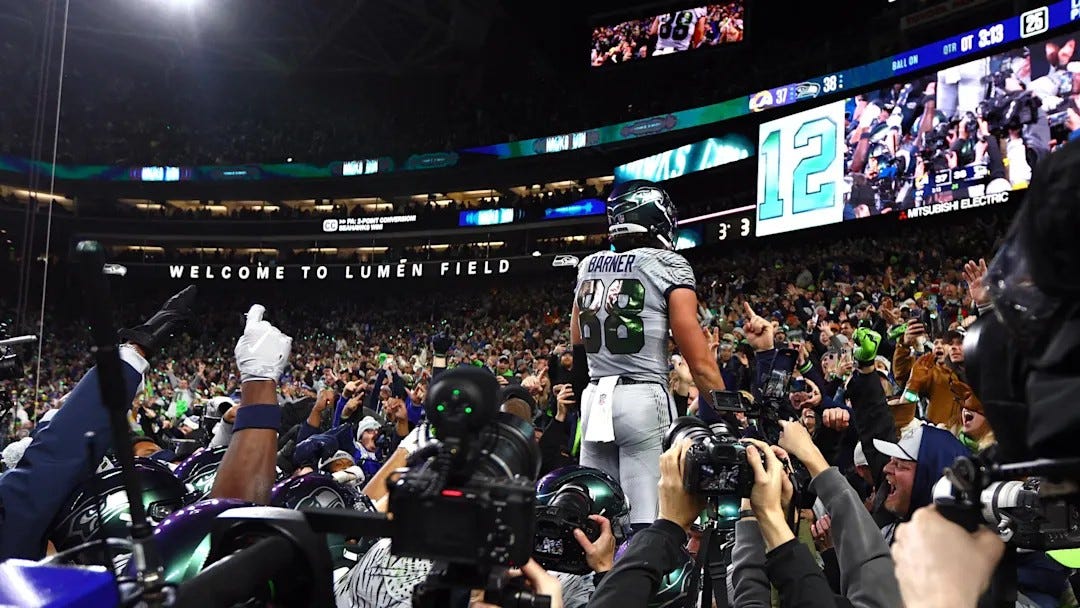
And then there are the 12s.
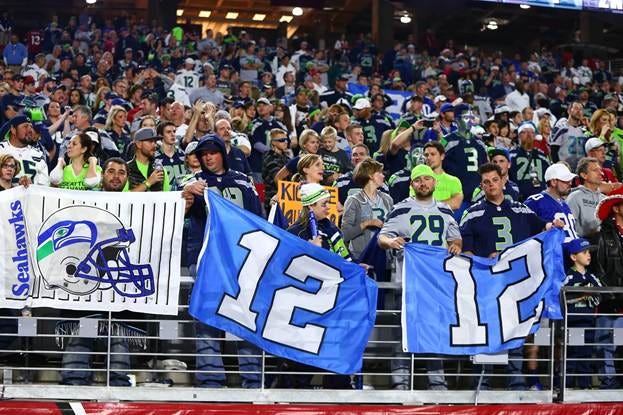
In the shadow of the spectacle economy, Seattle’s/PNW’s fan community stands as a quiet counter‑argument—loud in volume, yes, but gentle in spirit. They remind us that not every corner of American sports has surrendered to cynicism or commodification. Some crowds still gather not as consumers but as citizens.
The 12s treat the stadium as a commons. They show up in person, shoulder to shoulder, insisting on the communal over the algorithmic. Their signature roar—often dismissed as chaos—reads differently through the Trueman–Triola lens. It becomes a form of democratic participation, a collective refusal to be passive. They are not background noise; they are co‑authors of the experience.
Seattle’s relationship with the Seahawks remains unusually reciprocal. The team acknowledges the 12s as part of its identity. The city treats the team as a civic asset. The fans see themselves as stewards rather than customers. In a sports landscape where teams relocate for tax incentives and fans are treated as data points, this reciprocity feels almost radical.
The 12s do not erase the spectacle or the money. But they soften the edges. They keep alive something stubbornly unmonetizable: belonging. Their ethos—earnest, weather‑worn, unembarrassed about caring—reflects the Pacific Northwest itself. In a national sports culture fueled by outrage and performative conflict, the 12s offer a different emotional vocabulary: warmth, commitment, and civic optimism.
Seen this way, the 12s are not merely fans. They are a reminder that even in an age of spectacle, solidarity can survive. They show that the arena need not be only a marketplace or a stage for corporate theater. It can still be a gathering place, a civic ritual, a shared heartbeat.
They are, in short, the crowd that still believes.