
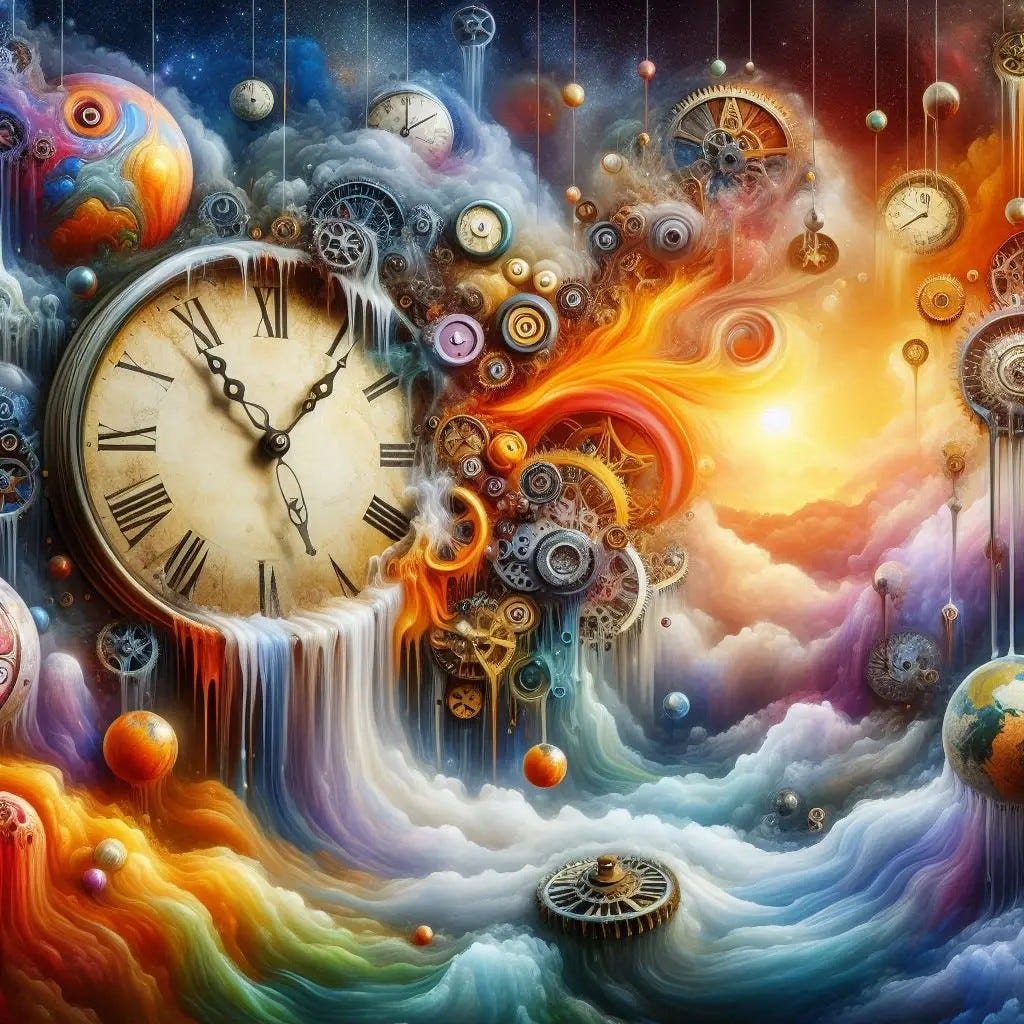
In the shared imaginative space where Vincent Triola’s essays meet the fiction of Terry Trueman, time becomes more than a backdrop. It becomes an argument. Triola’s work, in particular, makes this unmistakable: he writes life in weeks, months, and years, but he writes death in hours, minutes, and seconds. The shift is so sharp that readers feel it before they consciously register it. And when placed alongside Trueman’s long‑standing commitment to interiority and ethical attention, the contrast becomes even more revealing.
Triola’s long‑scale time is the time of erosion. It is the slow accumulation of pressures—economic, political, psychological—that shape a person long before any crisis arrives. His narratives often unfold across months of anxiety or years of institutional decay, capturing the way ordinary life wears people down through repetition and routine. Trueman’s novels, though different in form, share this understanding of duration. His characters live inside long arcs of misunderstanding, fear, or invisibility, their emotional landscapes shaped by forces that build gradually rather than explode.
But when Triola turns to death—literal or metaphorical—the tempo collapses. Suddenly the narrative tightens. A moment of violence or realization is measured in seconds. A political rupture unfolds in minutes. A personal breaking point arrives with the precision of a ticking clock. This contraction mirrors the psychological truth of catastrophe: when the stakes rise, consciousness sharpens. Time becomes intimate, almost unbearable in its clarity.
Trueman’s fiction offers a parallel, though expressed through interiority rather than temporal notation. In works like Stuck in Neutral or Inside Out, the most consequential moments are not stretched across chapters but concentrated in flashes of awareness—moments when a character’s inner life becomes painfully vivid. Where Triola uses seconds to mark catastrophe, Trueman uses interior silence. Both techniques force readers into proximity with vulnerability.
Together, these two writers reveal a shared ethical stance. Long time—years, months, weeks—shows how suffering becomes normalized, how systems grind people down so slowly that the damage can be overlooked. Short time—minutes, seconds—refuses that comfort. It demands attention. It insists that the reader feel the stakes rather than observe them from a distance.
In the context of this newsletter, where their voices and concerns intersect, the effect is a kind of dialogue about how narrative shapes moral imagination. Triola’s collapsing seconds and Trueman’s concentrated interiority both challenge readers to reconsider how they understand harm, agency, and the fragile boundary between endurance and catastrophe. Time, in their hands, becomes a moral landscape—one that asks readers not just to witness, but to feel.
.