

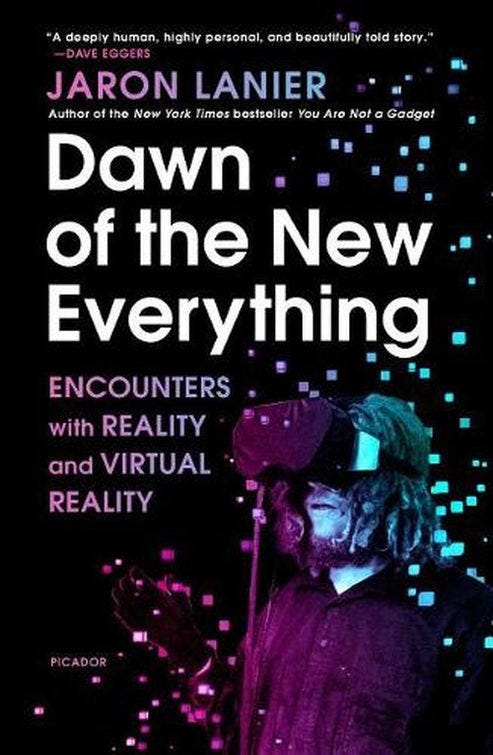
Jaron Lanier’s technology views stand out because he is one of the few major technologists who combines deep insider knowledge — he helped invent virtual reality — with a humanistic, almost moral-philosophical critique of the digital world. The result is a perspective that is neither anti‑tech nor boosterish, but something rarer: a defense of human agency, dignity, and interiority in a technological age that tends to erode all three.
He writes from the inside. As a pioneer of VR, he understands how technical architectures become cultural architectures, how engineering decisions ripple outward into the ways people think, feel, and relate. His critique is not the usual outsider lament about screens and attention spans; it is a diagnosis of how digital systems, built with certain incentives, gradually reshape the human sense of self.
At the center of his thinking is the individual — irreducible, sovereign, and economically deserving. Lanier insists that the deepest flaw in the modern internet is not merely surveillance or polarization but the economic dispossession of ordinary people. Every post, photo, comment, and behavioral trace enriches platforms while impoverishing the humans who generate the value. He calls this a crisis of “data dignity,” a phrase that captures both the moral and material stakes. In Lanier’s view, the internet’s business model is not just inefficient or unfair; it is spiritually deforming, because it trains people to see themselves as interchangeable data points rather than as authors of meaning.
This leads naturally to his critique of “free” platforms. Lanier argues that the absence of a price tag is not generosity but a structural trap. When users do not pay, platforms must extract value elsewhere — through manipulation, addiction, and the amplification of emotional extremity. The problem is not the technology itself but the moral logic of the business model, which rewards engagement over truth, spectacle over substance, and conformity over creativity.
What sets Lanier apart is his defense of interiority. He speaks openly about the soul — not in a religious sense, but as the fragile, private space where desire, memory, and imagination take shape. Digital systems, he warns, compress interior life into external performance. They reward the visible self at the expense of the lived self. In this way, technology becomes a force not of liberation but of subtle dispossession, encouraging people to outsource their identity to algorithms and networks.
He also rejects technological determinism. Nothing, in his view, is inevitable — not AI replacing humans, not the centralization of platforms, not the triumph of surveillance capitalism. He refuses the fatalism that dominates Silicon Valley, insisting instead that technology is a choice, a craft, a moral undertaking. This stance is quietly radical: it restores agency to designers, policymakers, and citizens who have been told for decades that “the future” is something that happens to them rather than something they shape.

Lanier’s critique of AI is similarly distinctive. He does not fear superintelligence or apocalyptic takeover. His concern is more intimate: that AI systems might erode human authorship, blur accountability, and diminish the diversity of thought. The danger is not that machines will become too powerful but that humans will become too passive, too willing to let algorithms mediate their creativity, memory, and judgment.
Above all, Lanier brings a moral vocabulary into a domain that usually speaks in metrics and abstractions. He talks about compassion, responsibility, personhood, and meaning. He treats technology not as an inevitability but as a cultural and ethical project. In doing so, he offers a way to imagine digital life that preserves the richness of human interiority — an imagination that resonates deeply with your own work on civic virtues, anti‑corporate art practices, and the dignity of the individual.
Special thanks to my good friend Neil Clemons for turning me onto Jaron. Neil Clemons: Writing, Photography, and the Art of Word–Image Fusion