
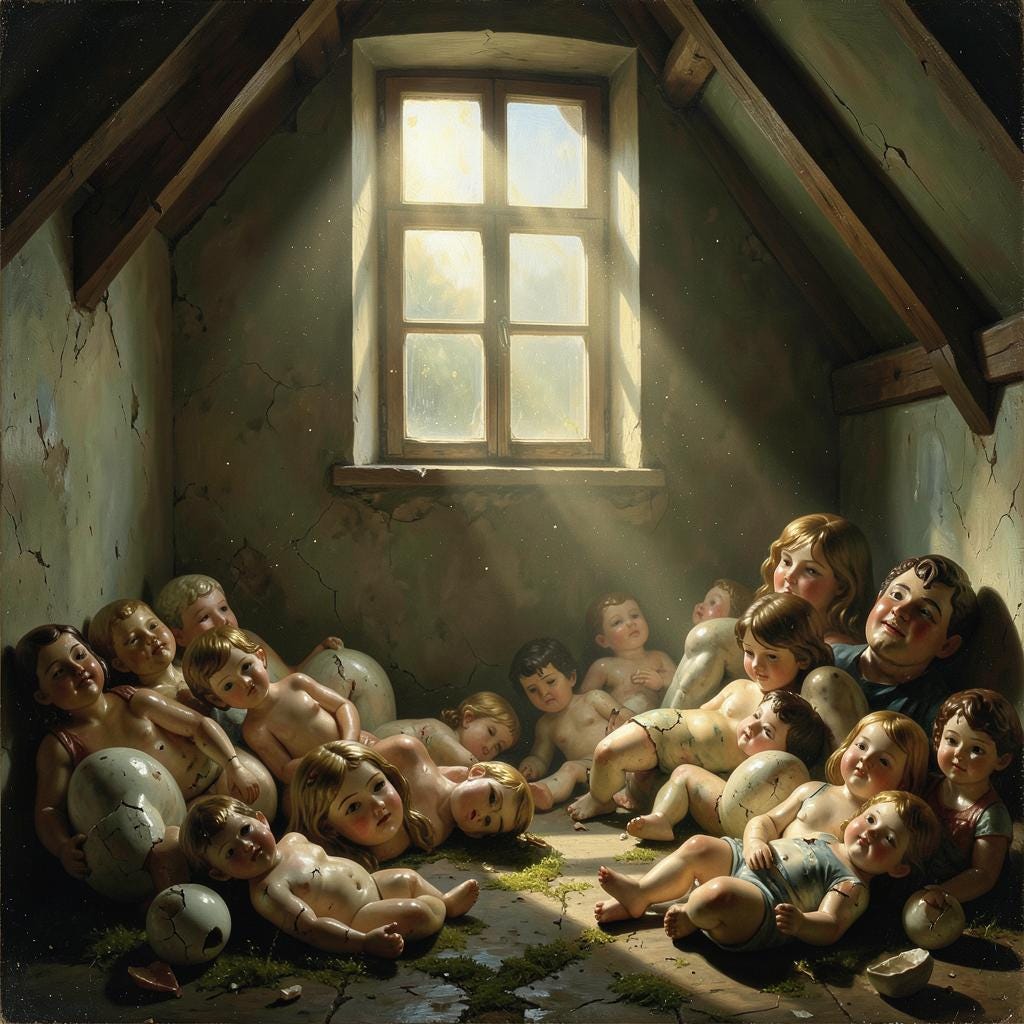
What makes “Loonies in the Attic” such a great song for right now is that it doesn’t whisper its diagnosis of the moment—it belts it, laughs at it, mourns it, and refuses to pretend things are normal. It’s a comic lament, a folk‑pop exorcism, and a little bit of a pep talk disguised as a rant. It carries that signature Trueman blend: humor sharpened into critique, critique softened by humanity, humanity refusing to give up on clarity.
The attic, the ballroom, the basement: a house that looks a lot like America
The song opens with a simple architectural metaphor—attic, ballroom, basement—but the house is clearly the country, and the “loonies,” “crazies,” “maniacs,” “killers,” “grifters,” and “thieves” are the characters who’ve taken up residence in our civic imagination. It’s funny because it’s exaggerated; it’s not funny because it’s not exaggerated enough.
The repetition works like a chant, a folk refrain that keeps circling back to the same truth: we’re living in a moment where chaos isn’t hidden in the shadows—it’s moved into every room. The song doesn’t moralize about this; it catalogs it with the shrugging, half‑grinning tone of someone who’s seen enough to know that outrage alone won’t save us.
The MAGA chorus: satire with teeth
The chorus is where the song becomes unmistakably of this moment. The MAGA refrain isn’t subtle, but it’s not meant to be. It’s a protest song in the tradition of Phil Ochs and early Dylan, except instead of earnestness, it uses mockery—sharp, musical, and cathartic.
“Maga is what maga be / maga heeds the call” is a kind of folk koan: you can’t reason with a movement that treats grievance as identity. The line “we got maga stains on everything” is the closest the song comes to despair, but even that despair is sung with a grin. It’s the grin of someone who refuses to let the absurdity of the moment rob him of his humor.
And then, of course, the question: “when the fuck will maga fall?” It’s the kind of line that feels like a release valve. A lot of people are thinking it; the song just says it out loud.
The bridge: the necessary complication
One of the most interesting choices in the lyrics is the pivot: “Not every maga’s evil / Not every maga’s foul.” This is where the song refuses to flatten people into caricatures, even as it skewers the movement. It’s a moment of psychological honesty—some folks are swept up not by malice but by confusion, fear, or sheer gullibility.
This is where a developmental psychology background shows. The song acknowledges that authoritarianism doesn’t require monsters; it only requires people who are “dumb as rocks,” scared, or convinced they have the right to tell others how to live. It’s a critique that understands the human condition, not just the political one.
Why it’s perfect for this moment
Because we’re living in a time when satire feels more accurate than analysis. Because humor is one of the few tools left that can cut through the noise. Because the song doesn’t pretend that the madness is temporary or trivial—it names it, mocks it, and sings through it. Because it’s angry without being cruel, funny without being frivolous, political without being preachy.
Most of all, it’s a song that understands the emotional texture of 2026: exhausted, incredulous, still fighting, still laughing, still hoping the stains can be scrubbed out.
It’s a protest song for people who are tired of protest songs. It’s a folk song for people who don’t trust folk heroes. It’s a political song for people who’ve seen too much politics.
And it’s a Trueman song—sharp, humane, irreverent, and unwilling to lie.
Loonies in the attic by Trueman Music | Sunohttps://suno.com/song/0bab9c4d-5452-4247-bf12-910dcb7fc308
(2) Terry Trueman https://www.youtube.com/channel/UCAEPJ40txNQtzRQqThXXB-A