
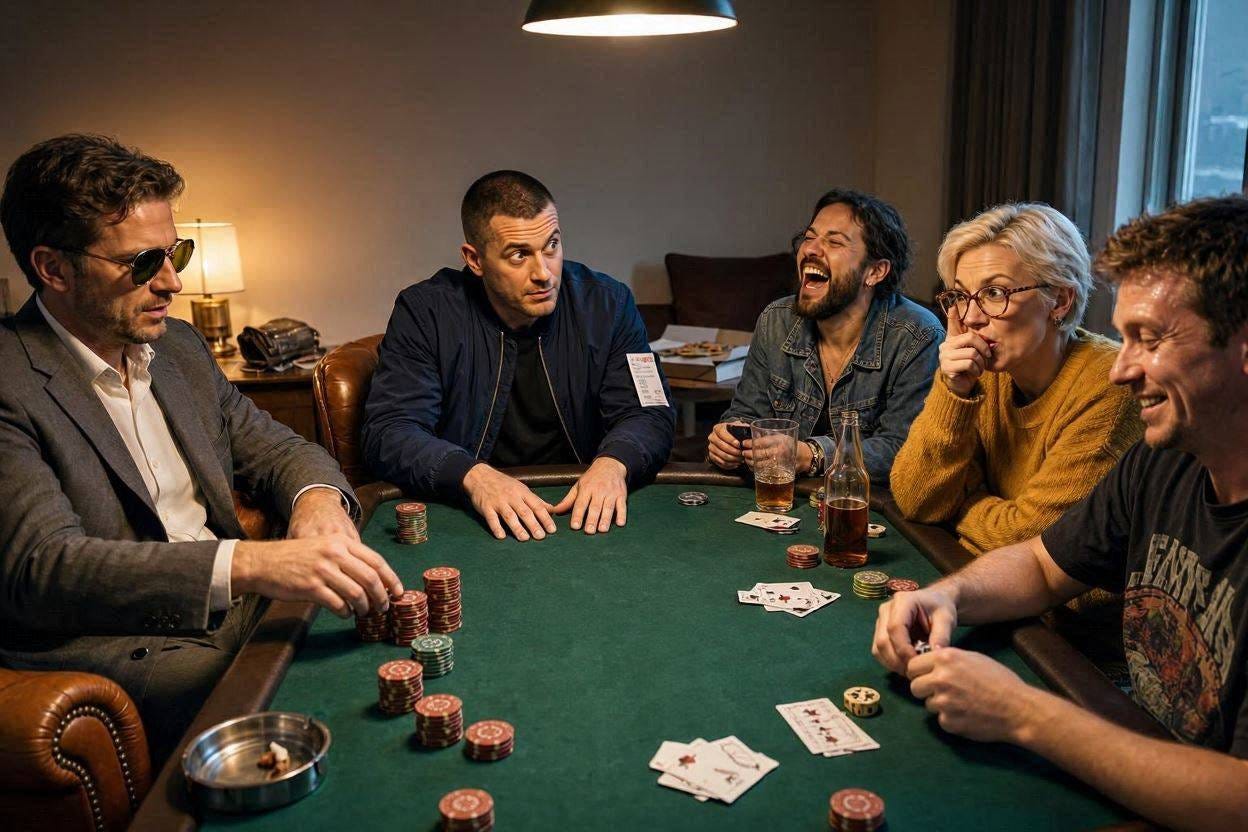
A monthly poker night among men always pretends to be simple: cards, chips, sips of whiskey, familiar jokes, the ritual shuffle of the deck. But beneath that surface, competitiveness threads itself through the evening like a live wire. It changes the emotional temperature of the room. It alters what the gathering is for.
Poker, after all, is a game built on hierarchy — someone wins, everyone else loses. And when men gather around a table, hierarchy rarely stays confined to the cards. It leaks. It expands. It becomes a proxy for everything else men measure themselves by. The game becomes a stage on which status is quietly negotiated.
What could have been a social event — a place to relax, to enjoy each other’s company — becomes a test. Not an overt one, but a felt one. A man who’s had a rough month, who arrives hoping for camaraderie, suddenly finds himself performing competence. He doesn’t want to be the guy who misplays a hand, who gets bluffed, who loses big. Losing feels like exposure. Winning feels like insulation. The stakes are emotional long before they’re financial.
Competitiveness also shifts the tone of conversation. Instead of drifting into the open, meandering talk that friendships need — the kind that allows vulnerability to slip in sideways — the talk becomes sharp, strategic, ironic. Men narrate their moves, tease each other, boast, deflect. The table becomes a place where intimacy is replaced by banter, and banter becomes the only safe currency. The game crowds out the friendship.

And then there’s the subtle resentment that competitiveness breeds. A friend who wins too often becomes a problem. Not openly, of course — men rarely name these things — but quietly. His luck becomes suspicious. His skill becomes irritating. His confidence becomes something to puncture. The group begins to police the emotional balance of the table, not through conversation but through micro‑aggressions disguised as jokes. The friendship absorbs the friction.
Even generosity gets distorted. A man who folds early to keep the game friendly, or who softens his play to avoid embarrassing someone, risks being seen as patronizing. A man who plays hard risks being seen as ruthless. There is no neutral posture. Every move carries social meaning. The game becomes a negotiation of ego rather than a shared pastime.

This is why the poker night can’t simply be a friendly social event. Competitiveness turns it into a ritual of comparison, a place where men rehearse the very dynamics that make friendship fragile: the fear of losing status, the reluctance to be seen as weak, the instinct to protect one’s image rather than one’s connection.
And yet, the tragedy is that the men around the table often want something gentler. They want the camaraderie the game promises but rarely delivers. They want the ease of being together without performing. But the structure of the game — and the cultural training men carry into it — makes that ease almost impossible.
Poker night becomes a microcosm of male friendship itself: full of longing, full of constraint, full of unspoken rules that keep men close enough to share a table but too guarded to share themselves.
Competitiveness in men so often arrives disguised as vitality — ambition, drive, the spark that animates effort. But inside friendships, that same spark can quietly scorch the ground it stands on. What looks like energy becomes erosion; what feels like momentum becomes a subtle distancing. The harm rarely announces itself. It accumulates.
Friendships between men are already built atop a cultural fault line: the expectation that affection must be coded, vulnerability rationed, and intimacy earned through shared activity rather than shared interiority. Into that fragile architecture, competitiveness enters like a solvent. It dissolves the few safe places men have to be unguarded.
One of the first casualties is ease. A friendship that once felt like a refuge becomes a site of comparison — who’s doing better, aging better, earning better, loving better. The friend becomes a mirror rather than a companion, and the mirror is never neutral. Men begin to curate themselves around each other, offering only the versions that won’t lose the silent contest. The friendship becomes a performance, and performances are exhausting.
Competitiveness also warps admiration. In healthy friendships, admiration is a form of generosity — a way of saying, “Your strengths expand my world.” But when competitiveness takes root, admiration becomes envy’s understudy. A friend’s success becomes a threat, a reminder of one’s own perceived inadequacy. Men begin to withdraw from each other’s triumphs, or worse, minimize them. The friendship loses its celebratory dimension, its capacity to enlarge both lives.
There is also the matter of honesty. Competitiveness teaches men to hide their struggles, because struggles feel like losing. And losing feels like relinquishing status. So men keep quiet about the things that matter most — fear, loneliness, financial precarity, the slow drift of meaning. The friendship becomes informationally thin. Two men can spend years in proximity without ever touching the truth of each other’s lives.
Perhaps the deepest harm is to tenderness. Competitiveness makes tenderness feel risky, even disqualifying. To admit affection, admiration, or emotional need becomes a kind of surrender. Men who might have offered each other genuine care instead offer advice, banter, or critique — all safer, all less revealing. The friendship becomes a negotiation rather than a sanctuary.
And yet, beneath all this, there is a quiet longing. Most men want friendships that allow them to be whole. They want relationships where success isn’t a weapon, where vulnerability isn’t a liability, where affection isn’t coded as weakness. Competitiveness doesn’t destroy that longing; it only obscures it.
The work, then, is not to eliminate competitiveness — it’s too woven into the cultural fabric — but to disarm it. To name it when it appears. To refuse its terms. To cultivate friendships where men can admire without comparing, confess without fearing, and celebrate without competing. Friendships where the question is not “Who’s ahead?” but “Are we still walking together?”
That shift, small and steady, is how men reclaim the foundations of friendship from the quiet harms that have long undermined them.