For the Trueman–Triola Newsletter

There is a particular kind of cultural work happening on Bluesky right now — small, improvised, and yet unmistakably civic. It is not organized, not theorized, not even self‑conscious. But it is there, in the feeds of people who post art not as escape but as orientation, and who pair that art with a moral vigilance that refuses to let the world slide into cruelty unremarked.
Ellsworth Green is one of the clearest examples of this emerging mode.
His feed moves with a rhythm that feels almost liturgical: Leonardo → Manet → Degas → Monet → Bob Ross → Morisot — a procession of images that remind us of the long, fragile lineage of human creativity. Then, without warning, the tone shifts: an AP News story about a child locked in a van, a denunciation of authoritarian aesthetics, a warning about democratic erosion, a reposted exchange about civic absurdities. The alternation is abrupt, but not incoherent. It is the rhythm of someone who understands that beauty and danger coexist in the same civic weather.
Green’s bio makes the stakes explicit: a veteran, a believer in the Constitution, a man who names fascism as a present threat and not a historical artifact. His feed is not a gallery; it is a perimeter. The art is what he is defending. The politics are the reason he feels compelled to defend it.
This is not merely personal expression. It is a philosophy of attention.
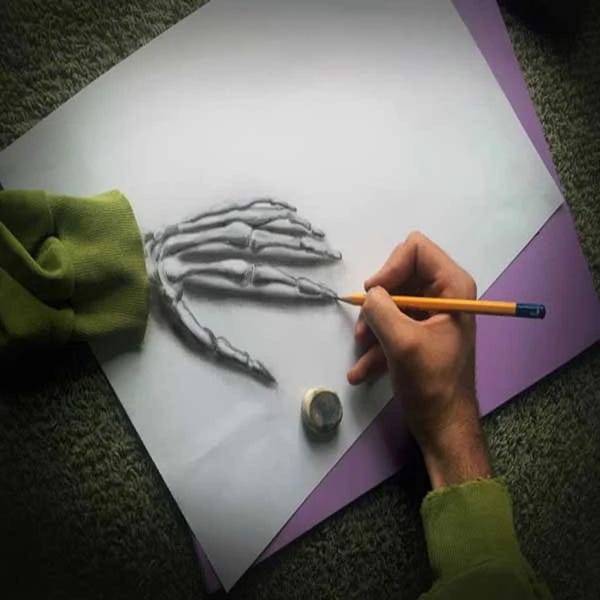
Greene’s own work above
I. The Aesthetic Argument: Beauty as a Commons
The art Green posts — Impressionist light, Renaissance balance, pastoral calm — is not curated for novelty. It is curated for continuity. These images remind us that civilization is not a given but a practice. They insist that the human capacity for tenderness, imagination, and form‑making is worth preserving.
In this sense, his feed echoes the Trueman–Triola conviction that attention is an ethical act. To look closely is to resist the flattening forces of spectacle. To share beauty is to insist that the commons is still worth tending.
II. The Political Argument: Anti‑Fascism as Cultural Stewardship
Then come the political posts — sharp, urgent, unambiguous. They are not theoretical critiques; they are alarms. They point to abuses of power, authoritarian aesthetics, and the slow normalization of cruelty. They are reminders that the conditions under which art flourishes — pluralism, openness, the rule of law — are historically rare and easily lost.
Green’s anti‑fascism is not an ideology; it is a form of cultural stewardship. It says:
If you love what humans can make, you must oppose what humans can destroy.
III. The Weave: A New Mode of Civic Expression
What makes Green’s feed compelling is not the content alone but the pattern:
Art — the world as it could be
News — the world as it is
Politics — the world as it must not become
Art again — the world we return to, the world we hope to preserve
This oscillation is a pedagogy. It teaches that beauty is not ornamental; it is a stake in the ground. It teaches that democracy is not a system; it is a mood, a way of seeing, a willingness to care about what is fragile.
IV. The Company He Keeps: Other Bluesky Aesthetic‑Civic Hybrids
Green is not alone in this mode. Bluesky has become a loose federation of accounts where art and civic urgency intermingle:
@caldeiragiselle, whose quiet, contemplative curation of global art forms a counter‑narrative to digital acceleration — beauty as resistance.
Duncan Crombie, whose surreal, idea‑driven images enact a philosophy of creative demand — art as a form of interior truth‑telling.
Grid (@isbergillustration), whose daily drawings model vulnerability, generosity, and communal imagination — art as ethical presence.
ms m, whose cosmic blend of flowers, music, and sincerity creates a worldview where joy becomes a form of defiance.
Each of these accounts, in different registers, performs the same civic gesture:
They remind us that the imagination is a public resource.
Green’s contribution is distinctive because he makes the stakes explicit. He shows the beauty, then he shows the threat. He refuses to let the two drift apart.
V. The Philosophy: Aesthetic Citizenship
What emerges from this constellation is a philosophy we might call aesthetic citizenship — the belief that:
Beauty is a form of civic memory.
Attention is a form of care.
Anti‑fascism is a defense of the imaginative commons.
Art is not separate from politics; it is what politics is meant to protect.
This is not activism in the traditional sense. It is quieter, more interior, more attuned to mood than to policy. It is the kind of civic imagination that grows in the cracks of a culture under pressure.
And it is precisely the kind of work the Trueman–Triola project has been tracing: the subtle ways people try to remain human in a world that keeps asking them to forget how.