
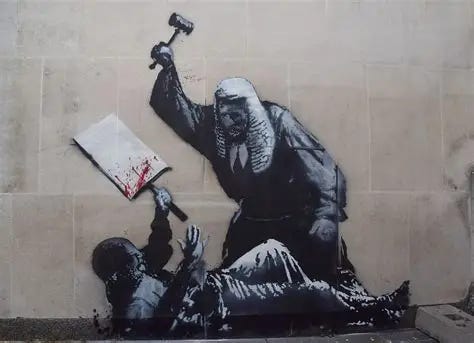
Every few months, the culture seems to rediscover its appetite for unmasking. A new investigation surfaces, a lost audio clip reappears, a journalist claims to have triangulated a name from the shadows. This week’s round of speculation—suggesting, again, that Banksy might be Robin Gunningham, or David Jones, or “Robbie,” depending on which breadcrumb trail one follows—has revived the familiar question: Do we finally know who Banksy is? bing.com
But the more interesting question, the one that belongs in a reflective corner of this newsletter, is simpler: Why do we imagine that knowing his name would give us anything we don’t already have?
There is a quiet civic wisdom in resisting the urge to unmask. Banksy’s anonymity is not a gap in our knowledge; it is part of the architecture of the work. The pseudonym is the frame, the scrim, the negative space that lets the art stand without the gravitational pull of biography. In an era when every public figure is flattened into a dossier of personal details, the refusal to be known becomes its own kind of cultural offering.
To know the legal name would be to collapse the multiplicity. “Banksy” is not a man so much as a phenomenon—part prankster, part moralist, part collective hallucination. The anonymity protects the art from the artist, and the artist from the machinery that consumes artists. It keeps the work from being reduced to the predictable rituals of scandal, personality, and market speculation. It preserves a rare commons: a shared mystery in a world that has almost forgotten how to hold one.

And so the Trueman–Triola position, if we can call it that, is modest but firm. The investigations will continue, as they always do. Names will be proposed, disputed, retracted, proposed again. But none of this touches the essential truth: we do not need to know Banksy’s real name because the art has already given us everything that matters.
The rest is trivia, and trivia is the enemy of wonder.