
Arts Consideration Dept., Trueman–Triola Newsletter
Epigraph “Some constellations are defined not only by the stars that burn, but by the ones that go out.”

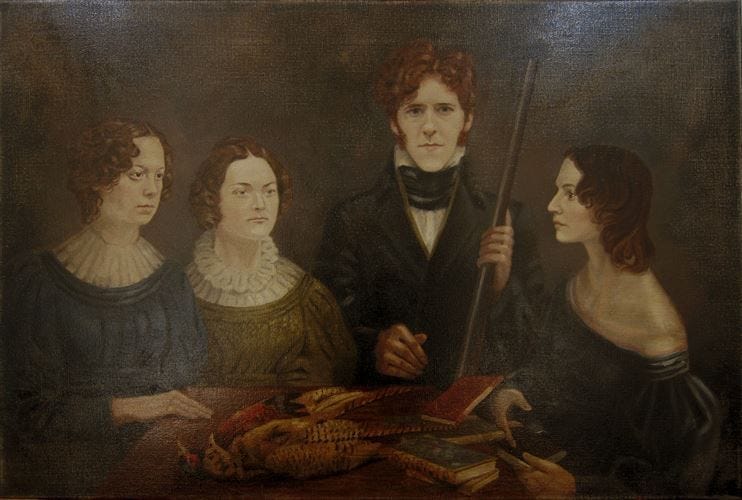
There are families and artistic circles in which one member burns too brightly, too briefly, and the others spend the rest of their lives creating in the light and shadow of that extinguished flame. The Brontës were such a family. The Beatles were such a band. And in both cases, the quietest member—the one history initially underestimated—turns out to be the moral center, the steadying force, the artist whose clarity outlasts the noise.
Anne Brontë and George Harrison occupy this parallel position with uncanny symmetry. They were not the leaders of their groups, nor the public faces, nor the myth‑makers. They were the ones who asked the deeper questions: What is the cost of genius. What is the ethical responsibility of the artist. What does it mean to tell the truth when the truth is uncomfortable.
Anne’s Tenant of Wildfell Hall and George’s “All Things Must Pass” are not merely works of art; they are acts of conscience. They refuse spectacle. They refuse self‑mythology. They insist on clarity, even when clarity hurts.
And behind them, in both stories, stands a lost brother.

Branwell Brontë and Stuart Sutcliffe—two young men of promise, instability, and tragic brevity—shape the emotional weather of their respective groups. Branwell, the early star of the Brontë children, whose decline into addiction created the atmosphere in which his sisters wrote. Sutcliffe, the painter‑bassist whose presence electrified the early Beatles and whose sudden death left Lennon permanently marked.
Both men were beloved. Both were destabilizing. Both died before the group’s greatest flowering. And in both cases, their absence becomes a strange, painful clearing—a space the others fill with work that carries the imprint of grief.
Charlotte and Emily write in the wake of Branwell’s collapse; Lennon and McCartney write in the wake of Sutcliffe’s death. And in each trio, the quiet one—Anne, George—becomes the keeper of the moral thread, the one who metabolizes sorrow into clarity rather than spectacle.
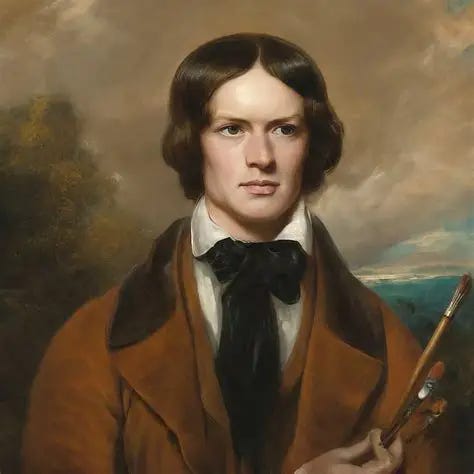
Anne saw Branwell’s decline with a steadiness her siblings could not bear. George saw the cost of fame with a spiritual acuity the others resisted. Their work is not reactive, but it is shaped by the emotional pressure of living beside brilliance and ruin.
The parallels are not perfect, but they rhyme in the way human stories often do: a quartet becomes a trio; the troubled brother dies; the quiet one steps forward with a truth the world is not yet ready to hear.
And perhaps that is the deeper connection between Haworth and Hamburg, between the parsonage and the Cavern Club: in both places, art was forged in the presence of a beloved ghost.
SIDEBAR: THE LOST BROTHERS
Branwell Brontë (1817–1848) & Stuart Sutcliffe (1940–1962)
Both men were early centers of gravity. Branwell, the prodigy of the Brontë household, was the one expected to rise. Sutcliffe, the painter with movie‑star cheekbones, was the one Lennon adored. Their gifts were real, but their lives were fragile. Addiction claimed Branwell; a brain hemorrhage took Sutcliffe. Their deaths left their groups wounded but strangely clarified. The surviving members—Charlotte, Emily, Anne; John, Paul, George—created their greatest work in the long echo of that loss. The ghost does not disappear; it becomes part of the architecture.
Closing Meditation: How Groups Carry Grief
Every artistic group develops a private language of grief. Some bury it in work; some transmute it into myth; some carry it like a stone in the pocket. The Brontës wrote through the storm of Branwell’s decline, their novels thick with the knowledge of what love cannot save. The Beatles carried Sutcliffe’s absence like a bruise—visible in Lennon’s lifelong ache, audible in the spiritual searching of Harrison’s later music.
Grief, in these constellations, is not an ending but a shaping force. It sharpens the questions. It deepens the work. It teaches the survivors how to see.
And perhaps that is the quiet truth Anne Brontë and George Harrison share across the centuries: that the gentlest voice in the room is often the one that understands loss most clearly, and transforms it—not into spectacle, but into something like wisdom.