
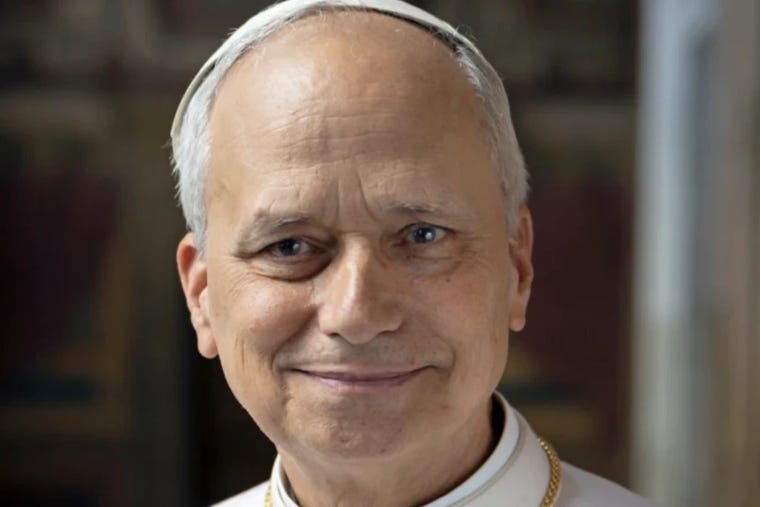
Epigraph
“Power is made perfect in weakness.” — 2 Corinthians 12:9
I. A New Technological Threshold, A Familiar Human Question
Pope Leo’s encyclical on artificial intelligence arrives not as a technocratic white paper, nor as a Luddite lament, but as something older and more demanding: a moral summons.
He is not asking what AI can do. He is asking what we are willing to become while using it.
Catholic leaders quoted in the National Catholic Reporter note that the document will take time to fully unpack. That feels right. Leo is not offering a list of rules; he is offering a horizon—one that asks us to see AI as a mirror of our deepest commitments, fears, and fantasies.
II. Disarmament as a Spiritual and Civic Task
The most striking phrase in the encyclical—already generating commentary—is Leo’s call to “disarm” AI.
He does not mean shutting it down.
He means stripping it of the capacity to wound.
In Leo’s framing, AI is a new kind of armament: not a weapon in the conventional sense, but a system capable of amplifying domination, accelerating conflict, and eroding the fragile trust on which civic life depends.
To “disarm” AI is to insist that power be made safe for the human person.
This is Catholic social teaching updated for the algorithmic age.
III. The Human Person at the Center
Leo’s anthropology is clear:
technology must serve the human person, not the other way around.
He warns against:
reducing people to data
treating vulnerability as a defect
imagining that human limitation is something to be engineered away
In a quiet but unmistakable rebuke to transhumanist fantasies, Leo insists that weakness is not a flaw but a site of grace.
This is the encyclical’s theological heart.
IV. The Church’s Own Reckoning
One of the more candid notes in the reporting is Leo’s insistence that the Church must examine itself if it hopes to speak credibly about technology, power, and abuse.
This is not window dressing.
It is a recognition that moral authority must be lived, not asserted.
Leaders quoted in the article acknowledge that this internal reckoning is ongoing—and necessary.
V. New Ethical Frontiers: Manipulation, Deepfakes, and Harm
Leo devotes significant attention to the ways AI can fabricate images, distort truth, and weaponize intimacy.
Commentators suggest this may open the door to new canonical norms, especially around AI‑generated abuse material.
This is not fearmongering.
It is a sober recognition that the line between the virtual and the real has dissolved, and that harm can now be manufactured at scale.
VI. Just War Theory Meets the Algorithmic Battlefield
Perhaps the boldest claim:
traditional just war categories are no longer adequate.
AI‑driven conflict—autonomous systems, predictive targeting, algorithmic escalation—renders older frameworks insufficient.
This is not a rejection of the just war tradition but an acknowledgment that the terrain has shifted beneath it.
Expect debate.
Expect development.
Expect the Catechism to evolve.
VII. A New Kind of Dialogue: The Vatican and the Tech World
The encyclical’s rollout—delivered alongside Anthropic co‑founder Christopher Olah—signals a new papal posture:
moral critique in conversation with technical expertise.
Leo seems to believe that neither theologians nor engineers can navigate this era alone.
This is a notable shift from earlier papal documents that spoke to technologists; Leo is speaking with them.
VIII. Closing Reflection: The Work Ahead
Pope Leo is not asking us to fear AI.
He is asking us to refuse the logic of inevitability.
He is asking us to remember that:
dignity is not an upgradeable feature
power must be accountable
weakness is not a problem to be solved
and the human person is the measure of all technology
The encyclical is not a map.
It is a compass.
And like all good compasses, it points us back to ourselves—our choices, our responsibilities, our capacity for both harm and hope.