
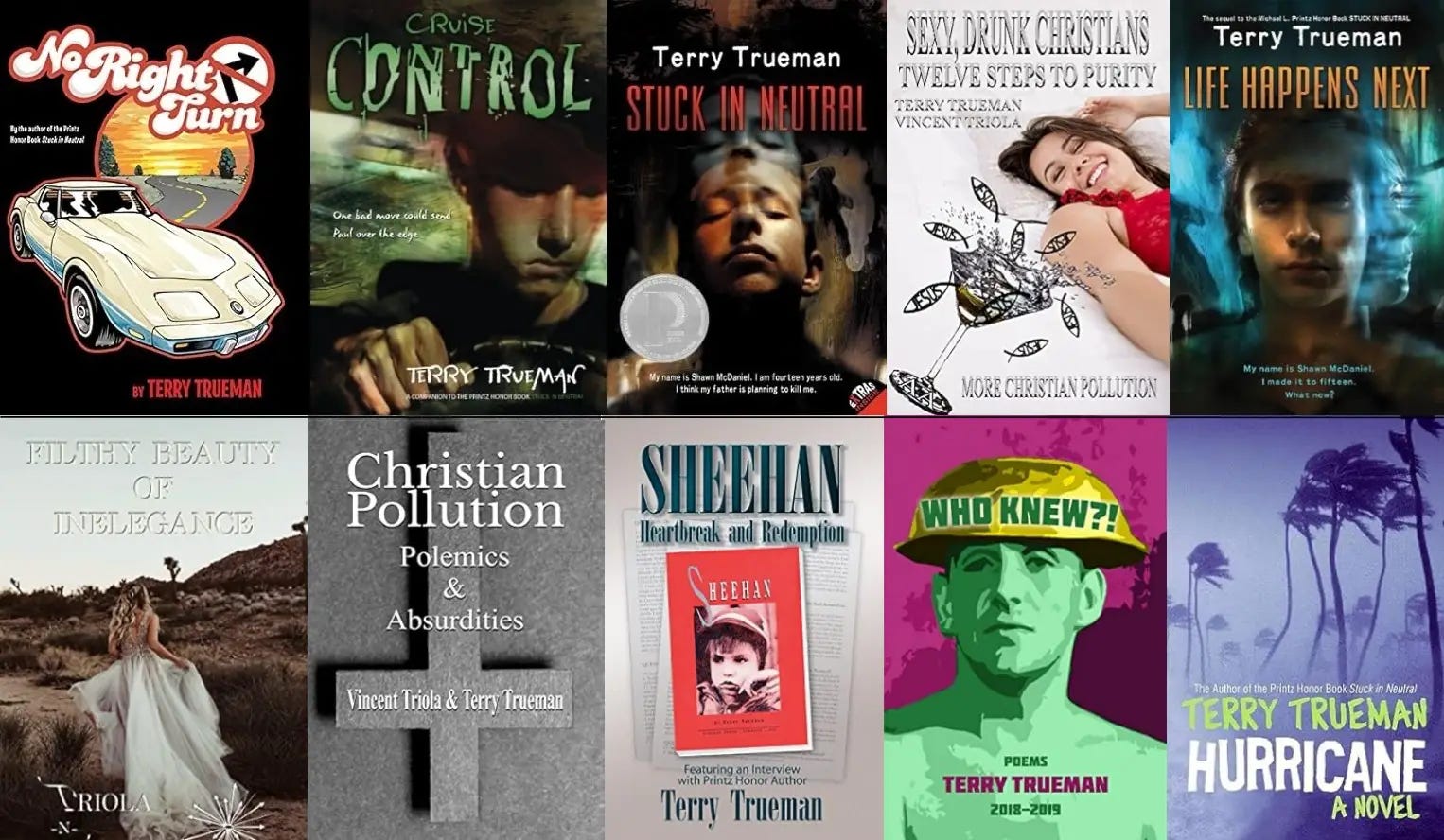
Terry Trueman’s fiction has long served as a counter‑narrative to the cultural reflex of treating difference as distance. Across his novels, he resists the easy categorization of characters as “others”—disabled, traumatized, culturally unfamiliar, or emotionally opaque—and instead insists on a literature of recognition. Trueman’s protagonists are not case studies or moral lessons; they are human beings whose interior lives invite readers into a shared emotional commons. His work argues that love, familiarity, and kinship are not sentimental themes but ethical practices that dismantle the boundaries that make otherness possible.
1. Interior Witnessing and the End of Otherness: Stuck in Neutral
In Stuck in Neutral, Trueman’s most widely discussed novel, the world sees Shawn McDaniel as unreachable, a boy locked inside a body that cannot communicate. Trueman overturns this assumption by granting readers direct access to Shawn’s interior life—his humor, intelligence, fears, and fierce love for his family. This narrative choice is an ethical act: it collapses the distance that allows others to treat Shawn as an abstraction. Shawn becomes familiar, not foreign; kin, not case.
2. Love as a Mode of Seeing: Life Happens Next
Life Happens Next extends this ethic by surrounding Shawn with characters who learn to love him not through pity but through genuine relational familiarity. Ally, who enters the McDaniel household, does not approach Shawn as a moral challenge. She simply sees him—fully, without distortion. Trueman suggests that love is not an emotion but a way of perceiving, a discipline of attention that dissolves otherness.
3. Trauma Without Estrangement: Inside Out
In Inside Out, Trueman renders Zach Wahhsted’s panic disorder with such clarity that readers experience his fear not as pathology but as recognizable human vulnerability. Even the would‑be robbers—boys who might easily be cast as villains—are portrayed with empathy. Trueman refuses to demonize them, insisting instead on understanding the social and emotional forces that shape their desperation. The novel becomes a meditation on how fear creates otherness and how compassion dismantles it.
4. Sibling Recognition and Emotional Clarity: Cruise Control
Cruise Control revisits the McDaniel family through Paul’s eyes. His resentment and exhaustion are rendered honestly, but the novel ultimately charts his movement toward a deeper, more loving recognition of Shawn’s humanity. Paul’s transformation is not about “accepting difference” in the abstract; it is about learning to see his brother clearly. Love, for Trueman, is a form of clarity.
5. Healing Through Connection: No Right Turn
In No Right Turn, Trueman explores self‑estrangement. Jordan, grieving his father’s suicide, withdraws from the world. His healing comes not from heroic transformation but from the slow, steady work of letting others in. Trueman suggests that otherness can arise even within oneself—and that love, again, is the antidote.
6. Cross‑Cultural Recognition and Shared Humanity: Hurricane
With Hurricane, Trueman expands his exploration of otherness into the realm of cross‑cultural encounter. Set in Honduras during the devastation of Hurricane Mitch, the novel follows José, a young boy whose village is torn apart by the storm. At first glance, José’s world may seem distant from the lives of Trueman’s American protagonists. Yet Trueman refuses to frame the story as an anthropological excursion into “foreign suffering.” Instead, he renders José’s interior life with the same immediacy, humor, and emotional honesty that characterize Shawn, Zach, Paul, and Jordan.
The novel’s power lies in its insistence that José is not an exotic figure but a familiar one—a boy who loves his family, fears loss, and clings to hope. The hurricane becomes not a spectacle of distant tragedy but a shared human crisis. Trueman’s portrayal of José’s community—its resilience, tenderness, and interdependence—invites readers to recognize themselves in lives shaped by different languages, landscapes, and histories.
Cross‑cultural understanding in Hurricane emerges not from grand gestures but from the intimate: a mother’s worry, a sibling’s loyalty, a community’s collective grief and courage. Trueman suggests that cultural difference is real, but it is not a barrier to recognition. The emotional architecture of José’s world—love, fear, responsibility, longing—is the same architecture that undergirds every Trueman protagonist. In this way, Hurricane becomes a global extension of Trueman’s central ethic: otherness dissolves when we attend to the interior lives of others with humility and love.
Conclusion: A Literature of Kinship
Across his novels, Terry Trueman constructs a literary universe in which otherness is gently but persistently dismantled. Whether portraying a boy with cerebral palsy in Seattle or a child surviving a natural disaster in Honduras, Trueman insists on the same truth: human beings are not strangers to one another. The emotional and ethical threads that bind us—love, vulnerability, humor, fear, hope—are universal.
Trueman’s fiction argues that love is not merely a theme but a way of knowing. To love someone is to see them clearly. To see them clearly is to refuse the categories that make them “other.” And in that refusal lies the possibility of a more humane, more expansive understanding of what it means to live together on this fragile, shared earth.