
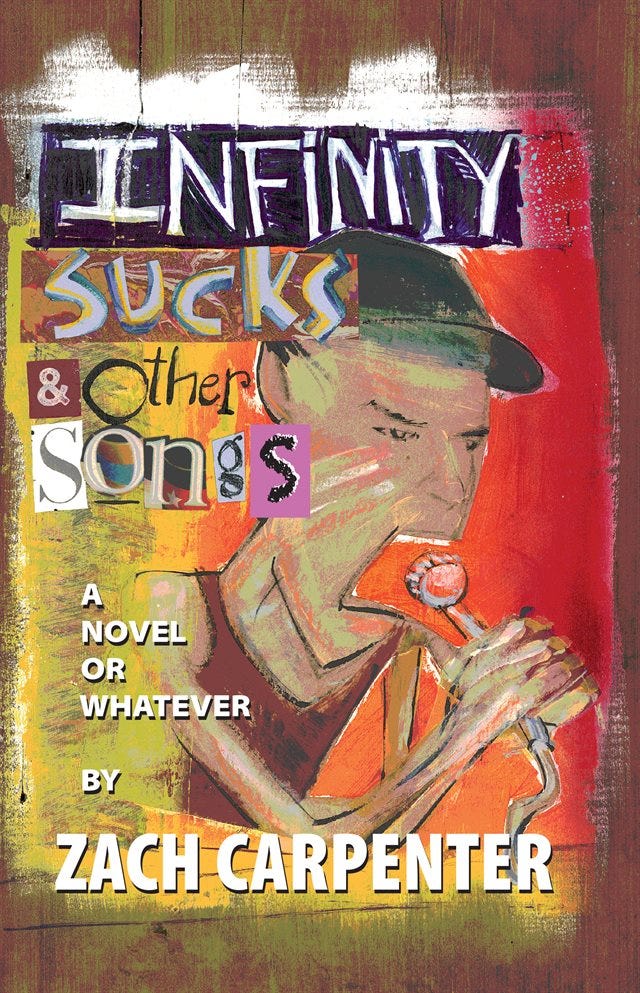
Zach Carpenter’s Infinity Sucks and Other Songs arrives like a small detonation—quiet, bright, and strangely cleansing. What makes the book remarkable isn’t simply its humor or its philosophical daring, but the way it blends artistic modes until the stories feel less like written artifacts and more like mixed‑media installations. Carpenter treats fiction as a site of collision: comic timing slams into conceptual art, lyric interiority brushes against graphic‑novel visuality, and speculative fable dissolves into philosophical prank. The result is a narrative texture that feels contemporary in the deepest sense, not because it chases trends but because it metabolizes the fragmented, multi‑modal way we actually experience culture now.
The title story, Infinity Sucks, is the clearest example of this hybrid vigor. Infinity becomes a comic‑cosmic nuisance, a metaphysical problem rendered with the pacing of a recurring gag in a cartoon. Scenes unfold like absurdist tableaux, each one a visual beat as much as a narrative one. Repetition works like musical motif; philosophical footnotes behave like graffiti. Carpenter uses humor not as decoration but as a delivery system for sincerity, smuggling vulnerability past the reader’s defenses. You laugh, and then you realize you’ve been moved.
Across the collection, the stories operate like collages—fragments of dialogue, tonal pivots, metafictional winks, and conceptual scaffolding arranged with the instinct of a visual artist. Meaning emerges not from a single dominant mode but from juxtaposition. It’s the same anti‑corporate epistemology we’ve traced in contemporary collage practices: a refusal to let any one frame dictate the truth. Carpenter trusts the reader to assemble the architecture of feeling themselves, and that trust becomes part of the book’s emotional power.
What lingers after reading isn’t just the stories but their afterlives. They return as images, rhythms, jokes, and philosophical provocations. They behave like hybrid organisms—part narrative, part performance, part conceptual art—each one continuing to evolve in memory. Carpenter’s achievement is to make fiction feel porous again, open to other arts, other ways of knowing, other forms of play.
In a cultural moment saturated with spectacle and commodified storytelling, Infinity Sucks and Other Songs feels like a reminder: art is most alive when it crosses borders, borrows languages, and refuses to stay in its lane. It’s a book built for the civic imagination, for readers who understand that the future of narrative will be multidisciplinary or it will be thin.
* * *
Full disclosure here: