
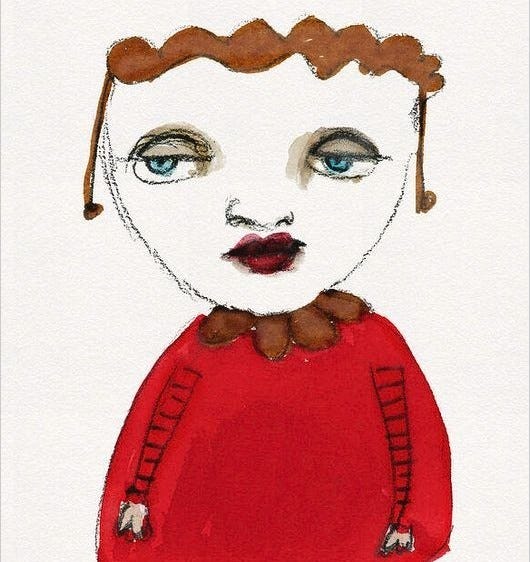
There is a way in which Flo Karp’s art seems to overstate everything—simplicity, complexity, beauty, ugliness—yet the exaggeration never feels like spectacle. It feels like candor. Her canvases behave as if they’ve grown tired of the polite half‑truths we use to navigate daily life and have decided, instead, to say what things actually feel like. In that sense, her work is not merely expressive; it is honest in the way a child or an old friend can be honest, without malice and without the usual social varnish.
Her simplest forms—flat colors, naïve silhouettes, shapes that look as though they’ve been cut from construction paper—carry a kind of radical transparency. They refuse sophistication as a shield. They insist that the world, when stripped down to its barest outlines, is still charged with emotional residue. The simplicity is exaggerated, yes, but only to reveal how much complexity we smuggle into even the most basic gestures of seeing. Karp’s minimalism is not an escape from life’s density; it is a confession of it.
And when she turns toward complexity—dense patterning, obsessive repetition, lines that seem to tremble with their own overthinking—she does so with the same unflinching honesty. These works do not pretend that complexity is elegant or admirable. They show it as it often is: anxious, fragile, a structure built from the human need to make sense of what refuses to be organized. Her complexity is not a celebration of intricacy; it is an admission of how easily our inner architectures collapse into noise.
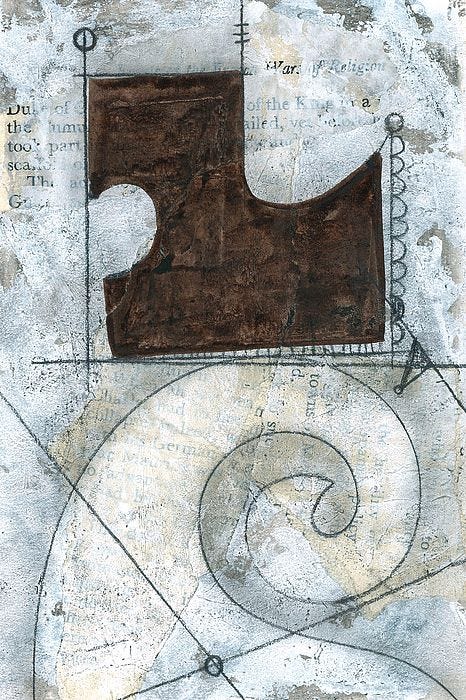
The same dialectic plays out in her treatment of beauty and ugliness. Karp’s beauty is lush, almost too lush—pastels that verge on saccharine, harmonies that feel one breath away from decay. She pushes beauty until it reveals its own artificiality, its own exhaustion. And yet she does this without cruelty. The honesty here is gentle: beauty is lovely, but it is also labor, also performance, also a kind of longing.
Her ugliness, by contrast, is tender. Distorted faces, awkward proportions, clashing colors—these are not indictments but recognitions. They acknowledge the parts of ourselves we usually crop out of the frame. In exaggerating ugliness, she restores its dignity. She lets it speak. And what it says is something like: I am here too, and I am part of the truth.
Across all of this runs a single current: Karp’s refusal to lie about the human condition. She does not resolve the tensions she depicts; she heightens them until their interdependence becomes visible. Simplicity contains complexity. Beauty carries its bruise. Ugliness holds its own kind of grace. Complexity trembles with its own vulnerability. Her exaggerations are not distortions but clarifications. They show life as it is lived—too much and not enough, lovely and difficult, orderly and chaotic, all at once.
In that sense, her work feels aligned with the spirit of this newsletter: a small cosmopolitan space where honesty is not a weapon but a form of ethical attention. Karp’s art reminds us that to see clearly is not to simplify or to beautify, but to allow contradictions to stand in their full, complicated truth. It is a kind of moral imagination, rendered in color and line.