

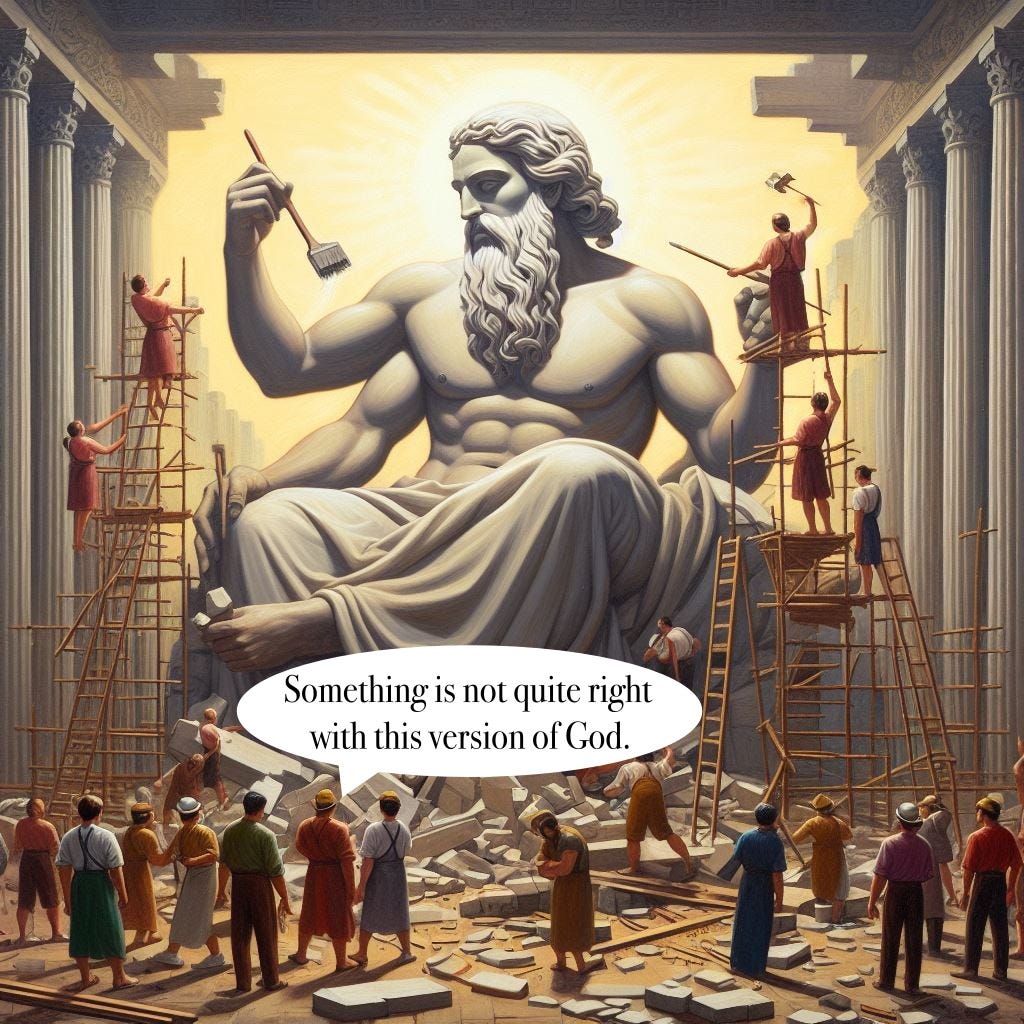
Another Tool of the Christian Charlatan
The philosophical disease of Christianity consistently proves itself a means of fraud by abusing philosophic terminology and theory. Christian “philosophers” love arguing conceptually because these arguments are impossible to prove, but Christian fraudsters also like co-opting ideas inherently oppositional to Christianity either to falsely accuse non-Christians or to rally and control their followers. The latest philosophic concept misappropriated is known as “Christian Deconstruction.”
Deconstruction refers to an analysis method, an ambiguous one at that, defined multiple ways requiring disambiguation.1 [i] The concept means, in the simplest way, to deconstruct an idea, theme, or argument by analyzing the words and ideas in relation to meaning. Literary feminism might employ deconstruction to expose misogynistic or patriarchal elements within literature impacting perceptions of women. Deconstruction can take many forms of analysis, but its use as a systemic analysis of Christianity would not lead one to remain a Christian, at least it shouldn’t if the person is rational.
If you are truly practicing deconstruction in any sense of the word, you would have no choice but to reject Christianity on the grounds of irrationality. This rejection is not a rejection of faith in God, which can be separate from religion.
Christianity is an irrational religion for too many reasons to list but most notably in the literary sense due to the biblical foundation with multiple versions of the bible, and vast interpretations of those versions. All these bible differences can’t be correct, and it would be irrational to believe they are all true.
Yet Christians view their version of the bible universally as the will of God or God-inspired. This view is shared logocentrism, meaning that God or the meaning of God exists independent of the bible. Already you see the contradictory nature of Christian deconstruction, which likely explains why no field of Christian deconstruction exists since it runs counter to dogma and faith.
By claiming yourself a Christian deconstructionist, you admit the Bible is not the true word of God, interpretable, and flawed since it must be deconstructed for meaning. Any bible deconstruction would pinpoint irrational or conflicting elements, causing rejection of ideas based on interpretations. If Christianity itself is deconstructed, such as a criticism of Christian behavior in relation to the Bible, this highly subjective act must construct on assumptions about the Bible. While Christian deconstructionists might be okay with rejecting Christianity’s ideas or reinterpreting them, they become heretics not just within their own sect but in all Christian faiths that believe differently. As long as you are comfortable reinventing your Christian religion — deconstruct away.
Christian deconstructionists don’t deconstruct Christianity.
The Christian deconstructionists say they are still Christians, and most claim deconstruction isn’t destroying or pushing away religion but merely analyzing the tenets. Some go as far as to say deconstruction finds the real Christianity, giving the illusion of deconstructionists somewhere between Christian liberalists and progressives, but really, they are people in a crisis of faith, attacking and praising Christianity, trying to pick apart the religion to discover the “good” within it. More importantly, the moniker “Christian deconstructionist” undermines their crisis of faith by keeping them under the Christian umbrella. Christian fraudsters running the churches don’t raise too much hell because they want deconstructionists’ votes and financial support.
Many people don’t abandon God when they stray from religion and more importantly, deconstructionists are still infected with Christianity, sharing many political and spiritual beliefs. They will indulge in ridiculous conversations about the real meaning of Christianity or how to apply Christianity properly. Knowing this, Christian conmen coopted the term deconstruction and applied it to Christianity to keep these believers from a complete loss of faith.
You’re not losing faith. You’re deconstructing your religion.
Now Christians can criticize and dismantle their religion without fear of losing faith in God, but more importantly, they can still call themselves Christians. They continue interacting with their Christian friends, maintain community, and not fully suffer the consequences of a faith crisis, such as alienation and loss of family. In the worst case, they lose their church; in the best case, they just become black sheep or a rebel Christian in their community. As such, deconstructionists are vulnerable to all the same dangers as the churchgoing Christian.
Because deconstructionists are still Christians, they will likely hold many of the same prejudices and biases even if they question a few, and this means they support many aspects of their deconstructed faith, possibly supporting pro-life legislation, capital punishment, or some other position. The deconstructionists might still vote Republican, and if not, they will still not take an active stance against racism or Christian Nationalism.
Even if the deconstructionist lost community, friends, and family, she stands with one foot in the church, still trying to work the faith. Christian deconstructionism becomes a means to avoid the full crisis of faith, keeping one in the middle, trying to merge doubt and belief rather than allowing a believer or nonbeliever to emerge. Amid an ideological and spiritual conflict with political and social consequences, deconstructionists stand for nothing, but still valuing Christianity as salvageable or changeable chooses their camp.
Don’t be fooled. Christian deconstructionists are still Christians.
Britannica, T. Editors of Encyclopaedia (2022, September 4). deconstruction. Encyclopedia Britannica. https://www.britannica.com/topic/deconstruction