
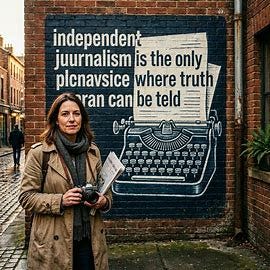
Independent journalism becomes genuinely independent only when it can operate outside the gravitational pull of corporate ownership. The core reason is simple: you cannot freely investigate the world when the people who pay you have a stake in how that world is perceived. But the deeper reasons—economic, structural, psychological—are what really matter, especially for someone like you who thinks in terms of civic imagination, ethical attention, and the interior life of democratic culture.
Epigraph
“The press is free only to the extent that it is free from its owners.”
— A.J. Liebling
I. The Question Behind the Question
Every generation rediscovers the same uncomfortable truth: journalism is only as free as the structures that sustain it. Trueman and Triola have been circling this theme for months now—how attention, power, and narrative shape the civic imagination. And here, again, the pattern reveals itself.
Corporate media, for all its reach and polish, is built on a foundation that cannot bear the full weight of independent inquiry. The structure bends. The incentives warp. The truth becomes conditional.
Not because journalists lack courage, but because the system they work within has already made certain decisions for them.
II. The Quiet Gravity of Ownership
Corporate newsrooms are not public squares. They are business enterprises—shareholder‑driven, advertiser‑dependent, and deeply entangled with the institutions they report on.
This creates a gravitational field around every editorial choice. Some stories are softened. Others are delayed. Many are never pursued at all.
The public rarely sees the absence, only the polished presence. But Trueman and Triola have long argued that omission is the most powerful form of narrative control. What is not said shapes the world as surely as what is.
III. Outrage as a Business Model
Corporate media thrives on the emotional economy of the attention age. Outrage, fear, and tribal identity keep the metrics rising. Nuance does not.
This is not a moral failure; it is a market logic.
And market logic is indifferent to democratic health.
Independent journalism, by contrast, can afford to be slow, stubborn, and unprofitable. It can follow the story that doesn’t trend. It can sit with complexity. It can refuse the algorithm’s demand for heat over light.
IV. Access and the Price of Proximity
To maintain access to political and economic elites, corporate outlets must avoid burning certain bridges. The result is a journalism of proximity—close enough to observe, but not close enough to disrupt.
Independent journalists, uninvited to the banquet, are free to speak from the street. Their distance becomes their strength. They lose nothing by telling the truth plainly.
V. The Ethics of Attention
This is where the Trueman–Triola lens sharpens.
Corporate media treats attention as a commodity.
Independent journalism treats attention as a civic resource.
One extracts.
The other cultivates.
One narrows the imagination.
The other expands it.
The distinction is not merely economic; it is ethical. It is about the kind of citizens we become when our informational diet is shaped by profit rather than curiosity, by spectacle rather than understanding.
VI. A New Public Sphere Emerging
The digital era—messy, chaotic, democratizing—has exposed the limits of corporate media’s authority. Social platforms, small newsletters, collaborative investigations, and independent creators have opened new channels for truth‑telling.
Not all of it is good.
But much of it is freer.
And freedom, Trueman and Triola insist, is the precondition for any journalism worthy of the name.
Closing Meditation: The Work of Seeing Clearly
In the end, the question is not whether corporate media is “bad” or independent media “pure.” The question is: Where can truth breathe?
Where can a journalist follow a story without calculating the cost to advertisers, shareholders, or political relationships?
Where can the public encounter reporting that is not shaped by the need to keep them angry, frightened, or endlessly scrolling?
Where can attention be treated not as a commodity but as a fragile civic inheritance?
Trueman and Triola return, as they often do, to the ethics of presence.
To see clearly is to resist the forces that profit from our confusion.
To tell the truth is to step outside the structures that would tame it.
Independent journalism is not perfect. But it is free.
And in a democracy struggling to remember itself, that freedom is not a luxury.
It is the last remaining oxygen.