
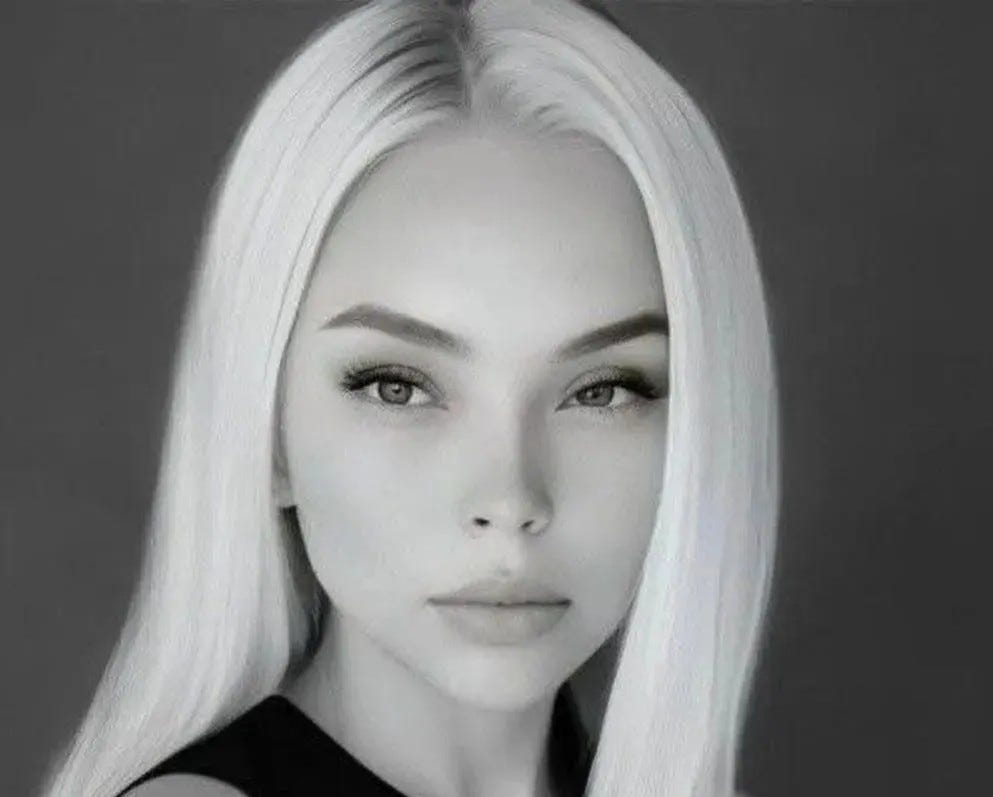
Ivy on Bluesky
When we sit with Ivy’s feed long enough, what emerges is not a sequence of posts but a kind of drifting, tidal essay—an ongoing meditation on how human interiority is shaped by the landscapes we move through and the art we choose to hold close. She doesn’t “curate” in the conventional sense; she composes. Her page reads like a long-form lyric, one that moves between forest, coastline, bedroom, city street, and dreamscape without ever announcing the transitions. The seams dissolve.
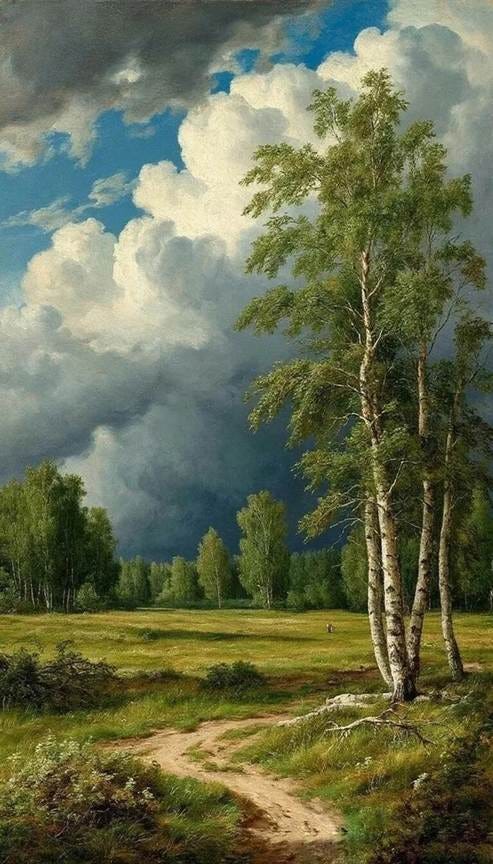
Shishkin forest—The Path Through the Woods
What makes her blend of nature, landscape, and human art so seamless is that she treats each as a mode of feeling rather than a category. A Shishkin forest—The Path Through the Woods—is not presented as a historical artifact but as a living corridor of memory, a place where the viewer might wander and lose track of time. Moments later, she offers Clare Elsaesser’s Asleep, a portrait that feels like the interior echo of that same forest: the hush, the drift, the surrender. The two works speak to each other across centuries and mediums, and Ivy positions herself not as an interpreter but as a witness to their conversation.
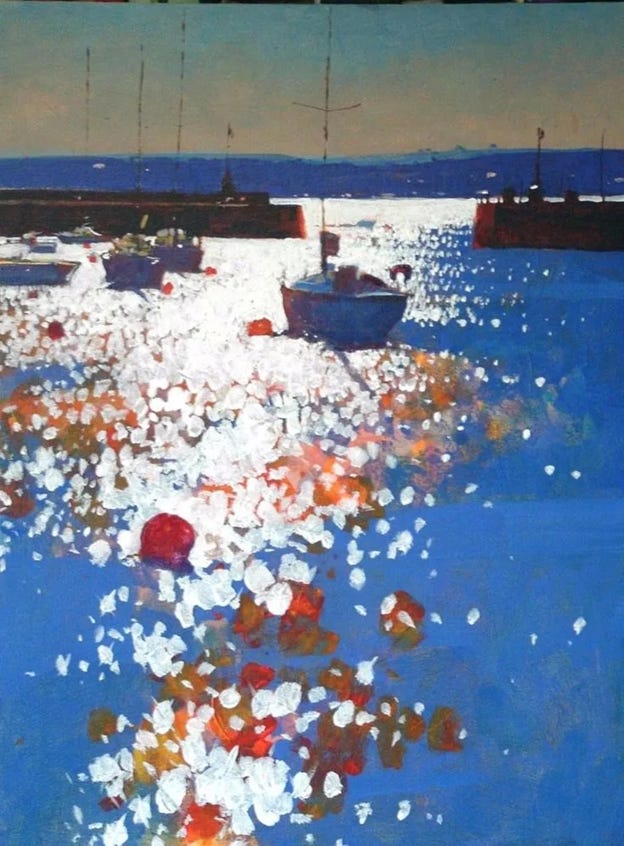
Richard Thorn’s Quiet in the Bay
Her landscapes are never just landscapes. Barbara Peirson’s moonlit Aldeburgh becomes a kind of emotional weather report—cool, reflective, edged with longing. Richard Thorn’s Quiet in the Bay feels like a pause in a sentence, a breath held between thought and confession. Even the cityscapes she chooses—Sergiu Ciochină’s Paris nights, Miguel Freitas’s vibrant urban scenes—carry the same atmospheric softness as her gardens and coastlines. Light fractures, fog drifts, color hums. The city becomes another form of nature, another terrain shaped by wind, shadow, and human yearning.
And then there are her captions, which function like the emotional ligature tying everything together. “the only thing we truly own are the words we never say.” “losing isn’t always loss.” “we write what we’re scared to voice.” These lines are not commentary on the art; they are the art. They infuse each image with a human temperature, a pulse. They turn a swallow in flight into a metaphor for hesitation, a secret garden into a meditation on interiority, a moonlit coastline into a confession whispered to no one in particular.
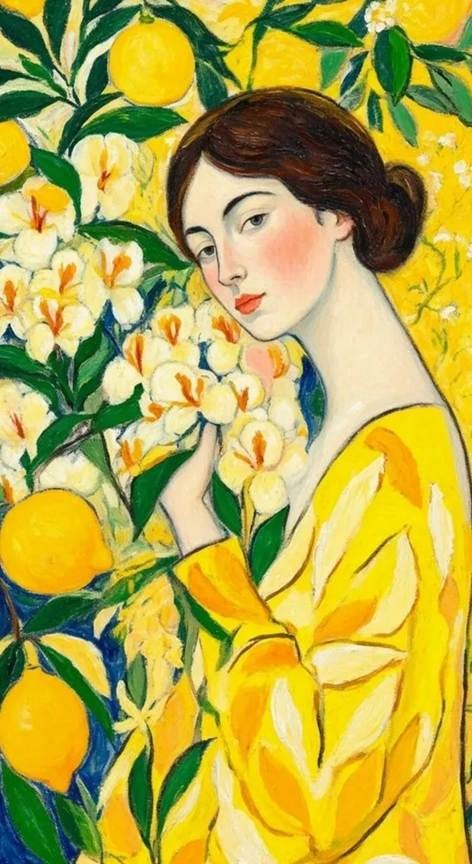
"Woman in Blooms" or "Floral Reverie"
What I find most compelling is her instinct for reciprocity between the human figure and the natural world. A portrait becomes a landscape of emotion; a landscape becomes a portrait of the viewer’s longing. In Woman in Blooms, the human form dissolves into petals and color, as if the boundary between body and garden were never meant to be firm. In The garden sea, the ocean behaves like a mind—restless, reflective, full of hidden depths. Ivy gravitates toward works where nature is not backdrop but protagonist, and where the human presence is a kind of weather system moving through the scene.
Her feed is also suffused with tenderness—toward art, toward nature, toward the people she loves. The reposts from her partner, the quiet gratitude, the soft declarations of connection—they create a parallel narrative running alongside the art. It’s as if the landscapes she shares are also landscapes of relationship, places where affection gathers like fog or sunlight.
Taken together, Ivy’s page becomes a serial reflection on how beauty moves through us. Not as spectacle, not as commodity, but as a kind of ethical attention. She reminds us that the world—its forests, its coastlines, its moonlit cities—carves hearts into us, and that art is simply the record of those carvings. Her blend is seamless because it is not a blend at all; it is a worldview in which nature, art, and human feeling are three expressions of the same quiet, persistent longing.
Ivy @askylitocean.bsky.socialky.social