
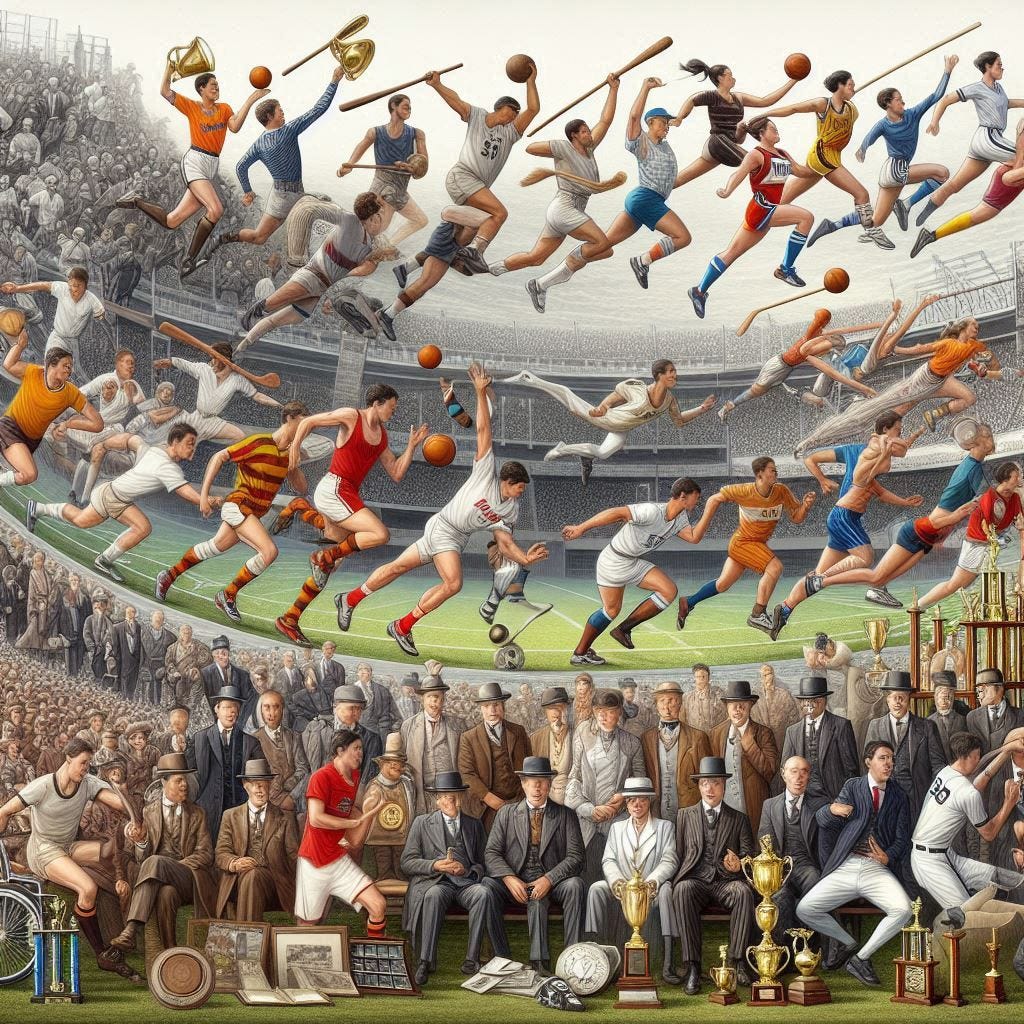
What America’s Sports Fixation Reveals
Every society has its preferred mirror. Ours, increasingly, is the stadium.
The United States’ obsession with professional and college sports is not merely a hobby or a harmless diversion. It has become a cultural barometer—one that suggests a society drifting toward spectacle, away from civic seriousness, and into a pattern recognizable from other civilizations in decline.
This isn’t a puritanical argument against games. It’s an ethical argument about scale, centrality, and what we choose to worship.
🏛️ 1. When Spectacle Replaces Citizenship: Rome’s Late Empire
The comparison is overused, but only because it fits too well.
In the late Roman Empire, the ludi—the games—expanded as civic life contracted.
Bread and circuses became a political strategy: distract the public with spectacle while the state’s institutions hollowed out.
Gladiatorial combat, chariot races, and theatrical bloodsport became the emotional center of Roman life.
The Romans didn’t fall because of the games.
But the games flourished because Rome was falling.
Spectacle thrives where civic imagination dies.
Today, the U.S. pours billions into stadiums while schools crumble, while public health systems strain, while civic literacy erodes. The games become the place where people feel belonging, identity, and emotional release—because those things are disappearing elsewhere.
🏺 2. The Greek Warning: When Athletics Become a Substitute for Virtue
Classical Greece revered athletics, but even they recognized the danger of excess.
Plato warned that a society obsessed with physical competition risks:
valuing victory over virtue
confusing strength with wisdom
mistaking spectacle for education
The Greeks believed athletics should serve the polis.
In America, the polis increasingly serves athletics.
College sports—nominally educational—have become billion‑dollar entertainment industries that distort university priorities, exploit young athletes, and turn campuses into feeder systems for corporate leagues.
When the tail wags the dog, something is off.
🕌 3. The Ottoman Parallel: When Elites Entertain Themselves While Institutions Rot
In the declining centuries of the Ottoman Empire, the ruling class became fixated on elaborate court entertainments—pageants, hunts, parades—while administrative competence collapsed.
The pattern is familiar:
Escalating spectacle
Diminishing civic capacity
A public numbed by entertainment rather than engaged by responsibility
America’s sports-industrial complex—its gambling partnerships, its militarized halftime shows, its corporate pageantry—fits this pattern with eerie precision.
🏟️ 4. The American Case: A Society That Outsources Meaning
What makes the U.S. unique is not that it loves sports.
It’s that sports have become:
the primary site of communal identity
the dominant language of aspiration
the emotional outlet for rage, hope, and belonging
the central ritual of many universities
the most visible form of civic participation for millions
In a healthy society, sports are a supplement to civic life.
In ours, they are a substitute.
We ask athletes to be moral exemplars, political voices, community leaders, and symbols of national pride because we no longer trust our institutions to provide those things.
We have turned games into a civic religion because our civic religion has failed.
💰 5. The Money Sickness
The financial scale is not incidental—it is diagnostic.
Publicly funded stadiums for privately owned teams
College coaches as the highest-paid public employees in most states
Billion-dollar TV deals that dictate game times, conference alignments, and even academic calendars
A gambling economy now woven into the fabric of fandom
When a society spends more on stadiums than on libraries, more emotional energy on draft picks than on elections, more attention on fantasy leagues than on public policy, it is telling us something about its priorities—and its wounds.
🔥 6. What the Fixation Reveals
The Trueman–Triola lens sees the sports obsession not as a moral failing but as a symptom:
a hunger for belonging in a fragmented society
a desire for narrative in a culture of chaos
a longing for heroes in an era of institutional distrust
a need for ritual in a secular age
Sports fill the vacuum left by weakened civic, communal, and spiritual structures.
But they cannot heal the wounds they distract us from.
🌱 7. The Invitation
The point is not to condemn sports.
It is to ask why they have become the emotional center of American life.
A healthy society can love its games.
A sick society needs them.
The question for us is simple:
What would it take to build a culture where the stadium is not the only place Americans feel united, alive, and part of something larger than themselves?
Every society has a place where it goes to remember who it is.
For some, it’s the temple.
For others, the marketplace, the square, the library.
For contemporary America, it is increasingly the stadium.
This is not an anti‑sports lament. It’s a meditation on what happens when a nation outsources its civic imagination to spectacle, and what that reveals about the American self at this moment in history.
🧭