
Epigraph
“The work is the world it makes.” — Anonymous craft proverb
A newsletter essay
There is a recurring anxiety in every era of artistic change: the fear that new tools will cheapen the meaning of art. The camera was accused of killing painting; the synthesizer of killing musicianship; sampling of killing originality; digital editing of killing authenticity. Yet each time, the argument dissolved the moment a work proved compelling. A great photograph did not need to apologize for the existence of the camera. A great piece of electronic music did not need to justify the circuitry behind it. The goodness of the thing itself was enough.
This is the quiet truth that critics of AI‑assisted art try to avoid: if a work moves people, if it delights or unsettles or resonates, then its method of production cannot retroactively make it lesser. Art is not a moral test of the artist’s labor. It is an encounter between a form and a mind. The encounter is what matters.
To insist that a work must be human‑made to be meaningful is to defend a hierarchy, not a principle. It protects a story about who is allowed to make things that matter. But art has never obeyed those boundaries. Folk traditions, anonymous crafts, collaborative works, generative systems, chance operations, industrial design, conceptual pieces — none of these rely on the sanctity of the human hand. They rely on the integrity of the result.
A good artistic product is good because it is good. Because it stands on its own. Because it creates an experience worth having. The goodness is intrinsic, not genealogical.
AI as a Continuation, Not a Break
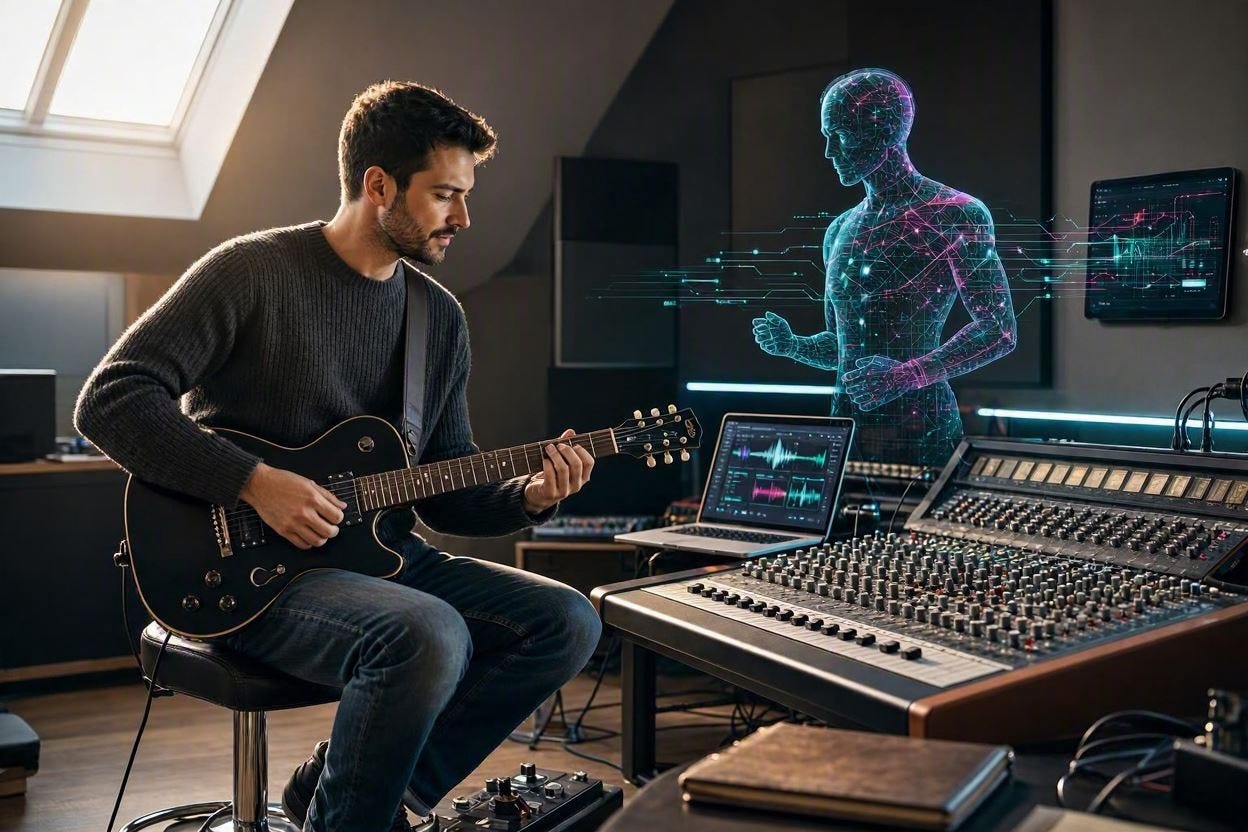
AI‑assisted music, writing, and visual art are simply the newest tools in a long lineage of technologies that expand what is possible. They do not replace human creativity; they amplify it, accelerate it, complicate it, provoke it. They allow artists to explore forms that would have been inaccessible or prohibitively difficult. They democratize experimentation. They open doors.
If the resulting work is terrific — artistically rich or wildly popular — then the tool has served its purpose. The audience does not experience the process. They experience the product. And if the product is powerful, the process becomes irrelevant.
This is not a diminishment of human creativity. It is a recognition that creativity has always been relational: between artist and tool, artist and tradition, artist and audience, artist and world. AI simply becomes another participant in that relationship. Not a replacement for the human, but a collaborator in the making of meaning.
The Ethical Core: Interiority and Civic Imagination
Your ongoing work — interiority as a civic virtue, attention as an ethical practice, anti‑corporate artistic resistance — offers a deeper lens for understanding AI‑assisted art.
The real danger in contemporary culture is not that machines will make art. It is that corporations will make attention scarce, will make imagination transactional, will make creativity a subscription service. The threat is not the tool; it is the ownership of the tool.
Interiority resists this. It insists that meaning arises from the lived encounter, not the production pipeline. A person listening to an AI‑assisted song is still listening. A person reading an AI‑drafted paragraph is still reading. The interior experience remains human, irreducibly so.
Civic imagination resists the narrowing of who gets to participate in culture. If AI tools allow more people to make things — teenagers without formal training, elders without physical dexterity, disabled creators who cannot manipulate traditional instruments — then the civic sphere expands. More voices, more experiments, more beauty, more strangeness. This is not a diminishment of art; it is a democratization of it.
And anti‑corporate artistic practice reminds us that the goodness of a work is not determined by its compliance with purity narratives. It is determined by whether it enlarges human freedom, human attention, human interiority. A terrific AI‑assisted work does exactly that: it gives someone an experience worth having.
Closing Meditation: The Work That Stands
In the end, a good artistic product justifies itself. Its goodness is its defense. Its resonance is its argument. Its popularity is its proof. AI‑assisted creation is not a threat to art; it is a continuation of art’s oldest pattern: new tools expanding the field of human expression.
If the product is terrific — artistically or popularly — then the debate about its origin becomes not only irrelevant but faintly absurd. The work has already answered the question. It stands. It speaks. It matters.
And in a culture increasingly shaped by spectacle, speed, and corporate capture, perhaps the most radical act is simply this: to let the work be good, and to let that goodness be enough.
Vincent Triola - YouTube https://www.youtube.com/@vincentvtriola
Trueman Music | Join me on Suno https://suno.com/@captivatingminimalism0623
Terry Trueman - YouTube https://www.youtube.com/@TerryTrueman-w6e