
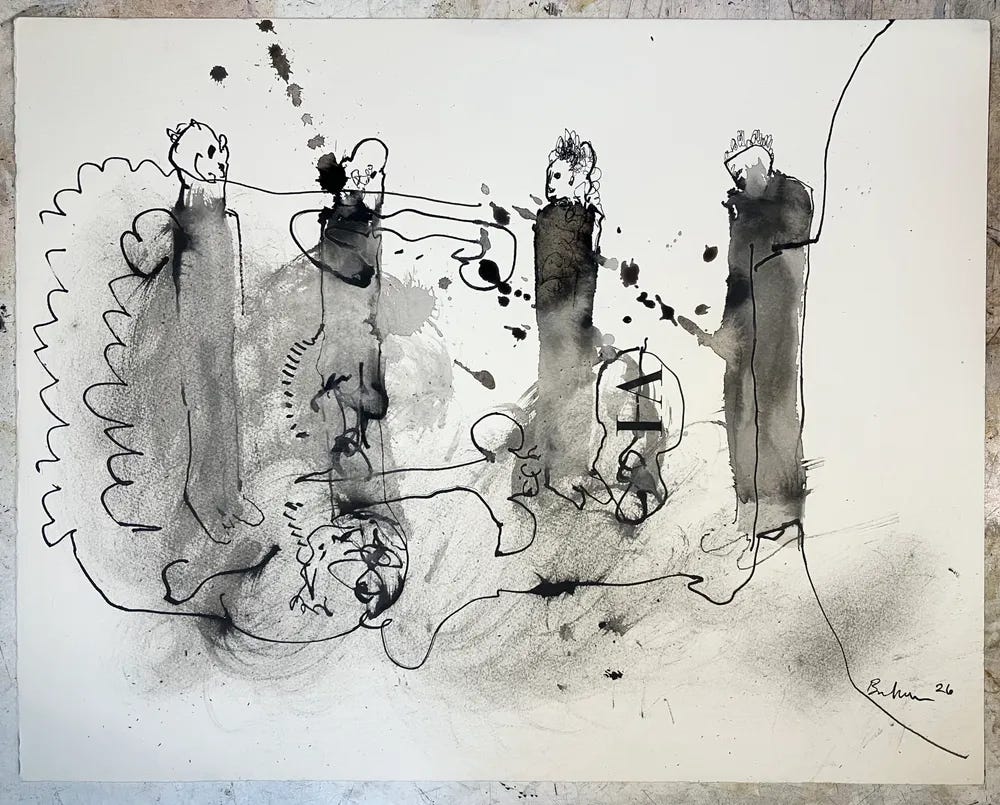
The Conversation
“The line is the first evidence of a mind trying to find itself.”
— unattributed studio proverb
I. The Gesture Before the Image
In the Trueman–Triola universe, art is rarely about the thing depicted. It is about the gesture that precedes depiction — the moment when the hand moves faster than the conscious mind, when the mark becomes a record of interior weather.
Bill Brunken’s work, as it appears in the steady stream of drawings, mixed‑media sheets, and oil paintings on his Bluesky feed, belongs to this lineage of artists for whom mark‑making is not decoration but ontology. The line is the subject. The line is the event.
His drawings — Too Much Flower, Hard, Faces in the Crowd, The Conversation — feel less like illustrations and more like the residue of thought. They are not polished; they are alive. They carry the tremor of a hand that trusts intuition more than plan.
In this sense, Brunken is not “expressive” in the casual sense. He is expressive in the older, more demanding sense: the gesture as a form of truth‑telling.
II. Paper as a Laboratory of Consciousness
The daily mixed‑media works on paper — often around 18 x 22½ inches — function as a kind of laboratory of the subconscious. Paper is where Brunken thinks with his hands.
Ink, watercolor, graphite, and other media accumulate in layers that feel both improvisational and deliberate. The surface becomes a palimpsest: marks crossing marks, erasures visible, forms emerging through strata.
This is not the corporate “process” of contemporary art discourse. It is closer to devotion — a daily return to the page, a willingness to be surprised by what emerges.
The work is not about mastery. It is about presence.
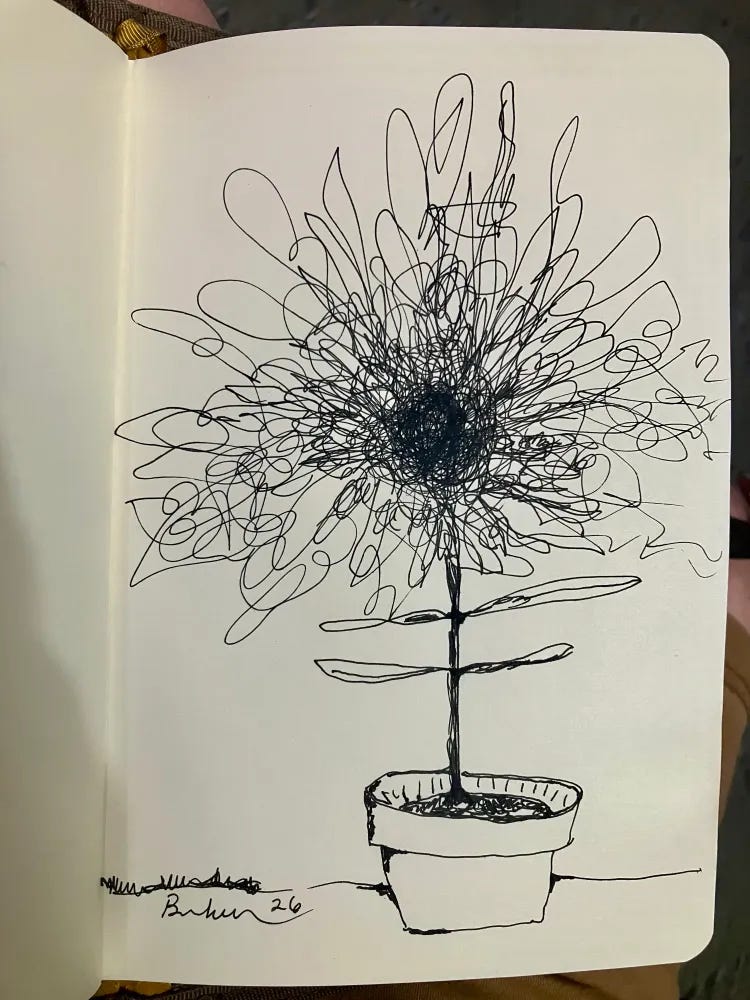
Too much flower
III. The Sketchbook as a Site of Discovery
Brunken’s small-format ink drawings — Stormy, Fruit Salad, Flight of a Dragonfly, Flowers with Toes — reveal a second method: the sketchbook as a finished arena, not a preparatory one.
Here the marks are quick, intuitive, sometimes humorous, sometimes cryptic. The scale encourages risk. The subconscious speaks more freely.
These drawings feel like the artist listening to himself.
IV. Oil on Canvas: Expanding the Emotional Field
When Brunken moves to oil — Light and Shadow Revisited, Nocturnal, Cherry, Conversation in the Clouds — the emotional register widens.
The gestures become atmospheric. Color becomes psychological. The canvases feel like expansions of the emotional states first explored in the sketchbooks.
If the drawings are the spark, the paintings are the weather system that forms around it.
V. Layering as Memory Work
One of the most revealing clues to Brunken’s method appears in his recollection of early work painted on clear plastic shower curtains, hung in layers to explore “the intangible nature of memory.”
This is not a gimmick. It is a worldview.
Memory, for Brunken, is not a stable archive. It is a translucent accumulation — images overlapping, fading, resurfacing. Even in his current work on paper, the layering impulse persists: marks that don’t erase but coexist.
The work remembers itself.
VI. Subconscious Imagery and Poetic Abstraction
Brunken describes himself as “exploring the subconscious with poetic introspective art daily.” The phrase is not marketing; it is accurate.
His figures, flowers, balloons, torsos, and animals appear as archetypal fragments, not literal depictions. They feel dreamlike, associative, emotionally coded.
This places him in the lineage of automatic drawing, surrealist intuition, and expressionist introspection — but without the theatricality that often accompanies those traditions. Brunken’s tone is quieter, more interior.
He is not performing emotion. He is tracing it.
VII. What the Work Asks of Us
The Trueman–Triola reader knows that art is not merely something to be looked at. It is something that asks something of us.
Brunken’s work asks for:
Patience — the willingness to sit with ambiguity.
Attention — the kind that notices the difference between a hurried line and a searching one.
Reciprocity — the understanding that the viewer’s interiority is part of the artwork’s completion.
His drawings and paintings do not shout. They invite.
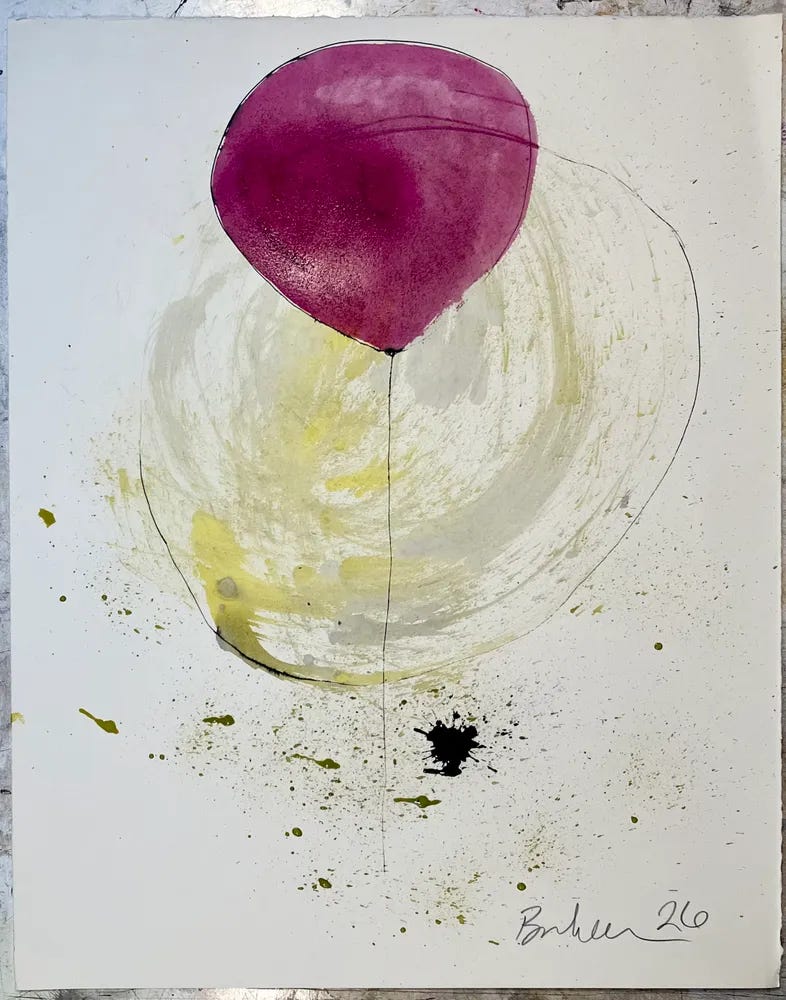
Red Balloon
Closing Reflection: The Ethics of the Daily Gesture
In an era when so much art is optimized for spectacle, virality, or brand coherence, Brunken’s practice feels almost radical in its humility. A daily drawing. A page of marks. A canvas that grows slowly, layer by layer.
There is an ethics in this — a belief that the interior life is worth tending, that the subconscious is not a problem to be solved but a terrain to be walked.
The Trueman–Triola sensibility recognizes this as a civic virtue: the cultivation of interior freedom through attention, patience, and the refusal to rush meaning.
Brunken’s work reminds us that the hand remembers what the mind forgets — and that sometimes the truest thing we can do is follow the line where it leads.
Bill Brunken https://bsky.app/profile/brunkenart.bsky.social
I love what you wrote about my favorite subject! Thank you.