
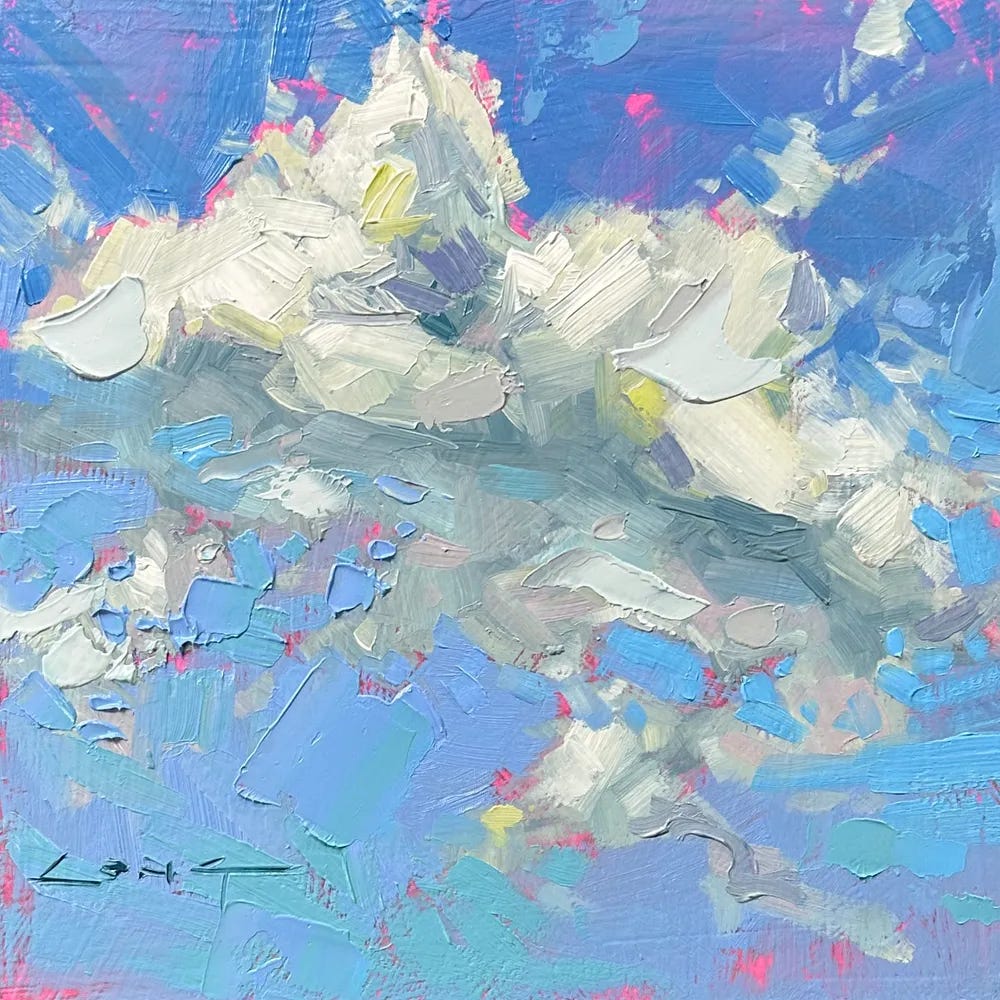
Influence is a tricky thing in art. It can flatten a younger painter into a derivative echo, or it can become a kind of inheritance—something absorbed, metabolized, and transformed into a new visual language. With Long_Painter, the Van Gogh connection is obvious at first glance: the liberated color, the charged strokes, the skies that behave like emotional weather rather than meteorology. But the longer you sit with his Bluesky feed, the more you see that he isn’t repeating Van Gogh so much as extending him into a distinctly modern, distinctly American register.
What Van Gogh discovered—that color could be emotional temperature, that a stroke could be a pulse of feeling—becomes, in Long_Painter’s hands, a way of seeing the contemporary landscape. His sunsets, for instance, are not the polite, pastel gradients of a travel brochure. They flare, they glow, they push pinks and violets to the edge of digital surrealism. When he writes, almost offhandedly, “Seldom are sunsets this intensely pink,” he’s acknowledging the tension between what the eye sees and what the heart insists on. Van Gogh painted wheat fields and orchards; Long_Painter paints Buc-ee’s parking lots, Sarasota RV parks, and the long American highways where the sky is the only cathedral most travelers ever enter. The emotional palette is inherited, but the subject matter is unmistakably ours.
His plein-air practice is equally contemporary. He works from tiny 2x3 studies made on the road, from iPhone finger sketches, from photographs snapped in the middle of travel, from memory of lightning strikes that refuse to leave him alone. This hybrid of immediacy, digital reference, and recollection creates a kind of nomadic Impressionism—rooted in movement, in the American habit of drifting, in the way modern life is lived through windshields and screens. Van Gogh had his fields and his stars; Long_Painter has the glow of LED-lit skies and the saturated color language of the digital age.
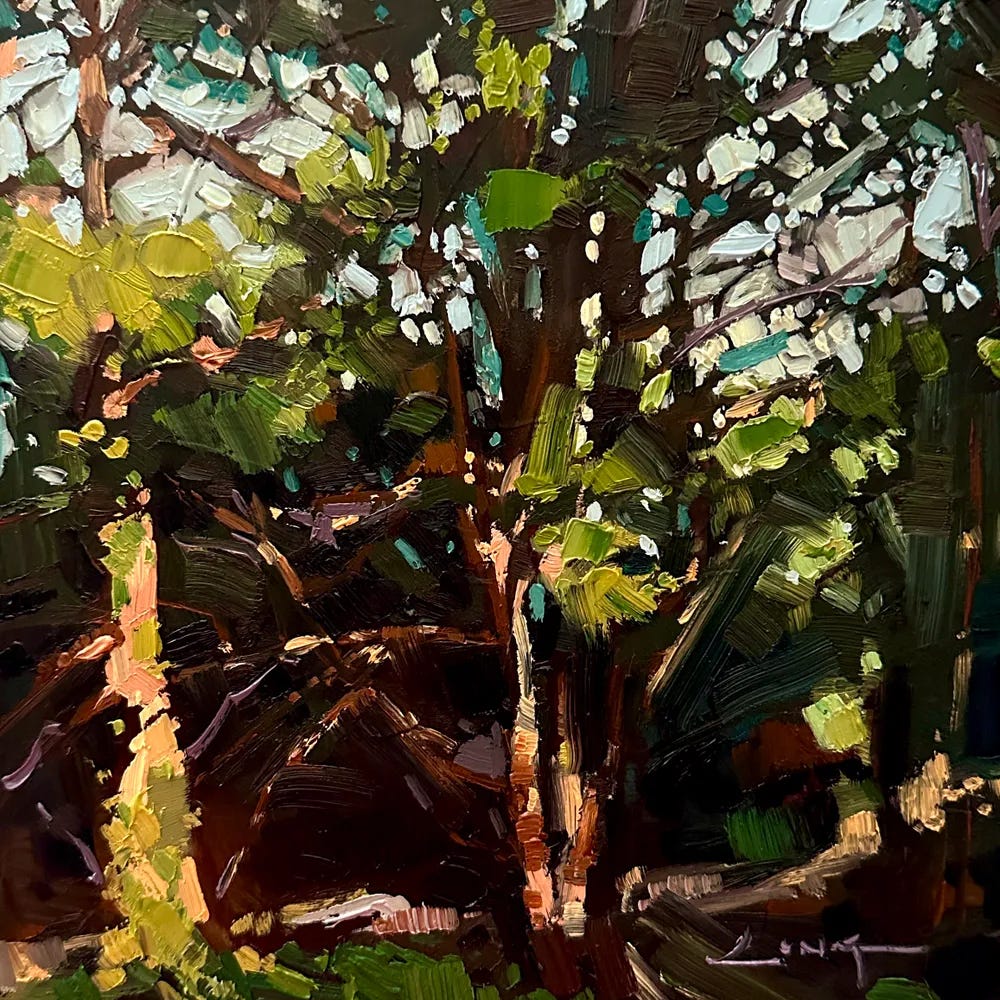
And then there is the humor, the wryness, the self-awareness that Van Gogh rarely allowed himself. Long_Painter can look at a cloud and say it resembles a mouse, or confess that a Buc-ee’s gives him an ominous feeling. These small tonal shifts matter. They place the work in a world where irony and sincerity coexist, where beauty is always tinged with the absurdity of modern life. The paintings may be luminous, but the captions remind us that the painter is a human being navigating the same strange, overstimulated world as the rest of us.
What emerges from all this is not imitation but evolution. Long_Painter takes the expressive freedoms Van Gogh fought for and applies them to landscapes shaped by road trips, RV culture, smartphone photography, and the restless American imagination. His skies are psychological fields, yes, but they are also the skies of a country in motion—skies glimpsed between errands, between states, between stages of life. They are skies that remember the past but belong to the present.
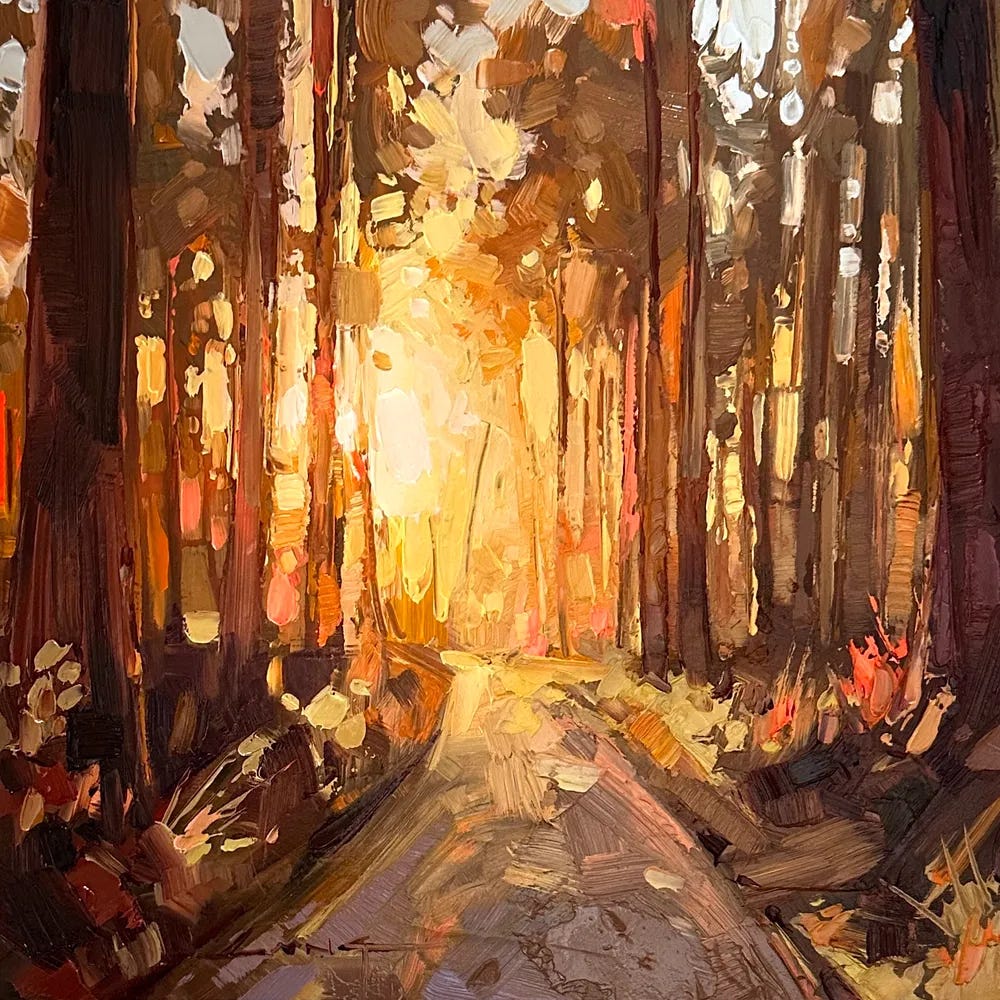
In the end, Long_Painter’s work feels like a bridge: a way of carrying forward the emotional intensity of post‑Impressionism into a century defined by mobility, digital color, and the quiet longing that accompanies both. He is not painting like Van Gogh. He is painting after Van Gogh—continuing a conversation across time, across continents, across the shifting light of two very different worlds.
Long_Painter