
Trueman & Triola Newsletter —
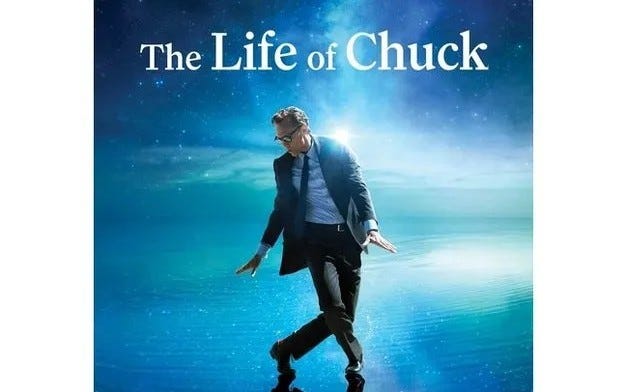
Epigraph “Most lives go uncelebrated, yet the universe keeps its own quiet ledger.”
I. The Strange Glory of an Ordinary Man
One of the most haunting choices in The Life of Chuck is the way people who have known Chuck — coworkers, neighbors, passersby — fail to recognize him in the final days. It’s not amnesia. It’s not magic. It’s not a plot twist. It’s a worldview.
The writers are showing us a man whose life mattered profoundly, but not publicly. Chuck is beloved by the cosmos, not by the crowd. The world honors him with billboards and commercials, but the people inside that world barely notice him. This is the metaphysical joke at the center of the story: the universe is sentimental, but humanity is distracted.
Chuck is the kind of person whose inner life is immense, whose quiet decency radiates outward, but whose social footprint is small. The film preserves that paradox. When characters don’t recognize him, it’s not a failure of memory — it’s a commentary on how little of each other we truly see.
II. The Cosmic Metaphor
Stephen King’s original novella imagines Chuck as a kind of spiritual infrastructure. His consciousness, his goodness, his interiority — all of it is woven into the fabric of the world. When he dies, the world collapses. Not because he was famous, but because he was foundational.
The film keeps this metaphysical structure intact. Chuck is not a celebrity; he is a pillar. The universe knows him intimately. The people around him do not.
This is why the recognition gap matters. It’s the story’s way of saying:
The universe cherishes lives that the world overlooks.
There’s something almost theological in that idea — a reversal of the usual hierarchy of significance. The cosmos is sentimental; society is indifferent. Chuck’s life is a private treasure, not a public monument.
III. The Psychology of Being Seen
There’s also a human truth here, one King returns to again and again: we live beside people whose inner worlds are vast, but we only ever encounter the surface. Chuck’s coworkers know his smile, his punctuality, his mildness. They do not know the depth of his loneliness, his imagination, his quiet heroism.
So when the world begins to end and Chuck walks through it, unrecognized, the film is staging a psychological truth: most of us will die unrecognized by the world, yet our lives will have mattered in ways no one around us ever fully understood.
This is not tragic. It’s tender. It’s the humility of being human.
IV. The Reverse Chronology and Its Emotional Trick
The film’s backward structure intensifies this effect. We, the audience, meet Chuck at the end of his life, when he is a stranger to the people around him. Only later do we learn who he was, what he meant, how he lived.
This creates a deliberate emotional dissonance:
We feel the weight of Chuck’s life long before the characters do.
The narrative is designed to make us ache for him in a way the people on screen cannot. Their failure to recognize him is not a flaw — it’s the architecture of the story. It’s the point.

V. Chuck as a Christ‑Like Presence
There is a quiet Christology running beneath The Life of Chuck, one the film never names but continually evokes. Chuck is not a savior in any doctrinal sense, but he is Christ‑like in the way his presence permeates the world, unnoticed yet essential.
Like Christ in the Gospels, Chuck moves through ordinary spaces — offices, sidewalks, classrooms — without fanfare. People see him but do not see him. His significance is invisible to those around him, yet the universe itself seems to know him intimately. The billboards and commercials that celebrate his life function almost like cosmic annunciations: proclamations of a truth the world is too distracted to perceive.
Chuck’s death brings about the end of the world not because he is divine, but because he embodies a kind of moral and metaphysical coherence. His interior life is the world’s interior life. His goodness is the world’s goodness. When he fades, the universe loses its center of gravity.
This is the Christ‑like paradox: the one who matters most is the one least recognized.
The film’s refusal to make Chuck famous is part of the theology. Christ’s own ministry was marked by anonymity, misunderstanding, and the quietness of ordinary encounters. Chuck’s life mirrors that pattern. His importance is cosmic, not social. His recognition comes from the universe, not from the crowd.
In this sense, Chuck is a figure of sacred ordinariness — a reminder that the divine often hides in the unnoticed corners of human life.

VI. What the Writers Are Really Saying
The film’s final days are not about memory loss. They’re about perspective. Chuck’s life was enormous in meaning but small in visibility. The world honors him because the world knows him. The people don’t because people rarely know each other deeply.
The writers are inviting us to consider a quiet, radical idea:
A life can be cosmically significant and socially invisible.
Chuck is not forgotten. He was never widely known. And yet he is loved — profoundly, mysteriously, metaphysically — by the very world that is ending with him.
This is a wonderful movie, I watched it just few months back... I loved how the story was told, and your writting too