
The Liminal Space Between Fiction and Life: Shawn McDaniel and Sheehan Trueman
By Walter Thomas-Weisman, PhD
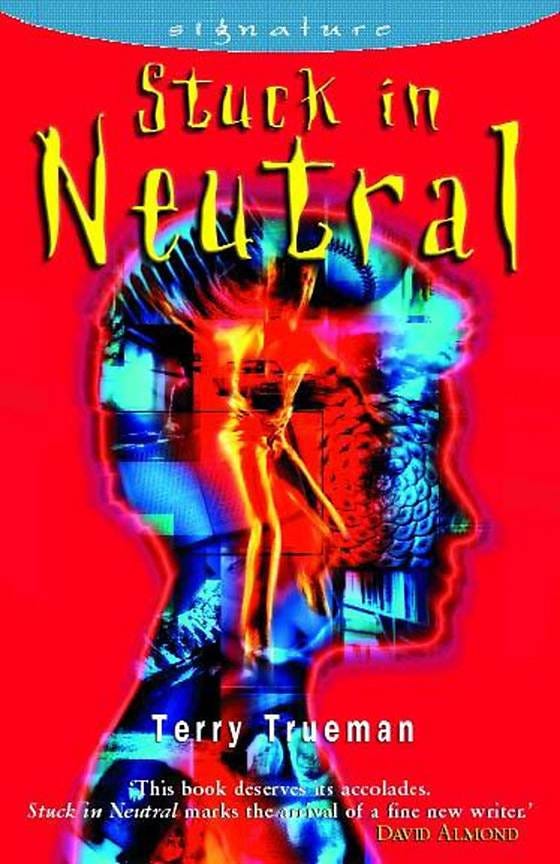
The genesis of Stuck in Neutral is inseparable from the lived experience of Terry Trueman and his son, Sheehan Trueman. In the novel, Shawn McDaniel is rendered with a radical interiority: a protagonist whose consciousness is vivid and articulate, yet whose body is entirely immobilized by cerebral palsy. This narrative experiment—foregrounding interior agency while stripping away all outward control—was not merely a literary invention, but a direct response to the existential realities faced by Sheehan Trueman.
“My poem Sheehan told my story — SIN tells Shawn’s.” — Terry Trueman
This statement, found in Trueman’s correspondence, reveals the intimate connection between the two: Sheehan Trueman’s life was the emotional and philosophical wellspring for Shawn McDaniel’s fictional existence. Trueman’s early attempts to process his son’s condition took the form of a long narrative poem—the “Sheehan Poem”—which later became the backbone of Stuck in Neutral. In fact, the earliest drafts of the novel embedded the poem as epigrams at the start of each chapter, a testament to how deeply the real and the imagined were entwined.
Witnessing and Misinterpretation
Both Sheehan Trueman and Shawn McDaniel occupy a liminal space: present, conscious, and emotionally rich, yet fundamentally misinterpreted by the world. Trueman writes that Sheehan Trueman “wasn’t just ‘developmentally delayed.’ There wasn’t any ‘delay,’ as in, ‘your flight is delayed.’ Sheehan’s plane would NEVER land.” This existential stasis—being alive but unable to communicate—becomes the central tension of Stuck in Neutral, where Shawn’s interior life is known only to the reader, while the surrounding characters remain tragically blind to his true self.
Ethical Stakes and Empathy
The ethical stakes in both the novel and Trueman’s lived experience are profound. Shawn’s dilemma—whether a life can be misjudged into oblivion—mirrors the real-world challenge of recognizing the full humanity of those whose interior lives are inaccessible. Trueman’s writing is a critique of ableist assumptions and a call to empathy, urging readers to reconsider the boundaries of voice, identity, and human worth.
Art as Survival
Trueman’s personal narrative is one of transformation through art. The birth of Sheehan Trueman, with all its heartbreak and pain, became the catalyst for Trueman’s literary career. He writes, “Sheehan gave me something to write about and something, if I could survive it, to tell and show the world about pain, heartbreak and loss.” The act of writing—first the poem, then the novel—was not only a means of survival, but a way to honor his son’s consciousness and to challenge readers to see beyond the surface.
The Reciprocal Mirror
In this sense, Shawn McDaniel is both a tribute and a mirror: a fictional consciousness that reflects the real, unspoken depths of Sheehan Trueman’s experience. The novel’s radical narrative design—where drama unfolds entirely within the protagonist’s mind—serves as a literary enactment of Trueman’s lifelong effort to make his son’s interiority visible to the world.
Conclusion
The relationship between Shawn McDaniel and Sheehan Trueman is thus one of profound interdependence. Shawn’s story is not simply inspired by Sheehan’s life; it is an imaginative extension, a philosophical meditation, and an ethical challenge rooted in the realities of disability, misperception, and love. Through Shawn, Trueman invites readers to witness what is so often unseen, and in doing so, transforms personal heartbreak into a universal call for empathy and recognition.
*Walter Thomas-Weisman, PhD is the pen-name of a University Instructor, visiting from UK to a regional state University in a western U.S. State. His identity remains secretive to protect his temporary status in the U.S.