
Epigraph
“To understand a thing is to sense its harmony.” — Albert Einstein
“An expression only has meaning within the stream of life.” — Ludwig Wittgenstein
I. The Quiet Constellation
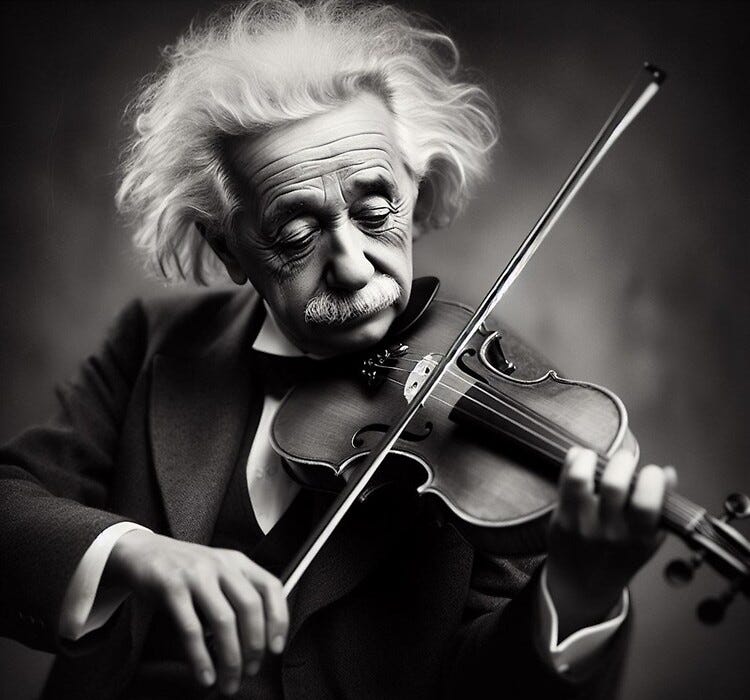
There are moments in intellectual history when disparate domains — physics, music, theology, linguistics — suddenly reveal themselves as facets of a single interior landscape. In Albert Einstein’s life, these domains were not separate rooms but adjoining chambers, each echoing the same intuition: that reality possesses a deep structure, a coherence that can be felt before it can be spoken.
Einstein’s “God” was never a deity of intervention or command. It was a metaphor for intelligibility itself — the astonishing fact that the universe can be understood. And music, for him, was the purest glimpse of that intelligibility. He often said that his greatest insights began not with equations but with a kind of inner music, a pre-verbal intuition that revealed the architecture of reality in ways language could only later approximate.
Language, in Einstein’s view, was always a translation — necessary, but secondary. Words were tools for communication, not instruments of discovery. They were too linear, too bound by grammar, too tethered to cultural habit to capture the leaps of intuition that defined his thinking. He believed that every language carries a worldview, a metaphysics. To speak a language is to inhabit a form of life.
This is where Wittgenstein enters the conversation.
II. The Stream of Life
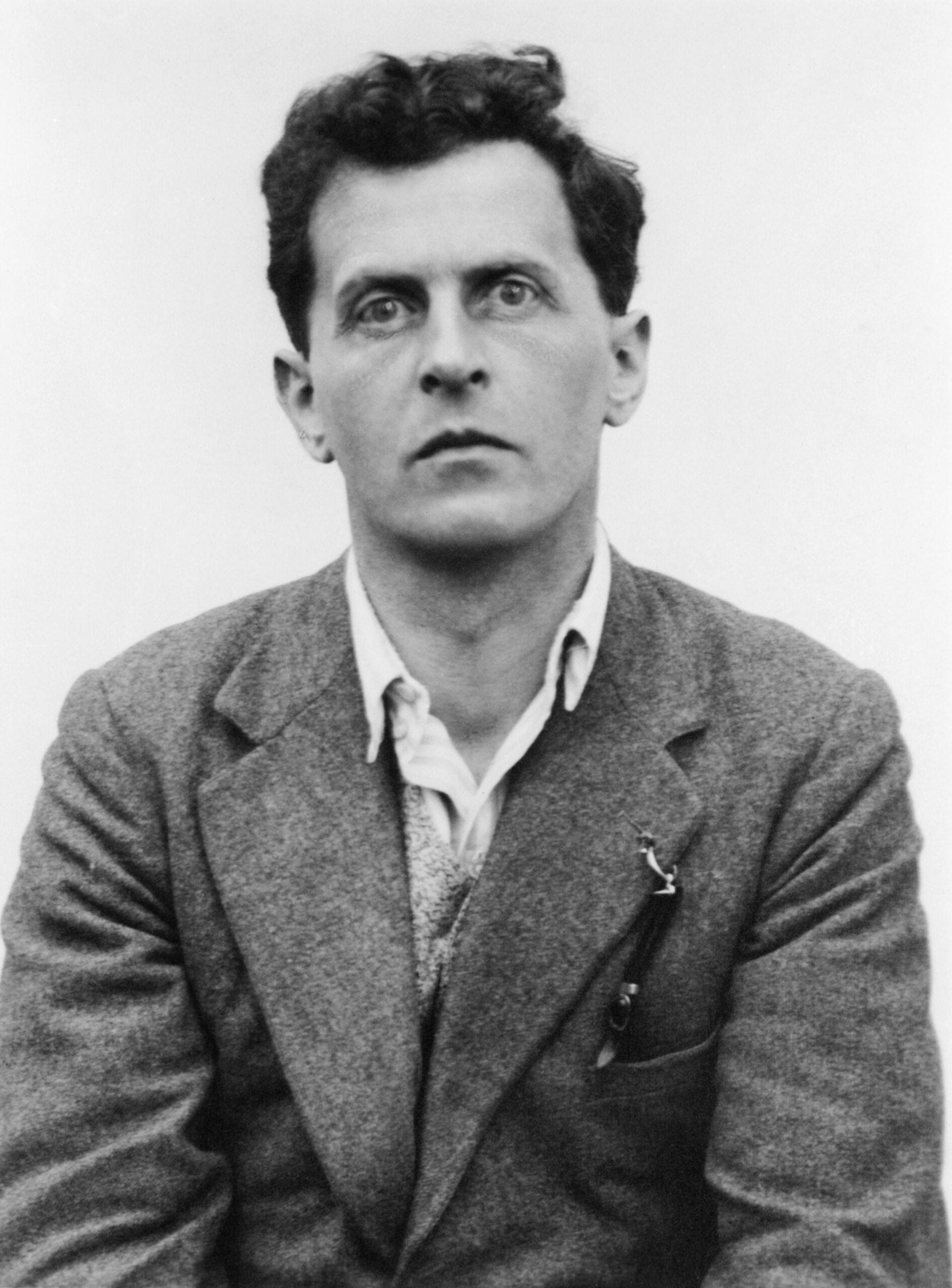
Wittgenstein’s claim — “An expression only has meaning within the stream of life” — is not a linguistic observation but a civic one. Meaning is not a property of words; it is a property of shared life. When a society fractures, when people no longer inhabit a common reality, language becomes unmoored. It becomes available for distortion, manipulation, and myth-making.
Einstein understood this intimately. He watched the Weimar Republic collapse under the weight of propaganda. He saw how words like “patriotism,” “order,” and “truth” were emptied of their ordinary meanings and refilled with ideological content. He saw how language could anesthetize conscience.
In the Trump/MAGA era, the same linguistic distortions recur — not identical, but unmistakably rhyming. Words like “fake,” “rigged,” “enemy,” “patriot,” and “freedom” function not as carriers of meaning but as signals of belonging. They are badges, not propositions. They sort friend from foe rather than describe reality.
Einstein would have recognized this as a collapse of the stream of life itself. When language is used to sever people from shared reality, meaning evaporates. Words become noise. Public life becomes theater. Civic imagination shrinks to the size of a slogan.
Sidebar: Wittgenstein’s “Forms of Life”
A form of life is the shared background that makes meaning possible — the tacit agreements about evidence, harm, truth, and reality that allow language to function. When forms of life diverge too sharply, words lose their grounding. Two people may speak the same language but inhabit different worlds. This is the condition of our present civic moment.
III. The Sacrilege of Distorted Words
Einstein’s spiritual sensibility — his “cosmic religion” — rested on the belief that reality is coherent, intelligible, and open to human understanding. When language is abused, when words are used to obscure rather than reveal, this coherence is violated. It is a kind of sacrilege, not in a theological sense but in an epistemic one.
For Einstein, truth requires humility, patience, and fidelity to reality. For Wittgenstein, meaning requires participation in a shared form of life. Both would have seen our current linguistic crisis as a threat not only to politics but to the very conditions that make understanding possible.
The degradation of language is not merely a political problem. It is a spiritual one. It is a wound to the civic imagination.
IV. Closing Meditation: Restoring the Music
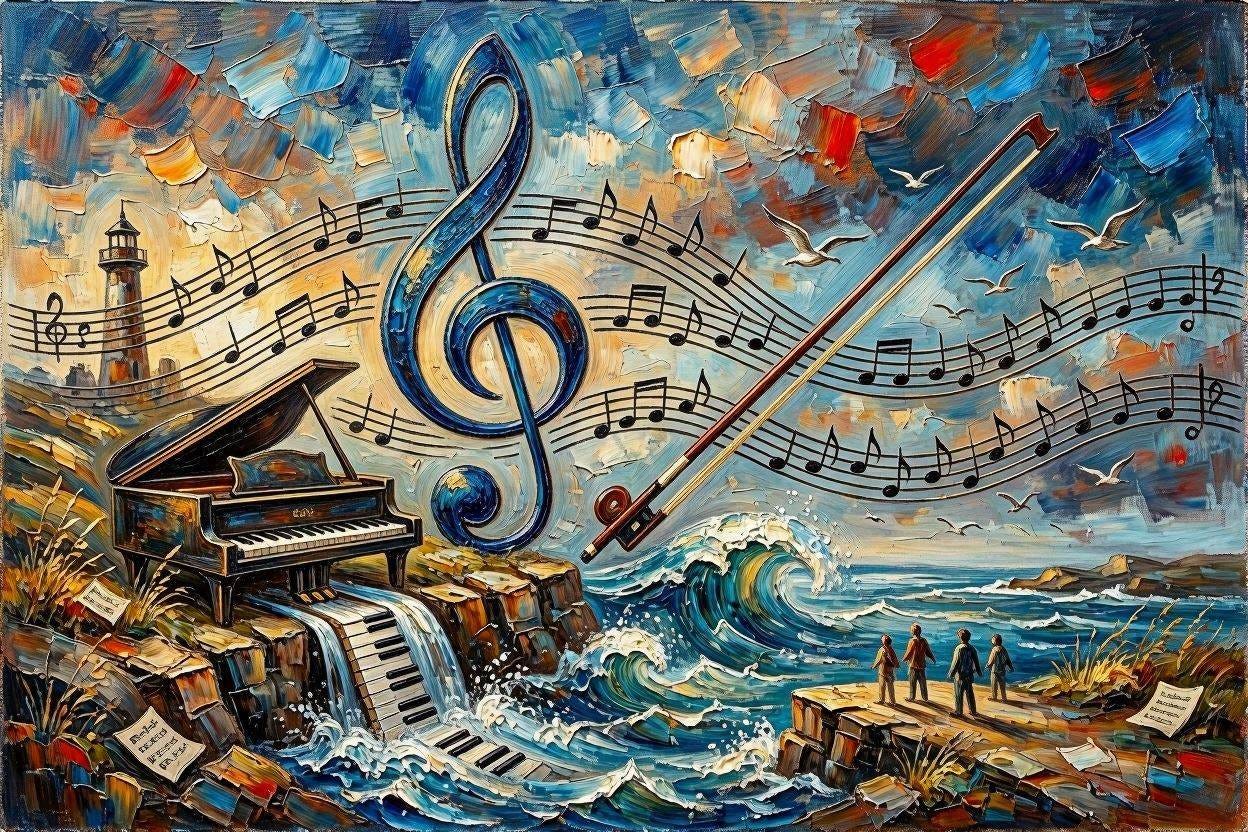
If Einstein believed that music reveals the architecture of reality, then our civic task is to restore the conditions under which that architecture can be sensed again. To repair language is to repair the stream of life. To insist on meaning is to insist on reality. To cultivate civic imagination is to refuse the seductions of distortion.
The work begins in small ways — with attention, with humility, with the refusal to let words be used as weapons. It begins with the insistence that language must once again describe the world rather than replace it. It begins with the courage to say: this is what is happening, even when others prefer the comfort of myth.
For Einstein, music was the purest expression of this grace. It was a language without words, a grammar without propositions, a theology without doctrine. It revealed the same truth his physics sought to describe: that beneath the turbulence of experience lies a pattern, a symmetry, a quiet coherence that invites contemplation. And language, in its imperfect way, was the bridge between these realms—the means by which intuition becomes thought, and thought becomes shareable.
In the end, Einstein’s reflections on God, music, and language form a single meditation on the nature of understanding. He believed that the universe is intelligible not because we are clever, but because reality itself is structured in a way that welcomes comprehension. Music lets us feel this structure. Language lets us express it. And “God,” in Einstein’s sense, is simply the name for the mystery that makes both possible.
Einstein believed that understanding arrives as a kind of grace. Wittgenstein believed that meaning arises from shared life. In our moment of linguistic distortion, their insights converge into a single imperative: Restore the music. Restore the stream. Restore the conditions under which truth can be felt again.