
TRUEMAN–TRIOLA NEWSLETTER
“The characteristic of the hour is that the commonplace mind, knowing itself to be commonplace, has the assurance to proclaim the rights of the commonplace and to impose them wherever it will. As they say in the United States: ‘to be different is to be indecent.’ The mass crushes beneath it everything that is different, everything that is excellent, individual, qualified and select. Anybody who is not like everybody, who does not think like everybody, runs the risk of being eliminated.”
— José Ortega y Gasset, The Revolt of the Masses (1930)
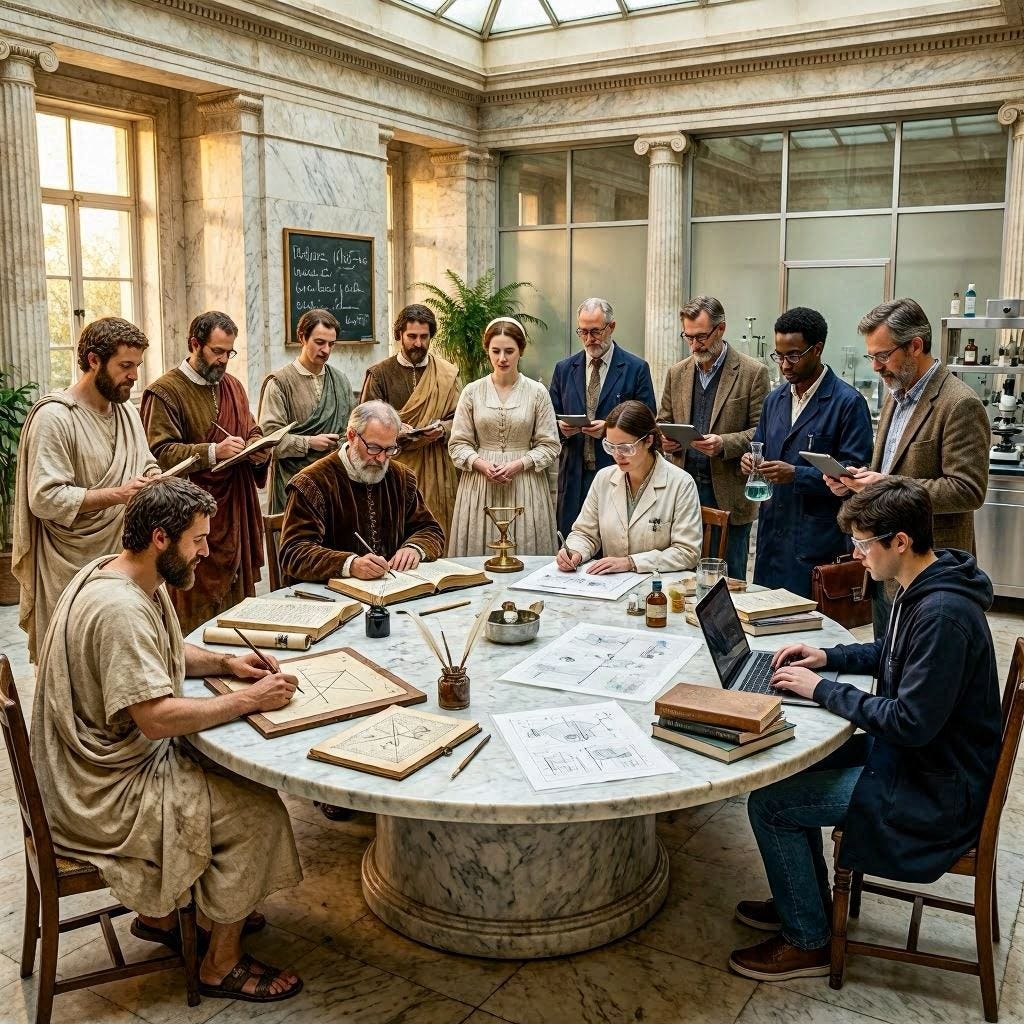
In an age when expertise is dismissed and nuance is weaponized against itself, we need to reclaim what it means to think — and to name, without apology, those who do it well.
I.
THE PROBLEM OF DEMOCRATIC ANTI-INTELLECTUALISM
Picture the scene: a congressional hearing at which a virologist, having spent thirty years studying respiratory pathogens, is lectured on viral transmission by a man whose qualifications consist entirely of having once watched a documentary. The audience applauds. The clip goes viral. The virologist stares at the table. This is not satire. It is a Tuesday.
We live in a peculiar historical moment — one in which the most democratizing technologies in human history have produced some of the most militantly anti-intellectual public discourse ever witnessed in a literate society. The internet promised us the library of Alexandria in every pocket. What it delivered, in large measure, was a planetary megaphone for the confidently uninformed. This is not the internet’s fault, exactly. It is the fault of something older and more structural: a deep ambivalence, threaded through the democratic tradition itself, about the legitimacy of knowing things better than other people.
Let us be precise about what is being diagnosed here. This is not a lament for lost privilege. The old elites — the aristocracies of birth, the gatekeepers of institutional prestige — deserve much of the skepticism they have received. Those hierarchies were often exclusionary, self-serving, and insulated from accountability in ways that genuine democracy rightly challenged. But in the legitimate project of dismantling those hierarchies, something else has been dismantled too: the idea that calibrated judgment, sustained study, and intellectual rigor produce something of public value. We have confused the critique of illegitimate authority with the abolition of legitimate expertise. These are not the same thing, and the confusion is killing us.
The civic stakes are not abstract. All functioning democracies — all of them, without historical exception — depend upon a stratum of citizens who think carefully, read deeply, hold their conclusions provisionally, and are willing to say true things that audiences do not want to hear. This is not a description of a governing class. It is a description of a civic function. And when that function atrophies — when the people capable of performing it either retreat into credentialed silence or are shouted into irrelevance — the consequences are not merely cultural. They are constitutional.
⁂
II.
WHAT “ELITE” ACTUALLY MEANS — AND WHY THE WORD MATTERS
The word “elite” has become, in contemporary American discourse, a kind of all-purpose curse. It functions as a social signal more than a description — a way of marking someone as an enemy of ordinary people, a creature of coastal condescension, a holder of unearned advantages. The word has been so thoroughly weaponized that many serious intellectuals have simply stopped using it about themselves, preferring circumlocutions that obscure what they actually mean to say. This is a mistake. The retreat from the word concedes the argument before it is made.
We should recover the distinction that Thomas Jefferson drew with characteristic clarity: between an aristocracy of birth or wealth — which he thought a corrupting and illegitimate force in republican life — and what he called a “natural aristocracy” of virtue and talent. Jefferson was not being elitist in the pejorative sense when he made this distinction. He was being honest about the observable fact that human beings differ in their capacities for sustained reflection, that these differences are not randomly distributed, and that a healthy democracy has an interest in identifying, cultivating, and listening to those who possess them in exceptional degree.
Alexis de Tocqueville, writing a generation later with the fresh eyes of a European visitor to American democracy, noticed the same tension. He admired the energy and egalitarianism of American life, but he worried — with a prescience that reads today like prophecy — about what he called the “tyranny of the majority”: the tendency of democratic culture to flatten distinction, to punish intellectual independence, to make conformity the price of social belonging. John Dewey, America’s great philosopher of democratic education, spent his career trying to square this circle — insisting that democracy required not the leveling of minds but their fullest possible cultivation, that the goal of democratic education was not uniformity but the widest possible distribution of the capacity for intelligent judgment.
C. Wright Mills, writing in the shadow of postwar corporate conformity, identified the same problem in more sociological terms: the rise of what he called “crackpot realism” — a way of thinking that mistakes conventional opinion for common sense, that confuses busyness for thought, that systematically discredits the discomforting insight in favor of the comfortable consensus. The intellectual, in Mills’s formulation, was not a class enemy but a civic necessity: the person who refuses to accept the framing, who asks the question that the framing is designed to prevent.
Refusing to make these distinctions is not democratic. It is intellectually lazy, and ultimately self-defeating. The person who insists that no one’s judgment is better than anyone else’s judgment — who treats all views as equally valid regardless of their evidentiary basis, their internal coherence, or the depth of reflection behind them — is not defending equality. They are abandoning the possibility of truth. And a democracy without a shared commitment to truth is not a democracy in any meaningful sense. It is a competition of appetites dressed in civic language.
⁂
Sidebar | Civic Stakes
WHY THIS MATTERS NOW
At this particular moment in history, the argument for an intellectual elite is not a luxury position. It is a survival argument for democratic culture.
AI-generated content now floods the public information environment at a scale no previous generation has faced — fluent, plausible, and often indistinguishable from the product of genuine reflection. Social media platforms are structurally engineered to reward outrage over insight, velocity over accuracy, certainty over calibration. Institutional trust — in journalism, in science, in government, in the university — has collapsed to historic lows across the political spectrum.
In this environment, the intellectual — understood not as a credentialed professional but as a person who reads primary sources, who revises their views under the pressure of evidence, who can hold two genuinely competing ideas in mind simultaneously without collapsing the tension prematurely — is not a relic of an elitist past. They are a survival mechanism for democratic culture. They are the human immune system of the body politic. And like any immune system, their value becomes most visible at precisely the moment when it is most under threat.
III.
THE ELDER INTELLECTUAL — A SPECIAL CIVIC RESOURCE
There is one dimension of this argument that is rarely made, and it is the one I find most pressing: the specific, undervalued civic value of the elder intellectual — the thinker who has not merely accumulated knowledge but has lived long enough to watch it complicate itself.
Younger commentators, however brilliant, however energetic, however fiercely committed to getting things right, cannot replicate what age provides. This is not a slight; it is a structural observation. The thirty-year-old intellectual, even a gifted one, has not yet had the experience of watching a confident conviction of their youth dissolve under the weight of later evidence. They have not yet seen an intellectual fashion rise, dominate the discourse with imperious certainty, and then quietly recede, leaving behind a residue of embarrassment and overcorrection. They have not yet been wrong in the specific way that takes years to recognize — not the quick, correctable wrong of a factual error, but the slow, humbling wrong of a worldview that turned out to be too simple for the world it was meant to explain.
The elder intellectual has. And that experience — lived through, not merely studied — produces something that no amount of intelligence or research can substitute for: intellectual patience.
Intellectual patience is not the same as slowness. It is the cultivated capacity to resist the pressure of the moment — to say, when the crowd is certain, “Let us wait and see”; to say, when the verdict seems obvious, “What are we not looking at?”; to say, when the new framework seems to explain everything, “What did the old framework explain that this one does not?” It is the ability to historicize — to place the present crisis in the context of analogous crises, not to minimize it but to understand it; to know that most things we experience as unprecedented are, in fact, not; that the shape of the current emergency usually has precedents that instruct us, if we know where to look.
The elder intellectual also carries something that younger minds are structurally prevented from carrying: institutional memory. They remember what the conversation looked like before the latest disruption. They remember the arguments that were made, the promises that were offered, the results that actually arrived. This is not nostalgia. It is data. And in an environment saturated with information but impoverished of context, it is among the rarest and most valuable forms of data available.
Perhaps most importantly, the elder intellectual has learned — often painfully, through the specific embarrassment of public error — the crucial distinction between conviction and certainty. Conviction is appropriate: it is the reasoned, evidence-based commitment to a position that one is prepared to defend and, if necessary, to revise. Certainty is different: it is the foreclosure of revision, the transformation of a conclusion into a premise, the substitution of confidence for argument. Young intellectuals, even excellent ones, are often seduced by certainty. Elder ones, if they have been paying attention, have learned to be suspicious of it — including in themselves.
This is not to romanticize age. There are elder intellectuals who have calcified into reflex and resentment, who have confused the prejudices of their formation with the conclusions of their experience. Age is no guarantee of wisdom. But the possibility of a specific kind of wisdom — patient, historically grounded, epistemically humble without being epistemically paralyzed — is one that ripens with time. And we are wasting it.
⁂
“The elder intellectual has learned, sometimes painfully, the crucial distinction between conviction and certainty — and in a culture addicted to the latter, that distinction is everything.”
IV.
THE CIVIC OBLIGATION TO INFLUENCE
There is a temptation, common among serious thinkers, to treat withdrawal from public discourse as a form of integrity. The argument goes something like this: public discourse rewards simplification; simplification distorts; therefore participation corrupts; therefore the honorable position is silence, or at least the retreat into specialized conversation with those capable of following the argument at its proper level of complexity. This is a tempting argument. It is also wrong, and its wrongness has consequences.
Silence is not modesty. It is abdication. When the people best equipped to navigate a complex question absent themselves from the public conversation about it, they do not thereby preserve the purity of the conversation. They simply leave it to others — to those less equipped, or more venal, or more willing to trade accuracy for applause. The vacuum does not remain empty. It fills. And it fills badly.
The history of serious intellectual work does not support the romance of pure withdrawal. Montaigne, the inventor of the essay form itself, wrote not for a guild of scholars but for any honest reader who would sit with him. George Orwell, one of the finest prose minds of the twentieth century, wrote for newspapers — actual newspapers, read by commuters on actual trains, argued about in actual pubs. James Baldwin appeared on television, sat across from William F. Buckley in a packed Cambridge debate hall, gave interviews to popular magazines, and spoke to audiences who had not read his novels. None of these figures considered popularization a betrayal of seriousness. They considered it a form of civic obligation — the extension of hard-won thought into the spaces where decisions are actually made and minds are actually formed.
The newsletter, the public letter, the Substack edition: these are historically legitimate forms of intellectual engagement. Voltaire wrote pamphlets. The Federalists wrote newspaper columns under pseudonyms. Thomas Paine wrote for anyone who could read, and for many who couldn’t, because the ideas were too important to keep in the library. The medium changes; the obligation does not. What serious thinkers owe to the democracy that makes their thinking possible is not perfection of form. It is participation — honest, rigorous, publicly accessible participation, even when the public space is imperfect, even when the algorithms are hostile, even when the comment sections are what they are.
The intellectual who stays home, who publishes only in peer-reviewed venues, who speaks only to colleagues already persuaded — that intellectual has made a choice. And the choice has a cost that they do not personally bear. The cost is borne by the public conversation, which grows louder and emptier in proportion to the number of serious minds that decline to join it.
⁂
CLOSING REFLECTION
WHAT SOCIETY NEEDS MOST
There is a particular feeling — difficult to name precisely, but instantly recognizable — that comes from living in a society that has lost confidence in careful thought. It is something between vertigo and exhaustion. It is the feeling of watching an important argument conducted entirely in slogans, of reading a debate in which both sides have agreed, beneath their apparent disagreement, not to think too hard. It is the ambient noise of a culture in which the volume is always rising and the signal is always harder to find. Those of us who have lived in that noise for years know it in our bodies. It wears on you in ways that are difficult to articulate to people who have not noticed it yet.
And then — occasionally, gratefully — you encounter a mind that has not surrendered to the noise. Perhaps it is someone you have known for years, whose letters you have saved, whose marginal notes in borrowed books you still remember. Perhaps it is an older voice, quieter than the rest, who speaks from a place of hard-won authority — not the authority of position or credential, but the authority that only comes from having read the relevant books, thought the relevant thoughts, been wrong in the relevant ways, and arrived at a position that has survived all of that and still holds. There is a quality of attention in such a mind that is unmistakable. It is not the attention of certainty. It is the attention of someone who takes the question seriously enough to stay with it.
What society needs, at this moment, is not merely more smart people. Intelligence is abundant; it is not the scarce resource. What is scarce is cultivation: the long, slow, sometimes uncomfortable process of forming a mind that can hold complexity without collapsing it, that can act on incomplete information without pretending the information is complete, that can speak with confidence and listen with genuine openness. What society needs is not just information — we are drowning in it — but wisdom: the capacity to know which information matters, how it fits together, and what it requires of us. What society needs, more than anything else it could be given, is voices willing to bear the cost of speaking carefully and truly — not simply, not reassuringly, not with the easy fluency of the algorithmically optimized, but with the slower, harder fluency of a mind that has earned what it says.

The intellectual elite, properly understood, is not the enemy of democracy. It is democracy’s necessary conscience, its institutional memory, its resistance to its own worst impulses. To name this plainly, without apology and without arrogance, is not elitism. It is honesty. And honesty, at this particular moment in our civic life, is among the rarest and most radical things a person can offer.
Trueman–Triola Newsletter | Civic Philosophy & Ethical Imagination | June 2026