
Intro Note
Friends—
In a season when Western democracies feel increasingly brittle, I’ve been returning to the ancient thinkers who first wrestled with the moral architecture of civic life. Not for nostalgia, and not for the comfort of “timeless wisdom,” but because some questions are perennial precisely because we keep failing to answer them.
This week’s reflection asks: Which classical Greek philosopher matters most right now, as we search for a way back to compassion, justice, honesty, and kindness?
I. The Question Beneath the Questions
Every era invents new explanations for democratic decline. We blame polarization, inequality, disinformation, loneliness, the collapse of shared narratives. All of these matter, but none of them quite reach the root.
The deeper crisis is ethical.
It is a crisis of how we treat one another.
And so the old question returns with new urgency:
Which classical Greek philosopher can help us rebuild the moral foundations of democratic life?
The answer, I think, is the one who refused to give answers.
The one who insisted on questions as a form of care.
The one who believed that justice begins in the soul.
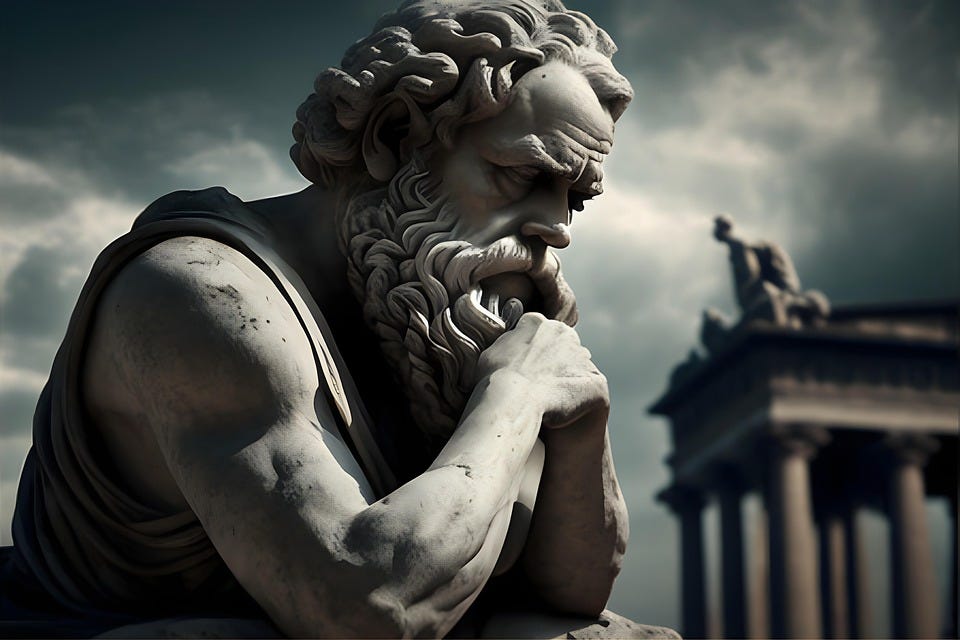
We need Socrates—not as a historical figure, but as a civic practice.
II. Socrates and the Art of Ethical Attention
Socrates never wrote a treatise. He never codified a system. His philosophy was a way of being with others—an ethic of attention, curiosity, and moral humility.
He listened with a seriousness that feels almost alien now.
He questioned with a tenderness that refused humiliation.
He believed that every person carried an interior life worth engaging.
This is not the soft compassion of sentimentality.
It is the rigorous compassion of someone who refuses to reduce another human being to a position, a tribe, or a slogan.
In a time when public discourse rewards speed, certainty, and cruelty, Socrates offers a countercultural stance:
slow attention, honest inquiry, and the courage to remain open.
III. Justice as a Form of Self-Scrutiny
Socrates’ most radical claim is that justice is not primarily a matter of laws or institutions. It is a matter of character. A just society is built from people who can examine themselves without collapsing into defensiveness or shame.
This is the civic muscle we have allowed to atrophy.
We have become fluent in accusation and nearly illiterate in self-reflection.
We know how to expose others and have forgotten how to interrogate ourselves.
Socrates reminds us that democracy depends on citizens who can say:
I might be wrong.
I might be missing something.
I might need to change.
No constitution can legislate this.
No court can enforce it.
It must be cultivated.
IV. Honesty Without Hostility, Kindness Without Cowardice
Socrates practiced honesty as a form of responsibility. He spoke truth not to dominate but to accompany. His kindness was not passive; it was a commitment to the moral growth of the other.
This is the civic temperament democracies require:
honesty that does not harden into cruelty
kindness that does not collapse into avoidance
disagreement that does not drift toward dehumanization
Pluralism is not sustained by shared opinions.
It is sustained by shared virtues.
V. The Socratic Imperative for Our Time
Western democracies do not need a new ideology. They need a renewed interior life. They need citizens capable of holding complexity without panic, of listening without retreating into tribal reflexes, of disagreeing without seeking annihilation.
Socrates teaches that democracy is not upheld by the loudest voices but by the most attentive ones.
He teaches that the moral imagination is a public resource.
He teaches that the examined life is a civic duty.
He teaches that the work of repairing a democracy begins with the work of repairing ourselves.
This is not ancient wisdom.
It is contemporary necessity.
Closing Reflection
If the democratic project is to survive its current turbulence, it will not be because we perfected our institutions or optimized our technologies. It will be because we rediscovered the slow, demanding virtues that make common life possible.
Socrates stands at the threshold of our moment, asking the same question he asked in the agora:
What kind of person must you become for your society to flourish?
It is a question worth returning to—quietly, repeatedly, and with the seriousness of someone who knows that the fate of a democracy is always, in the end, a matter of character.

Further Reading
• Plato, Apology
A vivid portrait of Socrates’ trial and his unwavering commitment to truth and integrity.
• Martha Nussbaum, The Fragility of Goodness
A modern exploration of Greek ethics and the vulnerability inherent in moral life.
• Danielle Allen, Talking to Strangers
A contemporary argument for why democratic citizenship requires trust, humility, and ethical attention.
• Josiah Ober, Democracy and Knowledge
A study of how ancient Athens used civic participation to cultivate collective intelligence.