
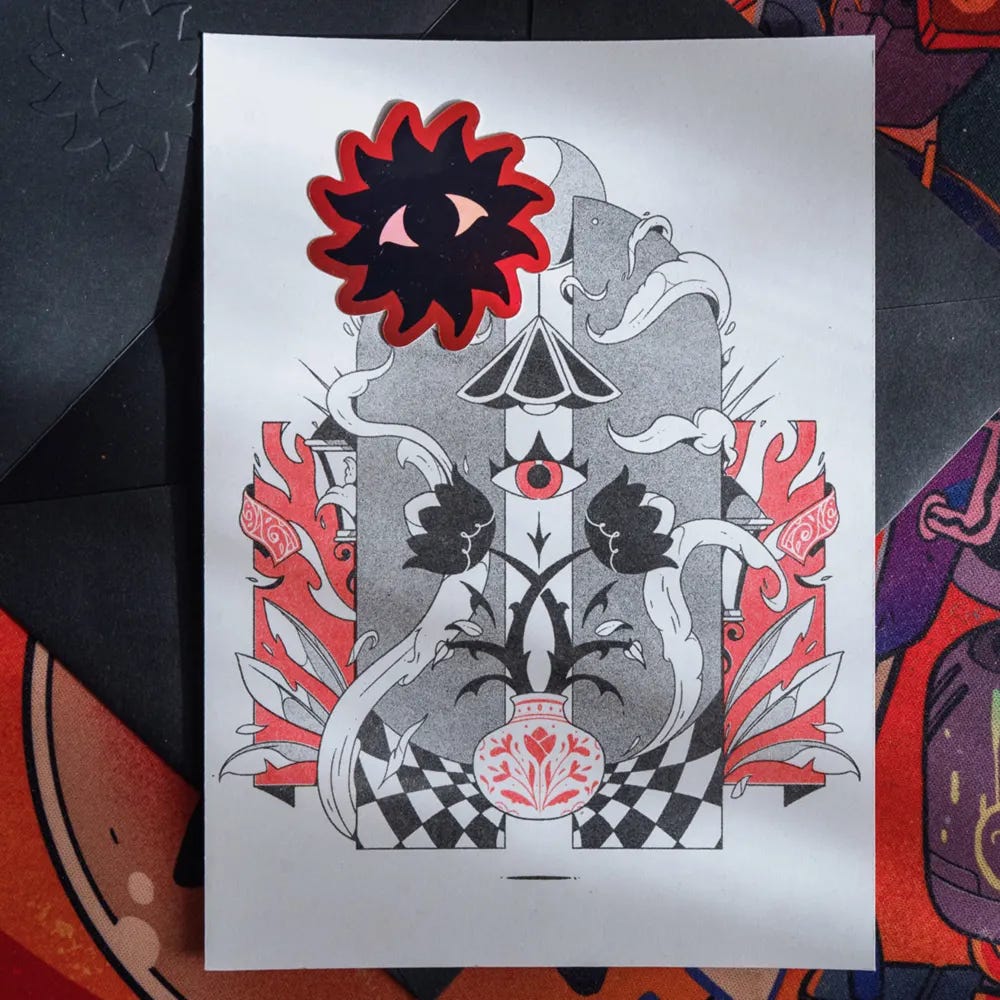
There are artists whose work feels like a portfolio, and there are artists whose work feels like a life. Cristian Pintos — illustrator, printmaker, animator, and indefatigable builder of visual worlds — belongs firmly to the latter. His Bluesky presence is not a gallery so much as a workshop with the doors flung open: ink drying, risograph drums humming, After Effects timelines blooming with color, and the artist himself moving between Spain and Uruguay with the steady rhythm of someone who treats creativity as a civic practice rather than a performance.
What makes his work so compelling is not merely talent, though there’s plenty of that. It’s the coherence of a sensibility — a design intelligence that moves fluidly between mediums without ever losing its center.
🌐 A Transnational Aesthetic with Local Roots
Cristian’s feed is a record of a life lived between places: Xàbia in Spain, Uruguay’s Carnaval stages, and the global community of artists who follow his work. That mobility shows up in the imagery — the “Viajeros” drawings, the “Inside Latinoamérica” series, the Carnaval backdrops — all of them carrying a sense of movement, of people in transit, of cultures layered rather than blended.
His line work is crisp but never cold. His compositions are dense with detail but never cluttered. He draws cities and crowds the way a musician hears harmony: each element distinct, but always in relation to the whole.
🎨 A Designer Who Thinks in Systems
One of the most striking aspects of Cristian’s practice is how naturally he moves between static and dynamic media. On Bluesky, you see:
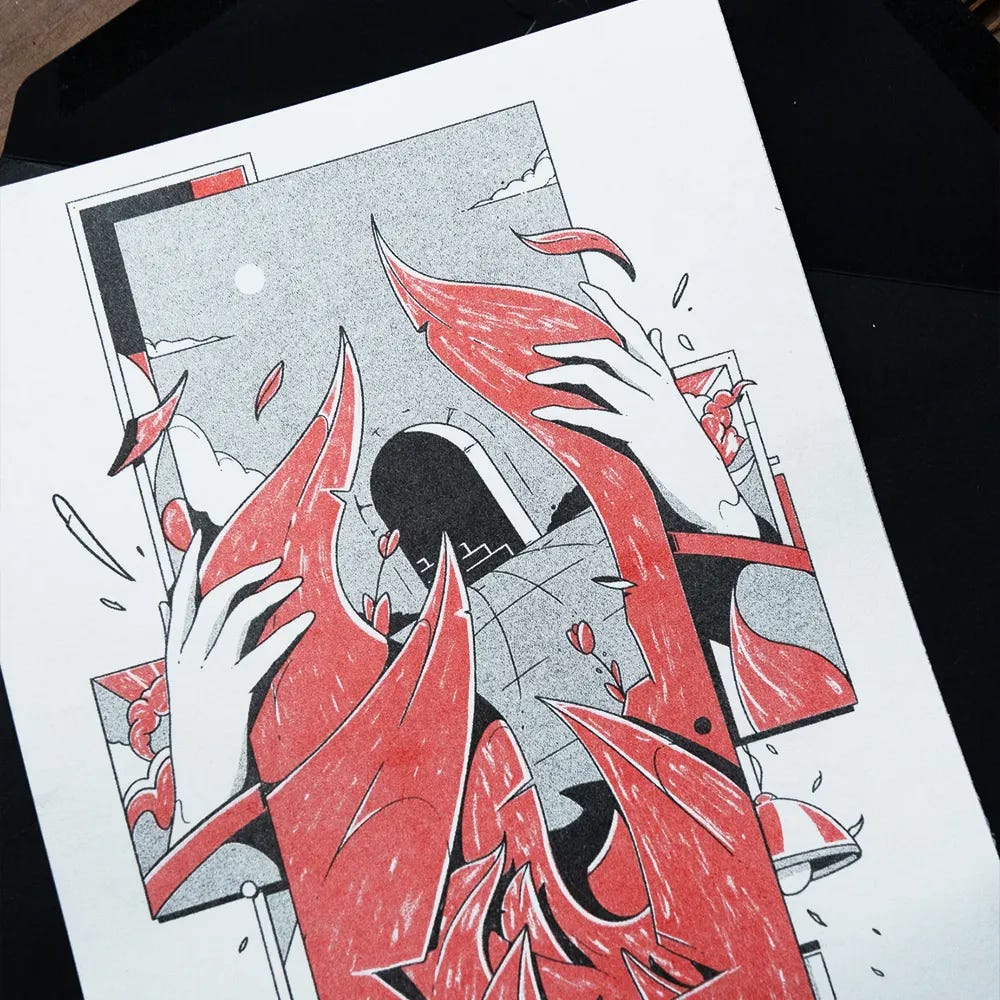
Risograph prints — two‑tint experiments, macro shots of grain and texture, limited editions shipped worldwide.
Linocuts — tactile, carved, and grounded in centuries-old craft.
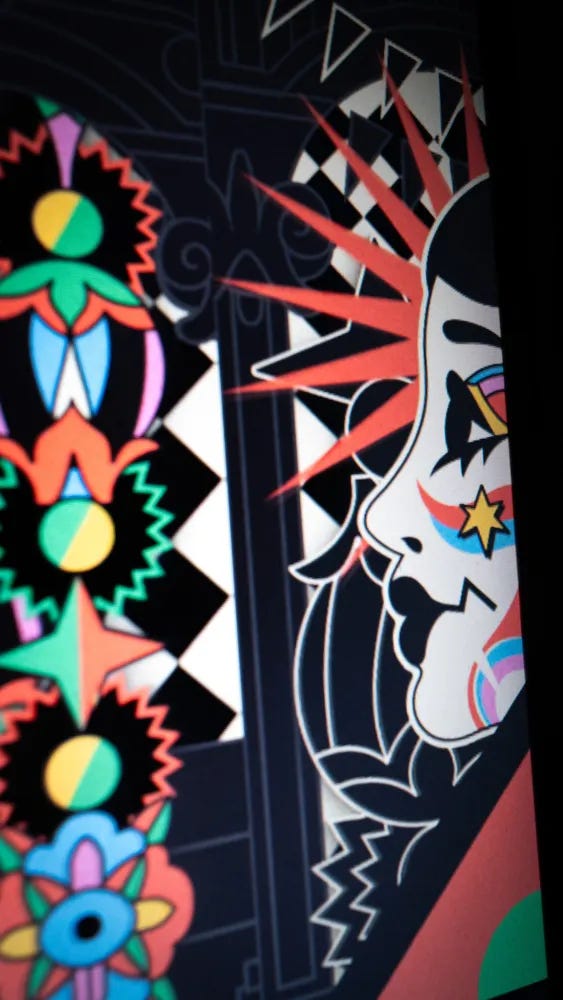
Digital backdrops for Carnaval — illustrated, animated, and performed live, a fusion of design and stagecraft.
VJ work — loops built in After Effects, tested, refined, and then run in real time during performances.
This is not a hobbyist’s eclecticism. It’s a systems thinker’s toolkit.
Cristian designs not just images but environments: prints that travel across borders, animations that fill public space, stickers that circulate like tiny ambassadors of his visual language. Even his monthly print club — with its careful packing updates, shipping notes, and behind-the-scenes glimpses — feels like an extension of the work itself: a community built through craft.
🔧 Craft as a Form of Transparency
One of the quiet pleasures of following Cristian is how generously he reveals process. He shows:
the stress of deadlines before traveling to Uruguay,
the second day of tests before a live show,
the macro textures of a risograph print,
the envelopes packed and labeled for subscribers.
This transparency isn’t confessional; it’s pedagogical. It invites the viewer into the ecology of making — the labor, the logistics, the joy, the fatigue. In a digital culture obsessed with frictionless surfaces, Cristian insists on showing the seams. It’s a small but meaningful act of resistance.
🎭 Carnaval as a Living Canvas
The Uruguay Carnaval work is perhaps the clearest expression of his talent. These aren’t mere backdrops; they’re narrative environments. Illustrated, animated, and then performed live, they transform public celebration into a multimedia collaboration between artist, performers, and audience.
There’s something beautifully civic about this: art that doesn’t sit on a wall but moves with music, bodies, and collective energy. Cristian’s role — designing, animating, and VJ‑ing in real time — positions him as both creator and participant, a kind of visual conductor shaping the mood of the night.
📦
The Print Club as a Model of Artistic Citizenship
The monthly print club is more than a subscription service. It’s a practice of continuity — a way of anchoring an international audience in the slow, steady rhythm of handmade work. Each print, whether linocut or risograph, becomes a small artifact of attention in a culture that rarely rewards slowness.
The club also reveals something essential about Cristian’s ethos: he treats his audience not as consumers but as collaborators in a shared creative economy. The prints travel from Spain to the U.S., the U.K., Germany, Canada, and beyond, forming a dispersed but connected community of people who value the tactile, the crafted, the intentional.
✨
Why His Work Matters Now
Cristian’s talent is undeniable, but talent alone doesn’t explain the resonance of his work. What sets him apart is the way he embodies a contemporary artistic ideal:
craft without nostalgia, digital fluency without disposability, community without spectacle.
In a moment when so much online art feels optimized for speed, Cristian’s practice insists on depth. He reminds us that illustration can still be a form of world‑building, that printmaking can still be a civic gesture, and that animation can still be a bridge between cultures.
He is, in short, an artist of continuity — someone who shows us that the future of design may lie not in novelty but in the patient, generous expansion of a coherent visual life.