
THE TRUEMAN–TRIOLA NEWSLETTER
A Cosmopolitan Commons for Ethical Imagination
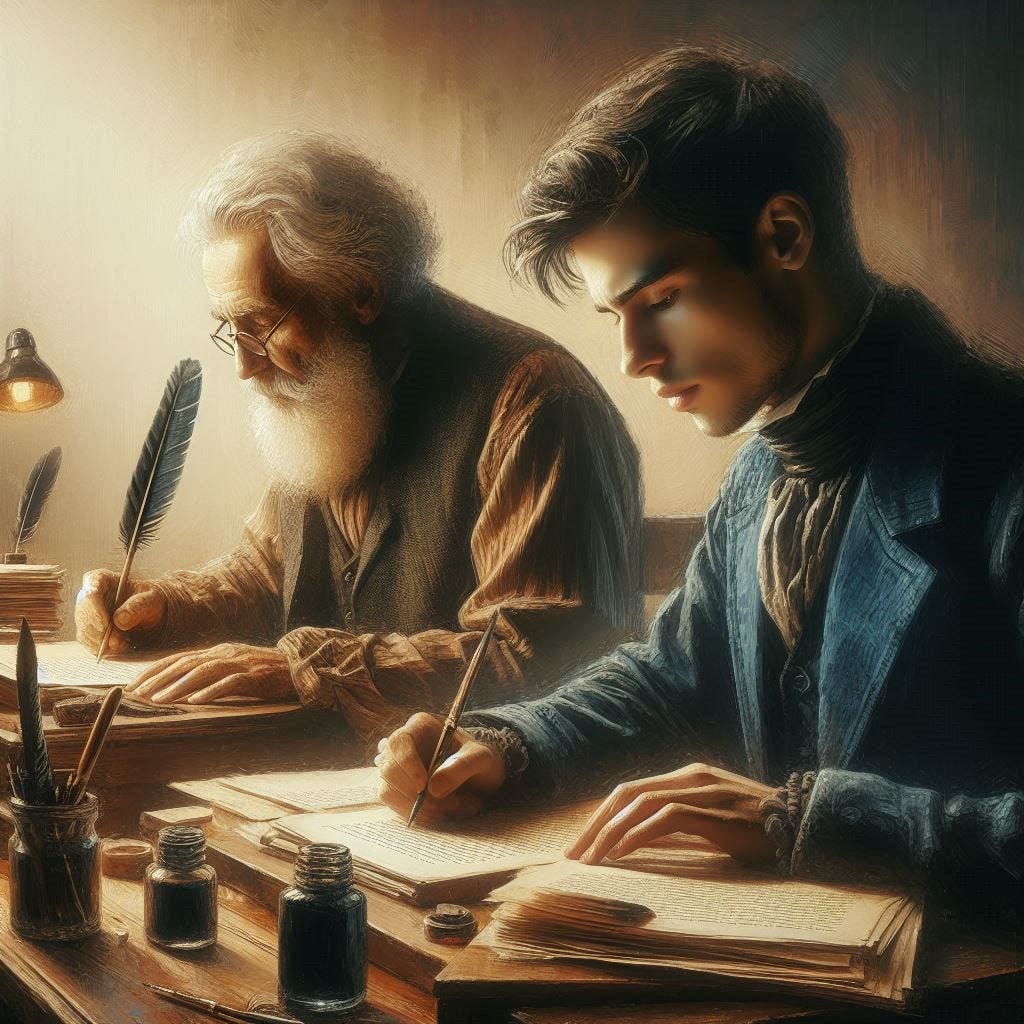
In yesterday’s reflection, Trueman and Triola turned their attention to two figures separated by generations, genres, and sensibilities, yet bound by a shared question: What does it mean to reach the end of something—of a struggle, of a story, of a self—and still keep going?
One is an old fisherman in a skiff off the coast of Cuba.
The other is a teenage writer in the Pacific Northwest.
Between them stretches a philosophical conversation about endings, endurance, and the strange geometry of human becoming.
I. Santiago’s Straight Line
Hemingway gives Santiago a world defined by linearity.
A single line cast into the sea.
A single fish.
A single battle.
A single long walk home.
His struggle is heroic precisely because it is terminal. The old man senses that his life has narrowed to a final proving ground. His “testament” is not written but enacted—etched into the salt of his hands and the ache of his spine. Meaning, for Santiago, is distilled in the act of enduring. The line he casts is the line of his life: taut, thinning, and aimed toward a single, irrevocable moment.
This is the metaphysics of the straight line:
Life moves toward an end.
The end reveals the truth of the life.
Dignity lies in how one meets that end.
It is a worldview shaped by scarcity—of time, of strength, of second chances.
II. Ryan’s Circle
Then comes Ryan, the young protagonist who closes The Kid Who Killed Cole Hart with a poem containing the quietly radical line:
“The planet is round and this road never ends.”
Where Santiago’s world contracts, Ryan’s expands.
Where the old man’s struggle funnels toward a final meaning, the young writer’s vision loops outward into possibility.
Ryan’s line is a refusal of terminal metaphysics. It suggests:
Life is cyclical, not linear.
Identity is a process, not a verdict.
Endings are simply points on a larger curve.
This is the metaphysics of the circle:
We return to places we thought we’d left behind.
We revise ourselves.
We continue.
For a young writer, this is not naïve optimism but a declaration of agency. He is not finished. He is not defined by a single moment. He is still becoming.
III. Two Testaments, Two Worlds
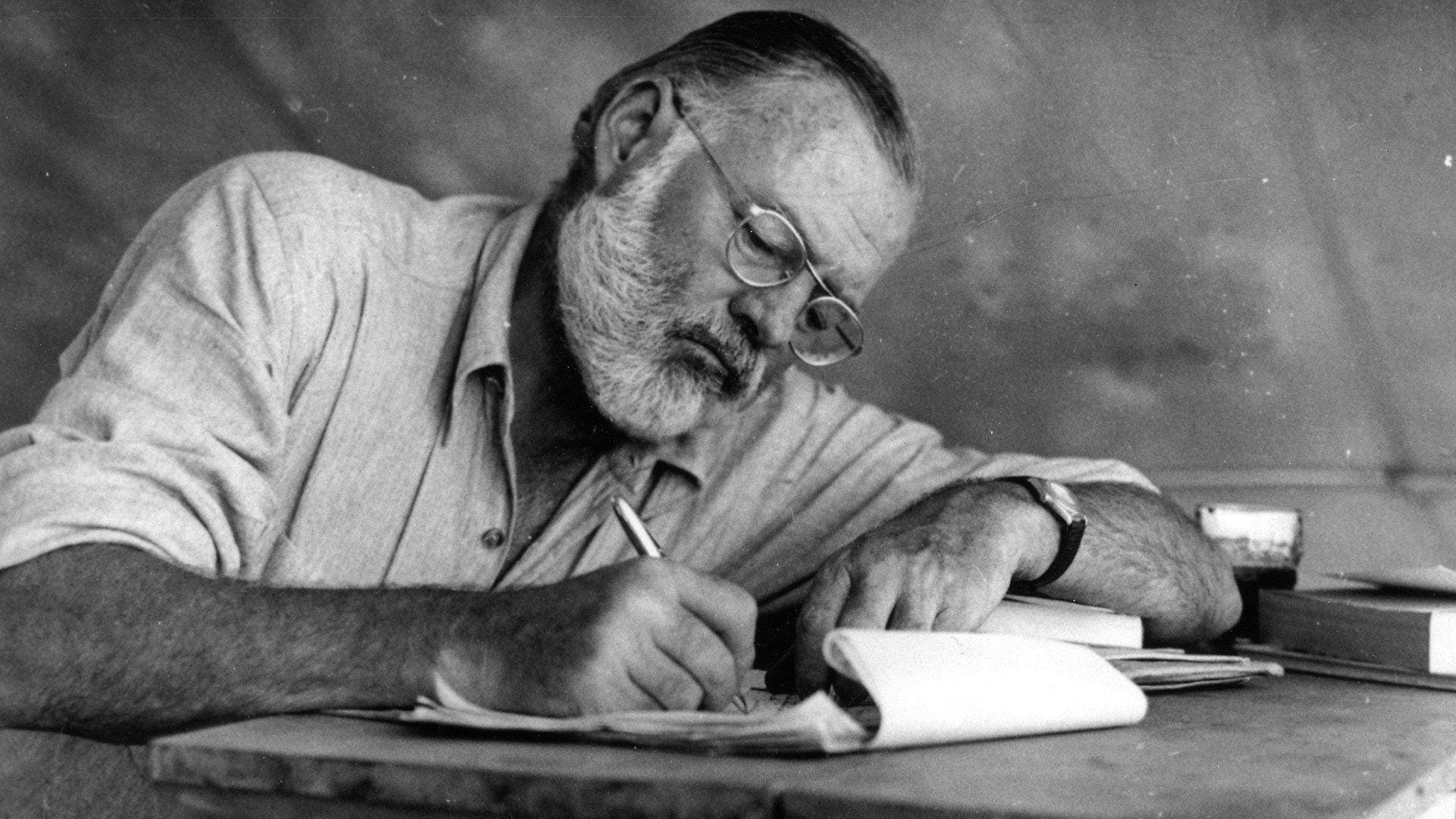
Placed side by side, the two works form a generational dialogue about what it means to write a life.
Hemingway’s Santiago: Trueman’s Ryan
A straight line: A widening circle
Final testament: Ongoing testament
Meaning through endurance: Meaning through motion
The dignity of finishing: The hope of continuing
A life narrowing: A life opening
Santiago’s struggle is a last stand: Ryan’s poem is a first step.
Yet both are acts of authorship. Both are attempts to shape meaning from the raw material of experience. Both insist that a human being—old or young—has the right to speak their truth into the world.
IV. The Shape of a Life, The Shape of a Story
What emerges from this pairing is not a contradiction but a spectrum of human possibility.
Santiago teaches us that there is honor in the final effort, in the willingness to face the inevitable with grace.
Ryan teaches us that there is freedom in refusing to let any moment—no matter how defining—be the last word.
Together, they remind us that a life is not one shape but many.
Sometimes it is a line.
Sometimes it is a circle.
Often it is both at once.
And perhaps that is the quiet wisdom Trueman and Triola want to leave with their readers:
that the stories we tell about ourselves—our last writes, our first drafts, our testaments and counter-testaments—are not monuments but movements.
The planet is round.
The road never ends.
And we are always, beautifully, still on it.