
🖤Bluesky Edition
Source: Soul-Paralyzed Art of Sergei Zolotov profile on Bluesky bsky.app
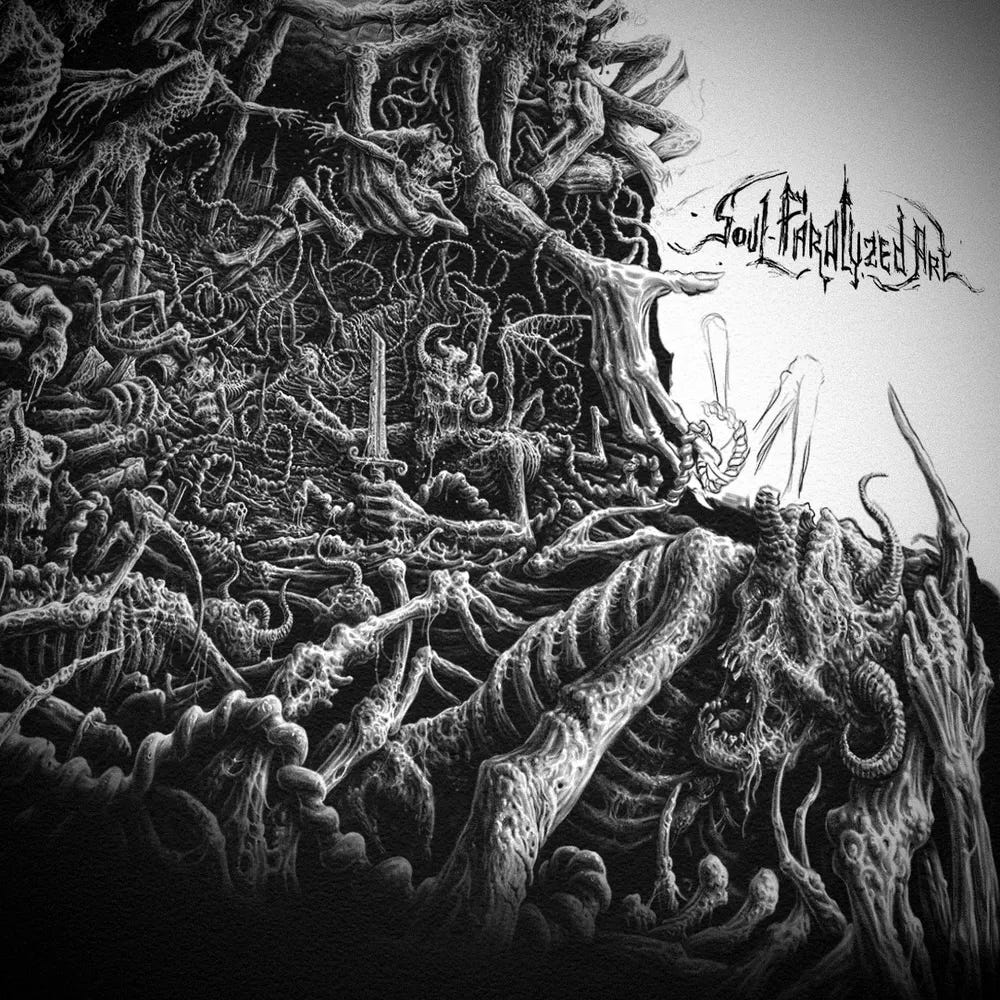
Some artists draw. Some artists render. And then there are artists like Sergei Zolotov, who seem to excavate—pulling images out of some subterranean chamber where dread, devotion, and discipline fuse into a single, trembling line of ink.
Zolotov’s Bluesky presence, under the moniker Soul-Paralyzed Art, is not a gallery so much as a chronicle of endurance. Each post feels like a dispatch from a long night: hours spent scratching at a tablet or pen nib until something tolerable, or terrible, or true emerges. He tells us openly—almost clinically—how many hours each piece consumes. 16.5 hours for an illustration you might glance at for seconds. 135 hours for a ritual of self-doubt and persistence. This is not self-pity; it’s testimony. It’s the cost of making something that stares back.
🔥 The Beauty of the Burden
Zolotov’s work is unmistakably dark—ink-drenched, bone-forward, myth-haunted. But the darkness is not gratuitous. It’s structured, almost architectural. His images feel carved rather than drawn, as if each line is a chisel mark on stone. Even his postcards—“Screams Carved as Prayers into Stone,” “She Loved the Amalgam as Her Own”—carry the weight of artifacts, relics from a civilization that worships fear with reverence.
What makes the work beautiful is not the horror itself, but the precision of it. The care. The devotion to craft. Zolotov’s darkness is never sloppy or sensational. It’s meticulous, almost tender. The monsters are rendered with the same attention one might give to a portrait of a beloved.
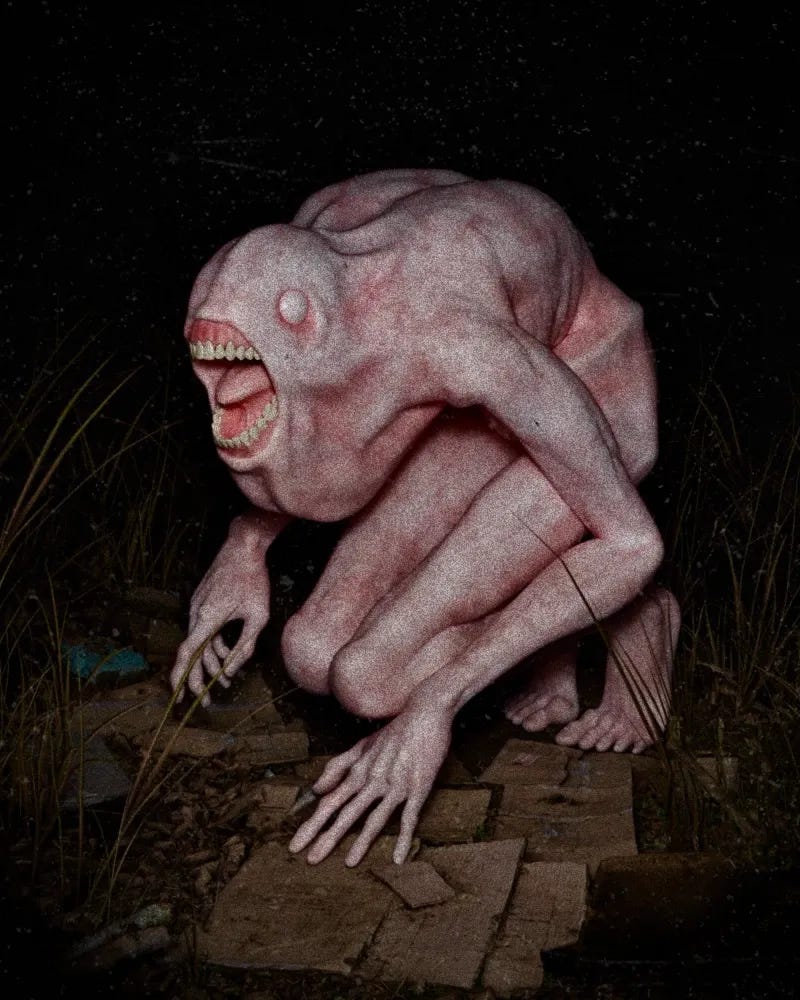
This is the paradox at the heart of his art:
The grotesque becomes sacred through labor.
Applying the Idea: Vincent Triola and the Trueman & Triola Machine
Political: In Triola’s corner of the project, “labor” isn’t just hours at a drawing table—it’s infrastructure: the unromantic web-developer work of building and maintaining the Trueman & Triola newsletter and the surrounding sites, then keeping the whole machine publishing on schedule. It’s the behind-the-scenes work of turning a critique (of religious smog, moral bullying, and public hypocrisy) into something durable: pages that load, archives that hold, feeds that syndicate, and an operation that can keep speaking even when the culture tries to dismiss it as a mere rant.
Ethical: The grotesque here is not monsters and bone-ink; it’s the human material most people prefer sanitized—fear, cruelty, self-deception, indoctrination, the quiet harms done in the name of holiness. Triola’s ethic shows up in craft decisions: taking point on the technical side while the writers take swings at belief, and insisting the work be legible, navigable, and preserved. Even the “boring” tasks—serial-format publishing, converting older books into electronic forms, building pages that make claims traceable rather than hazy—carry a moral implication: if you’re going to argue that Christianity poisons the culture, you owe the reader structure, continuity, and receipts. Labor becomes a kind of conscience—proof that the critique isn’t cheap.
Sociological: Sociologically, the “sacred” is whatever a group sets apart and protects. Christianity has its sanctuaries; Trueman & Triola builds a counter-sanctuary: a reader community gathered around skepticism, argument, satire, and the steady naming of things people are trained not to say out loud. Triola’s repeated labor is what stabilizes that community—an infrastructure and SEO plan meant to route strangers into the same shared room, a publishing cadence that teaches readers when to return, and even experiments at the edge of the project (like exploring a crypto-pay system that would keep distribution under the creators’ control). It functions like ritual: repeated actions that make a subculture coherent, and convert outrage into an ongoing practice rather than a passing spike of attention.
So when we say the grotesque becomes sacred through labor, Triola’s version is pragmatic and cultural: take what is considered impolite, “too much,” or socially radioactive; build a disciplined delivery system around it; and the thing itself changes status. Not because it gets prettier, but because it gets made—repeated, organized, refined—until it behaves like a rite instead of a reaction.
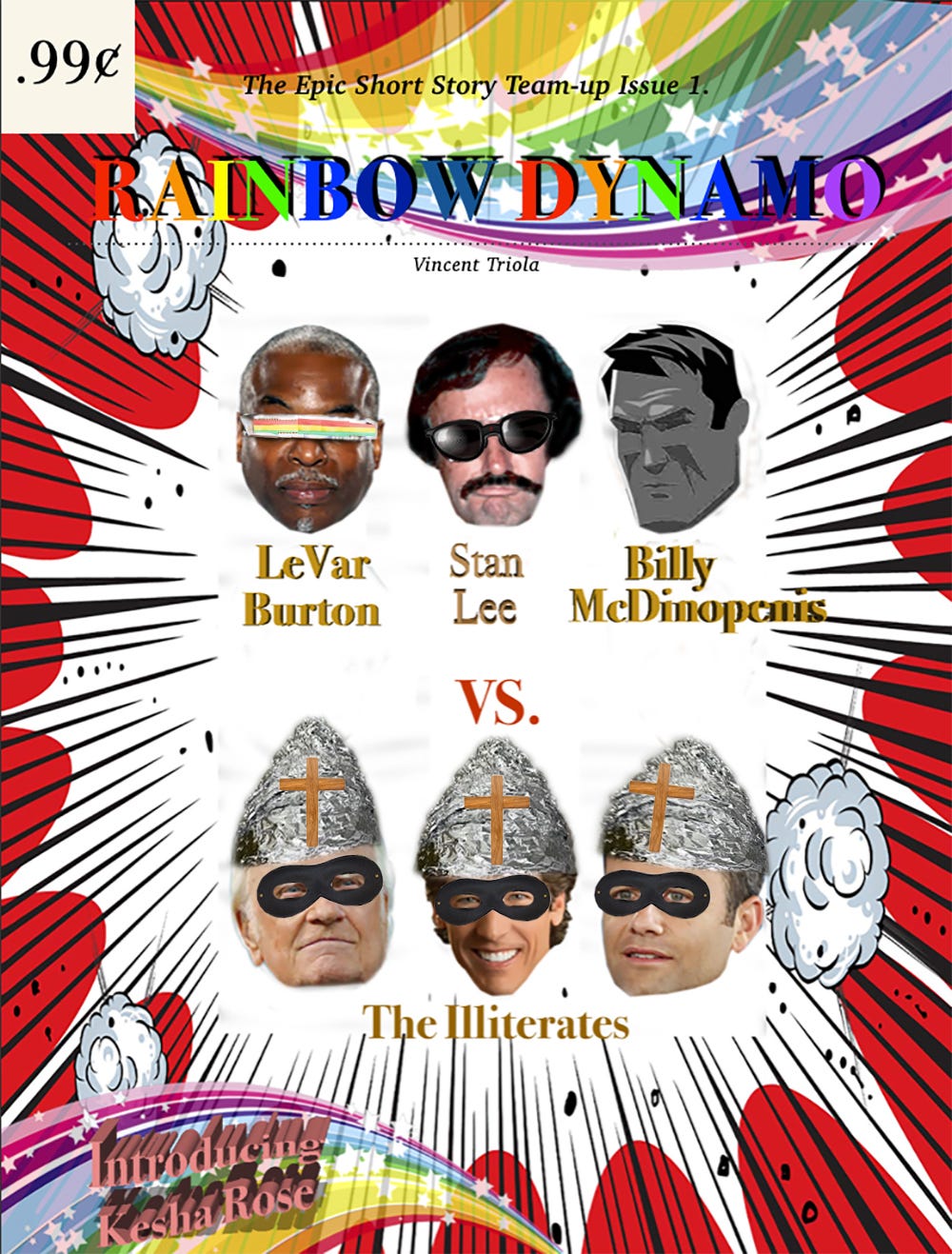
In the Archive of Trueman & Triola Newsletter:
🕯️ Concepts: Ritual, Ruin, and the Artist’s Self-Interrogation
Three conceptual threads run through Zolotov’s feed:
1. Art as Ritual
His posts read like entries in a monk’s journal—hours logged, doubts confessed, small breakthroughs noted. The repetition of Inktober prompts, the ongoing “from_the_abyss_of_the_past” series, the postcards born from “100 sketches”—all of it suggests a devotional practice.
Art is not inspiration; it’s liturgy.
2. Horror as Memory
Many pieces are tagged as resurfacing from the past—February 2024, July 2021, February 2022. The past is not a place he visits; it’s a pit he draws from. His images feel like recovered memories, or memories he wishes he could forget.
3. The Artist as Witness to His Own Undoing
Zolotov writes with startling candor about the emotional cost of creation:
spirals of self-hatred, the fever breaking, the void leaking hours.
This vulnerability is not performative. It’s diagnostic.
He is both patient and physician, documenting the symptoms of making art that demands too much.
🩸 Why This Matters
In a digital landscape saturated with speed, ease, and algorithmic gloss, Zolotov’s work stands as a counter-practice. It insists on:
slowness
difficulty
obsession
the dignity of craft
the honesty of struggle
His Bluesky page becomes a kind of sanctuary for those who understand that beauty is often born from discomfort, and that the line between creation and self-erasure is thin, trembling, and worth walking anyway.
🌑 Closing Reflection
To spend time with Soul-Paralyzed Art is to be reminded that darkness is not the opposite of beauty—it is one of its oldest languages. Zolotov speaks it fluently. His work is not merely “dark art”; it is a philosophy rendered in ink. A meditation on endurance. A record of the hours we give to the things that refuse to let us go.
And in that way, his art is not paralyzing at all.
It is, strangely, a form of liberation.