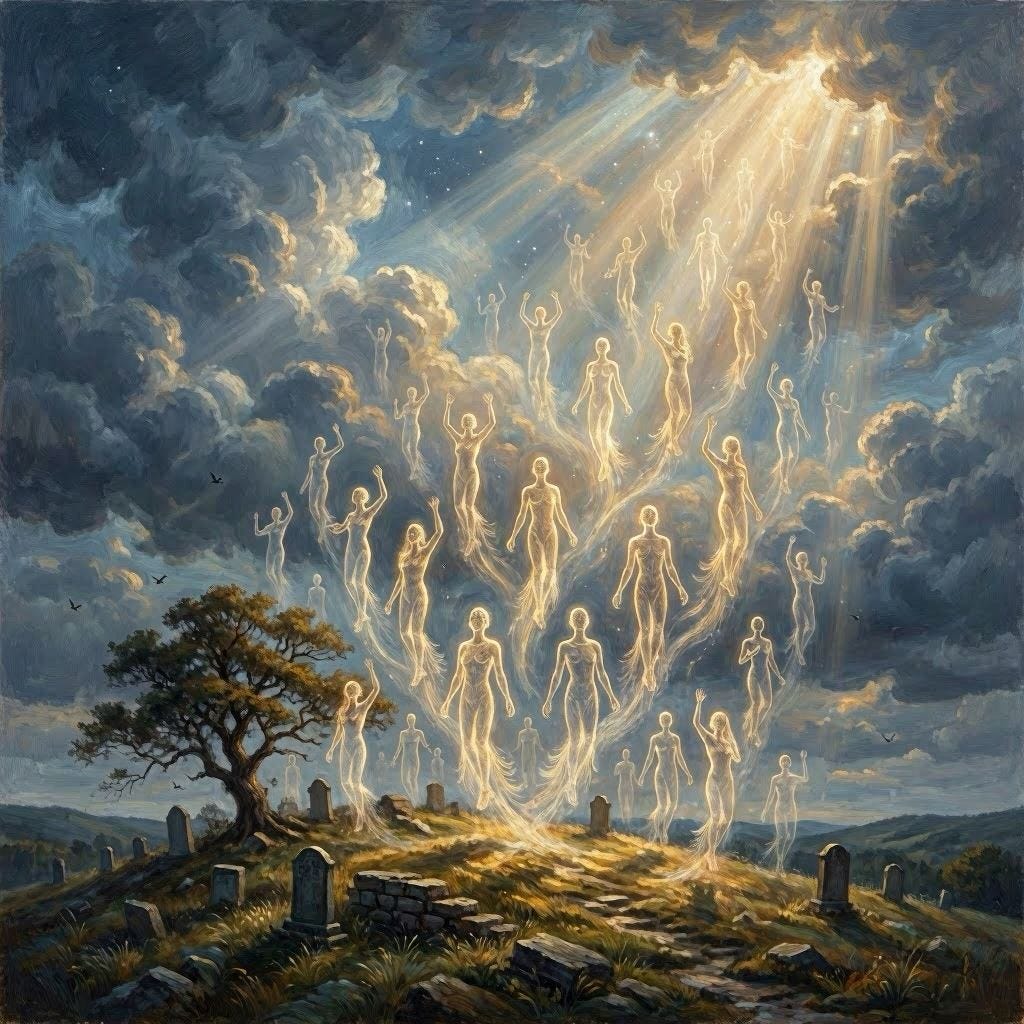
We speak of the soul as if it were a hidden organ—tucked somewhere behind the ribs, glowing faintly, waiting for its release. But the soul, as humans actually use the word, is less a metaphysical object than a cultural technology. It is our oldest attempt to solve a problem that every conscious creature eventually encounters: What becomes of me when I am no longer here to ask the question?
Long before philosophy, long before theology hardened into doctrine, people noticed that something of a person seemed to linger after death. A laugh remembered. A story retold. A gesture that lived on in the hands of a child. The dead did not vanish cleanly; they left traces—behavioral fossils embedded in the living. And because humans are meaning‑hungry animals, we needed a name for this residue. We called it a soul.
The soul, then, is not proof of an afterlife. It is proof of our awareness that others carry us forward. Reputation, memory, influence, the emotional weather we leave behind in the people who loved us or struggled with us—these are the mechanisms by which a life continues after its biological ending. The soul is the narrative container we built to hold all of that continuity. It is the story-shaped answer to the fear that our story might simply stop.
In this sense, the soul is not an illusion. It is a human creation, yes, but so are laws, symphonies, novels, and the idea of justice. Its reality comes from its function. The soul gives us a vocabulary for the ways we persist in the minds of others. It lets us imagine that our choices matter beyond the span of our days. It allows us to believe that the moral shape of a life has consequences that outlast the body that enacted it.
We invented the soul because we needed a framework for the strange fact that people continue to exist in the world even after they are gone. Not as ghosts, but as influences. Not as spirits, but as consequences. The soul is the name we give to the ongoing life of our impact—our imprint on the living, our echo in the social and emotional architecture of others.
If anything, this makes the soul more urgent, not less. It means the afterlife is not a distant realm but a present responsibility. It is being built right now, in the memories we are creating, the kindnesses we offer, the harms we avoid, the stories we leave behind. Our souls are not waiting for us elsewhere. They are accumulating in real time, in the minds and hearts of the people who will one day speak of us in the past tense.
And when they do, that remembered version of us—partial, flawed, luminous, enduring—will be the soul we made.