
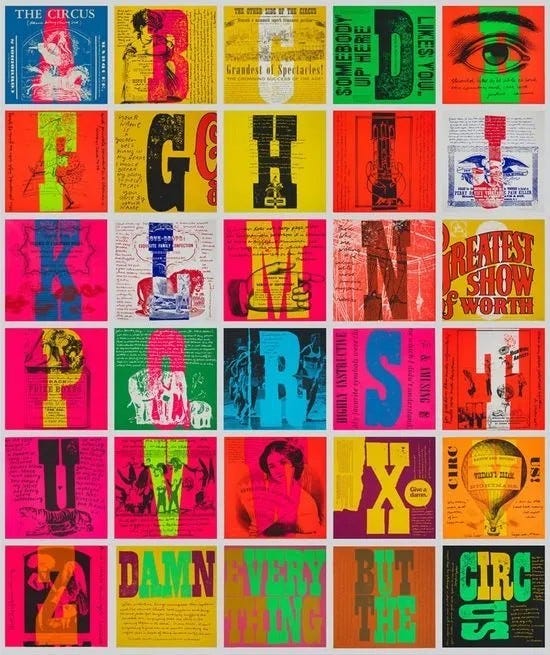
‘Alphabet’ by Corita Kent (1965), a US Roman Catholic nun, peace activist and Pop art artist who helped shape the Pop Art movement and was also friends with Andy Warhol #WomensArt
There is a particular kind of beauty that emerges when women’s art is gathered together—not as a category, not as a corrective, but as a chorus. The @womensartbluesky feed is one of those rare digital spaces where that chorus becomes audible. It is not a gallery so much as a living archive, a daily unfolding of artistic lineage: painters, printmakers, photographers, sculptors, textile artists, land artists, designers, activists. Each post is a reminder that women have always made art, everywhere, in every medium, often against the grain of the world around them.
Scrolling through the feed, what strikes me is not uniformity but astonishing variety—a garden of forms, colors, histories, and sensibilities. And the curation itself is an act of care: a steady insistence that women’s creativity is not peripheral but central to the story of art.
I. The Visionaries of Landscape and Light
Some of the artists here work in the language of landscape—yet each one sees the world differently.
Victoria Crowe’s Landscape with Hidden Moon holds the quiet tension of twilight, a moment suspended between seen and unseen.
Rebecca Vincent’s Bluebell Woodland and Niki Bowers’ linocuts translate forests into pattern and pulse, where nature becomes both refuge and revelation.
Emily Carr’s Arbutus Trees reminds us that women were shaping modernism long before the textbooks admitted it.
These works are not simply depictions of nature; they are meditations on presence. They ask us to look again, and then again, until the world reveals its deeper textures. bsky.app
II. The Innovators of Form, Craft, and Material
Other artists in the feed push materials into new territories:
Ellen Jewett’s surreal animal sculptures, where petals become antlers and bodies become dreamscapes.
Rachel Newling’s engravings, carved with a precision that feels almost botanical.
Sylvie Facon’s steampunk “book dress,” a garment that reads like a library in motion.
Vicki Foster’s embroidered night skies, where thread becomes starlight.
These works remind us that craft is not lesser than art—it is art’s beating heart. Women have always known this, even when institutions did not. bsky.app
III. The Keepers of Cultural Memory
Some artists in the feed carry forward traditions that predate modern art entirely:
The Guna/Kuna women of Panama, whose mola embroidery turns myth and daily life into vibrant geometry.
Traditional Polish folk embroidery, a language of color and symbol passed through generations of women’s hands.
Female Bauhaus students, photographed in 1927, whose contributions were long overshadowed by their male peers.
These works are not nostalgic. They are acts of cultural continuity—threads that bind past to present, women to women, art to life. bsky.app
IV. The Rebels, Activists, and Boundary‑Breakers
The feed also honors women whose art is inseparable from resistance:
Cécile Nobrega, who fought for fifteen years to erect the first public statue of a Black woman in England.
Fearless, the South Asian collective reclaiming public space for women through art and activism.
Corita Kent, the nun‑turned‑Pop‑artist whose alphabet of justice shaped a generation.
Amy Sherald, whose portraits insist on the dignity and complexity of Black life.
These artists remind us that art is not only beauty—it is agency, defiance, and the refusal to disappear. bsky.app
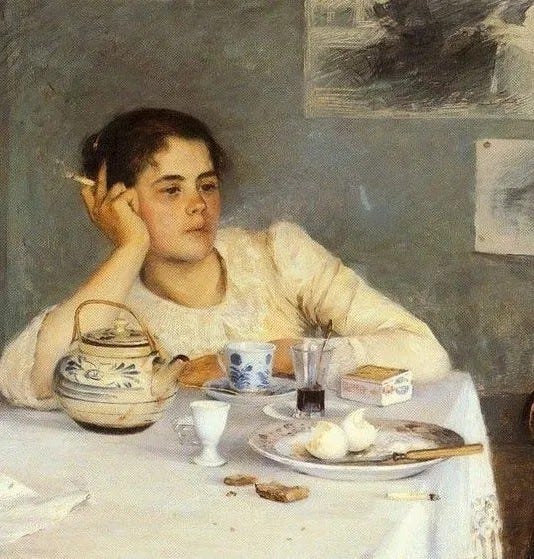
After breakfast, c.1900 by Finnish painter Elin Danielson-Gambogi #womensart
V. The Storytellers of the Everyday
And then there are the quieter works, the ones that linger:
Elin Danielson‑Gambogi’s After Breakfast, a domestic moment rendered with radical seriousness.
Sandra Jordan’s photographs of overlooked buildings—hidden beauty in plain sight.
Helen Zughaib’s East‑meets‑West imagery, bridging cultures through color and pattern.
Tove Jansson’s Alice in Wonderland illustrations, whimsical yet psychologically precise.
These pieces remind us that the everyday is not small. It is the stage on which most of life unfolds. bsky.app
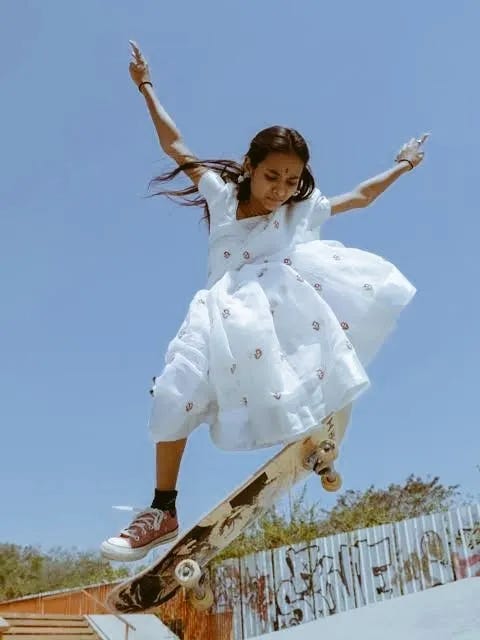
Photographer Chantal Pinzi's photogragraphic series of women skateboarders around the world, including in India #WomensArt
What This Archive Really Shows
Taken together, the women of @womensartbluesky form a kind of counter‑canon—one that refuses the old hierarchies of “major” and “minor,” “fine art” and “craft,” “center” and “margin.” What emerges instead is a more honest map of human creativity.
A map where:
beauty is not a luxury but a practice,
attention is a form of respect,
and women’s art is not a footnote but a foundation.
In a digital world that often rewards noise, this feed rewards looking. It rewards care. It rewards the belief that art made by women—across centuries, continents, and mediums—is not a category but a cosmos.
And the cosmos is still expanding.