
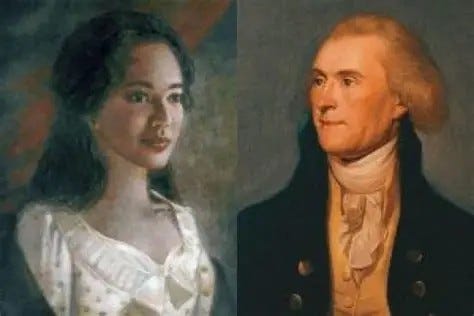
Sally Hemings and her rapist, Thomas Jefferson
If we evaluate Thomas Jefferson not by his eloquence or his architectural flair but by the net moral consequences of his life—his choices, their effects on human beings, and the ethical contradictions he refused to resolve—then the negative outweighs the positive. His slaveholding, his exploitation of enslaved people (including Sally Hemings), and his obsessive devotion to Monticello as a personal monument all function as moral gravity pulling down whatever philosophical light he generated.
1. The central contradiction: Jefferson’s ideals vs. Jefferson’s life
Jefferson authored the line that has shaped democratic imagination for 250 years: “all men are created equal.”
But he spent his life actively violating that principle.
This isn’t a case of a man failing to live up to his ideals. It’s a case of a man using ideals rhetorically while building his wealth, comfort, and legacy on the forced labor of hundreds of enslaved people. He knew slavery was wrong—he said so repeatedly—yet he chose personal benefit over moral action every time.
That gap between belief and behavior is not neutral. It is a form of harm.
Jefferson’s defenders often say “he was a man of his time.” But many people of his time recognized slavery as evil
2. Slave ownership as a lifelong moral deficit
Jefferson enslaved more than 600 people across his life.
He freed almost none of them.
The ethical weight here is not abstract. It includes:
The daily violence of enslavement—forced labor, family separation, corporal punishment, surveillance, and deprivation.
The sexual exploitation of Sally Hemings, who was enslaved, a teenager, and unable to consent in any meaningful sense.
The generational harm inflicted on the Hemings family and others, whose descendants still live with the legacy of bondage.
Jefferson’s defenders often say “he was a man of his time.” But many people of his time—Quakers, abolitionists, enslaved people themselves—recognized slavery as evil and acted accordingly. Jefferson chose not to.
Ethically, that choice is decisive.
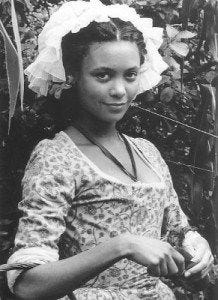
Sally Hemings—Produced six children fathered by her owner and rapist, Thomas Jefferson
3. Monticello as a symbol of misdirected moral attention
Jefferson poured enormous energy, money, and emotional investment into Monticello.
He redesigned it endlessly. He obsessed over its details. He treated it as a kind of secular temple to his own intellect.
But Monticello was not built by Jefferson’s genius alone. It was built by enslaved craftsmen, enslaved carpenters, enslaved gardeners, enslaved cooks, enslaved children carrying water and firewood. The beauty of Monticello is inseparable from the suffering that made it possible.
Jefferson’s devotion to Monticello becomes ethically troubling because:
It required the ongoing exploitation of human beings.
It diverted his attention from the moral crisis he knew slavery represented.
It became a monument to self-regard rather than civic responsibility.
Monticello is not just a house. It is a physical record of Jefferson’s moral priorities.
4. The political legacy: brilliance compromised by hypocrisy
Jefferson’s contributions to political philosophy are real.
But the credibility of those contributions is undermined by the fact that he refused to apply them to the people he enslaved.
His hypocrisy had consequences:
It gave intellectual cover to later generations of slaveholders.
It weakened the moral authority of the early republic.
It embedded racial hierarchy into the DNA of American political life.
The harm was not merely personal. It was structural.
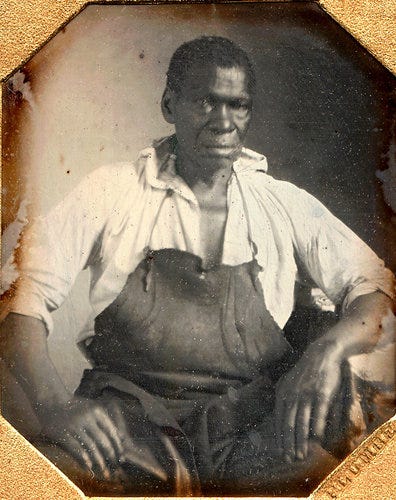
Isaac Jefferson (1775-1846) —fathered and owned, by Thomas Jefferson
5. The net value calculation
To evaluate Jefferson’s “net value,” we must weigh:
Positive contributions
The Declaration of Independence
Advocacy for religious liberty
Support for public education
Certain expansions of democratic imagination
Negative contributions
Lifelong slaveholding
Sexual exploitation
Failure to free enslaved people even when financially possible
Rationalizations of racial inequality
The generational trauma inflicted on hundreds of human beings
The symbolic and material legacy of Monticello as a plantation
The political hypocrisy that weakened the moral foundation of American democracy
When the ledger is honestly tallied, the negative is not a footnote.
It is the dominant entry.
Jefferson’s ideas inspired freedom.
Jefferson’s actions perpetuated bondage.
The contradiction is not symmetrical.
The harm was real, daily, and borne by people who had no choice.
The good was rhetorical, aspirational, and often unrealized.
Thus the net moral value of Jefferson’s life—when measured by the human consequences of his choices—leans negative.