
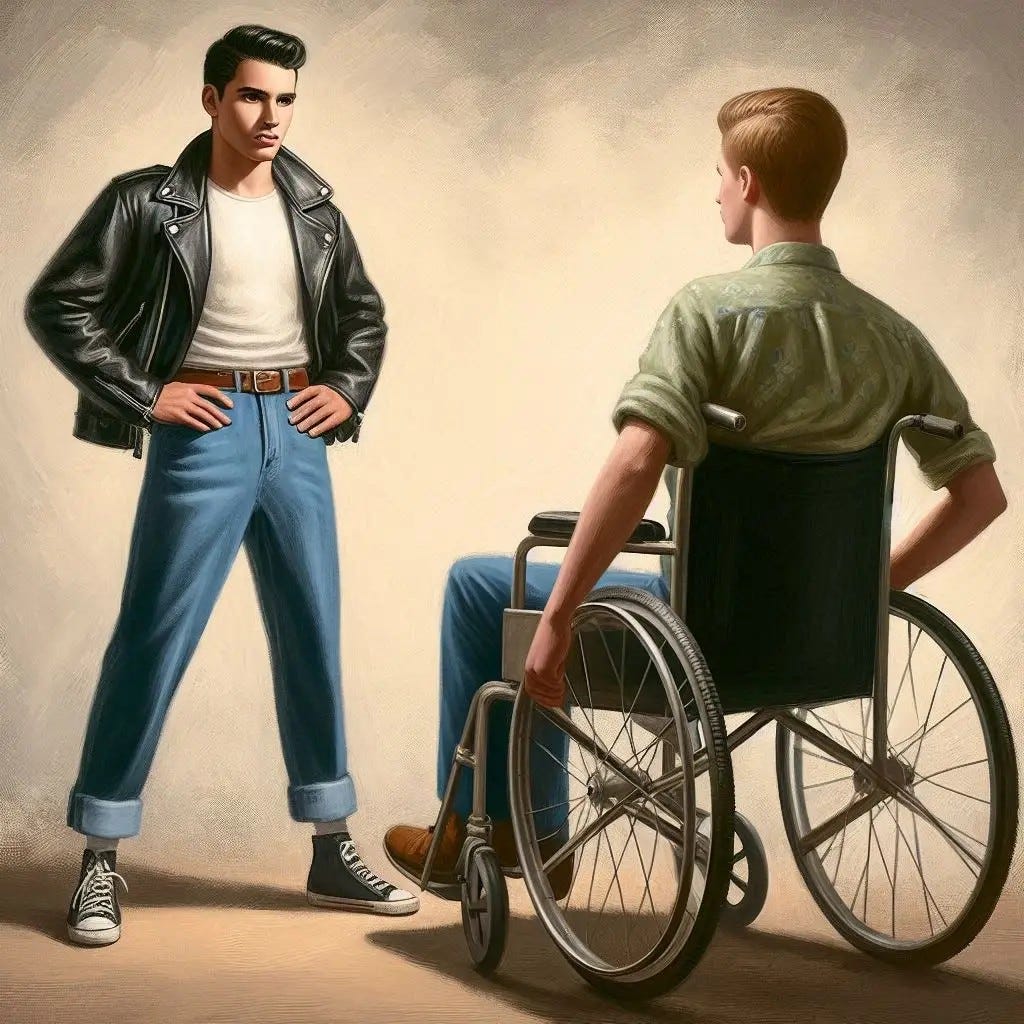
American culture in the Trump/MAGA era has been marked by a powerful nostalgia for a mythic past—an imagined time when innocence was intact, hierarchies were stable, and “real Americans” were culturally centered. Scholars such as Sarah Churchwell describe this as a “restorative nostalgia,” a longing for a past that never existed but is politically useful because it simplifies and purifies national identity (Churchwell 2018). When we place J.D. Salinger’s The Catcher in the Rye (1951) beside Terry Trueman’s Stuck in Neutral (2000), we see two radically different visions of adolescence that illuminate this cultural divide.
Both novels center on young protagonists who resist the worlds around them. But the nature of their resistance—and the cultural anxieties they expose—could not be more different.
🌪️ Holden Caulfield and the Myth of the Authentic American Boy
Holden Caulfield has long been read as the archetype of adolescent alienation. Yet in the context of Trump-era cultural politics, Holden’s rebellion looks less like radical critique and more like a lament for a world built for boys like him. As literary critic Louis Menand notes, Holden’s voice is “a protest against conformity from within the very center of postwar American privilege” (Menand 2001).
Holden’s longing for a lost, “un-phony” America mirrors the MAGA movement’s rhetoric of cultural decline. His crisis is existential, not structural. He can wander New York freely, insult adults, and imagine himself as the heroic “catcher” who saves children from corruption. His vulnerability is real, but it is also culturally protected.
In this sense, Holden embodies what sociologist Arlie Russell Hochschild calls “deep stories”—narratives in which certain Americans feel they have been unfairly displaced from the center of national life (Hochschild 2016). Holden’s story resonates with those who believe America was better before it became more diverse, more self-critical, and more accountable.
Holden’s America is disappointing, but still fundamentally designed for him.
🔥 Shawn McDaniel and the Ethics of Being Seen
Stuck in Neutral offers a radically different vision of adolescence—one that MAGA culture often refuses to acknowledge. Shawn McDaniel is brilliant, observant, emotionally alive, and unable to communicate. His father, convinced that Shawn’s life is unbearable, contemplates killing him out of misguided mercy.
Where Holden narrates his disillusionment, Shawn must endure the world’s projections. His crisis is not existential but ethical: Will the people who claim to love him recognize his humanity?
Disability scholars such as Rosemarie Garland‑Thomson argue that disabled lives are often framed through “misfit narratives,” where society’s limited imagination becomes the real source of suffering (Garland‑Thomson 2011). Shawn’s interior monologue—rich, articulate, fully human—directly contradicts the cultural scripts that define him as tragic or burdensome.
In a political climate where disabled people, immigrants, queer youth, and other marginalized groups are often spoken about rather than with, Shawn’s predicament becomes a mirror. MAGA rhetoric frequently frames vulnerability as weakness and difference as threat. Shawn’s story demands a moral imagination that refuses such simplifications.
If Holden embodies the fear of growing up, Shawn embodies the fear of not being allowed to grow at all.
🧭 Two Adolescences, Two Americas
Theme
Catcher in the Rye
Stuck in Neutral
Cultural Position
Catcher in the Rye: Center of the American mythos; white male adolescence as universal
Stuck in Neutral: Marginalized adolescence; disability as a site of ethical responsibility
Crisis
Catcher in the Rye: Disillusionment with adult hypocrisy
Stuck in Neutral: Survival in the face of misinterpreted suffering
Agency
Catcher in the Rye: Overabundant; Holden rejects the world
Stuck in Neutral: Nearly absent; Shawn depends on others’ moral imagination
Relevance to Trump/MAGA
Catcher in the Rye: Resonates with nostalgia for a simpler, “purer” America
Stuck in Neutral: Challenges narratives that erase or devalue vulnerable lives
Moral Question
Catcher in the Rye: “Why is the world so phony?”
Stuck in Neutral: “Will the world recognize my humanity?”
🌉 What These Books Reveal About Us Now
Placed in dialogue, the novels expose a cultural fault line intensified in the Trump/MAGA era:
Holden’s story reflects an America anxious about losing its centrality and innocence.
Shawn’s story reflects an America fighting to be seen, heard, and valued despite systems that prefer simplicity over complexity.
One novel mourns a world slipping away; the other demands a world not yet built.
In the Trueman–Triola Newsletter’s ongoing project—mapping the ethical imagination of American literature—this pairing reminds us that the stories we elevate shape the citizens we become. Holden asks us to sympathize with the disillusioned. Shawn asks us to expand our moral universe.
Only one of these tasks feels adequate to the America we inhabit now.
Works Cited
Churchwell, Sarah. Behold, America: The Entangled History of “America First” and “The American Dream.” Bloomsbury, 2018.
Garland‑Thomson, Rosemarie. Misfits: A Feminist Materialist Disability Concept. Hypatia, vol. 26, no. 3, 2011.
Hochschild, Arlie Russell. Strangers in Their Own Land: Anger and Mourning on the American Right. The New Press, 2016.
Menand, Louis. “Holden at Fifty.” The New Yorker, Oct. 1, 2001.
Salinger, J.D. The Catcher in the Rye. Little, Brown, 1951.
Trueman, Terry. Stuck in Neutral. HarperCollins, 2000.