
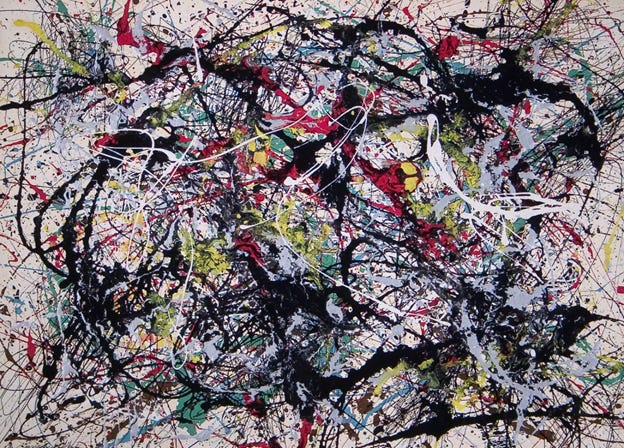
Jackson Pollock had a way of saying things that sounded mysterious, even arrogant, until you looked closely at what he was actually getting at. One of his most famous lines—“I am nature”—is a perfect example. It’s been quoted endlessly, usually as proof that he had a giant ego. But the truth is almost the opposite. Pollock wasn’t claiming to be a god of the natural world. He was trying to explain how he understood art, the self, and the act of creation.
To make sense of the phrase, you have to imagine Pollock in the middle of painting: moving around the canvas, dripping and flinging paint, letting his whole body become part of the process. For him, painting wasn’t about making a picture of something. It was about participating in the same forces that shape everything around us.
He Didn’t See Himself as Separate From the World
Most traditional art starts with a distance: the artist stands here, the world is over there, and the artwork is a representation of what the artist sees. Pollock rejected that whole setup. He didn’t want to stand outside nature and look at it. He wanted to act from inside it.
When he said “I am nature,” he meant that he wasn’t an observer of the world—he was part of the same energy and motion that makes the world what it is. His paintings weren’t meant to show nature. They were meant to behave like it.
His Technique Was Built on Natural Forces
Pollock’s drip paintings look wild, but they’re shaped by very real physical laws: gravity, momentum, the thickness of the paint, the speed of his arm, the rhythm of his steps. These are the same forces that shape rivers, storms, and roots spreading underground.
So when Pollock said he was nature, he wasn’t being poetic. He was being literal. The same forces that move through the natural world were moving through him as he painted. He wasn’t trying to control the paint so much as cooperate with it.
He Trusted Instinct More Than Thought
Pollock didn’t want to paint from the polite, civilized part of himself—the part that worries about composition, symbolism, or what critics will think. He wanted to paint from the raw, instinctive part of himself. To him, that instinctive core was nature. It was the part of a person that acts before it explains, feels before it interprets.
In that sense, “I am nature” means “My truest self is the part that isn’t filtered or tamed.”
He Wanted His Paintings to Be Events, Not Illustrations
Pollock wasn’t interested in painting trees, mountains, or sunsets. He wasn’t trying to imitate nature. He wanted his paintings to function like natural events—full of motion, tension, and unpredictability.
A Pollock canvas doesn’t show you a storm. It is a storm, in the sense that it’s created through the same kind of dynamic forces.
He Saw the Artist as a Conduit, Not a Performer
People often imagine Pollock as a swaggering, macho figure throwing paint around. But his own descriptions of his process sound more like surrender than domination. He talked about getting “in” the painting, letting the work take over, and losing the sense of himself as a separate person.
“I am nature” wasn’t a boast. It was a way of saying that when he painted, he wasn’t expressing his personality—he was letting something larger move through him.
The Heart of the Idea
Pollock’s statement boils down to a simple but radical belief: art isn’t a picture of life. Art is life, happening in real time. The artist isn’t outside the world, commenting on it. The artist is inside the world, participating in it.
When Pollock said “I am nature,” he was describing a way of being—one where the boundaries between self, action, and environment dissolve. Painting becomes a natural event, and the painter becomes one of the forces that make it happen.