
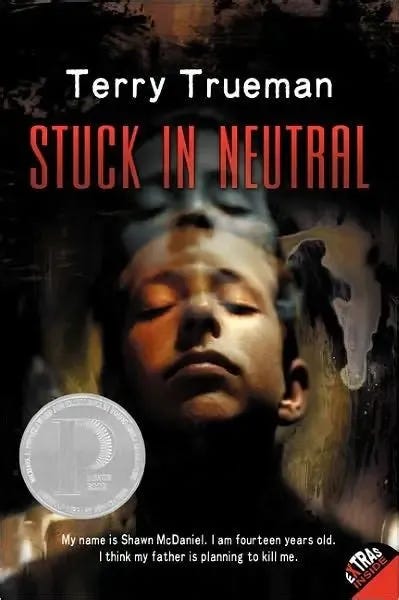
The short answer:
Many readers call Stuck in Neutral one of the best books of the century because it does something almost no other American novel—YA or otherwise—has dared to do: it builds an entire moral universe around a boy whom the world believes has no interior life, and then proves that assumption catastrophically wrong. It is formally radical, ethically destabilizing, emotionally exact, and culturally durable in a way that sneaks up on people.
Why this slim YA novel has earned that kind of reverence.
1. It performs a narrative miracle: total interiority without external agency
Most novels rely on a protagonist who does things. Shawn McDaniel cannot move, speak, or control his body. By every conventional standard of narrative craft, this should be impossible material for a gripping novel.
And yet Stuck in Neutral is gripping.
The book’s achievement is that it redefines what narrative action is. The “plot” is Shawn’s consciousness—his humor, fear, intelligence, erotic awakening, and philosophical clarity. The tension comes from the gap between what he knows and what the world thinks he is.
That gap becomes the novel’s engine.
That engine becomes its ethical argument.
Very few novels—YA or adult—have ever pulled this off.
2. It forces readers into an uncomfortable but necessary ethical position
The book’s central question—What do we owe a mind we cannot access?—is one of the defining moral questions of the 21st century. It touches:
disability rights
medical ethics
parental fear
autonomy
the limits of empathy
the politics of “quality of life”
And it does this without preaching, without sentimentality, and without giving the reader a safe place to stand. The ending, especially, refuses the comfort of certainty. It demands that the reader sit with ambiguity, which is the only honest position when confronting another person’s interiority.
In a century defined by polarization, absolutism, and moral shortcuts, Stuck in Neutral insists on uncertainty as compassion.
That is rare. That is radical.
3. It changed how millions of young Americans imagine disability
This is the quiet part of its greatness.
Because the book became a classroom staple, it shaped the ethical imagination of an entire generation. Students who read it at 12 or 14 often say it was the first time they understood:
that a person who cannot speak may still have a full, rich mind
that assumptions about intelligence are often projections of our own fear
that empathy requires humility, not certainty
This is not the splashy cultural impact of a blockbuster. It is the slow, deep work of reshaping how people see other human beings.
That is cultural bloodstream work.
4. It is formally minimalist but emotionally maximal
The prose is clean, direct, and deceptively simple. But the emotional stakes are enormous. The book achieves what the best YA novels do: it speaks to young readers without condescending to them, and it speaks to adults without flattering them.
It is a novel that trusts its readers.
And readers feel that trust.
5. It has aged into its moment
When Stuck in Neutral was published, the culture wasn’t yet ready to talk about:
neurodiversity
nonverbal communication
medical paternalism
the ethics of care
the politics of “mercy”
Now these are central 21st‑century conversations.
The book reads today like it was written for this era—an era in which we are finally confronting the limits of our empathy and the dangers of our certainty.
6. It is one of the few YA novels that is both accessible and philosophically profound
Most YA novels that become “classics” do so because they are emotionally resonant. Stuck in Neutral is emotionally resonant and philosophically rigorous. It is a novel that can be taught in a seventh‑grade classroom and in a graduate seminar on ethics.
That duality is extremely rare.
7. It is unforgettable
Readers remember where they were when they finished it. They remember the ending. They remember Shawn’s voice. They remember the feeling of having their assumptions quietly dismantled.
A century’s “best” book is not always the biggest, longest, or most ambitious. Sometimes it is the one that changes how people see other people.
Stuck in Neutral does that.