
Karl Marx cleaned-up for today’s world
Short answer, B/c:
Marxist theory argues that when a tiny percentage of people control most capital, the problem is not just inequality—it is a structural distortion of how society works. It concentrates power, shapes the entire economy around the interests of a few, and undermines the freedom and well‑being of the many. The ownership of capital in the hands of the few naturally tends to concentrate and centralize over time, producing exactly these dangers. Research Outreach Marxists Internet Archive
Why Marx saw extreme capital concentration as a massive problem
1. It creates an antagonistic class structure
Marx’s starting point is that capital accumulation depends on extracting surplus value from workers—value they create but do not receive. As capital concentrates, this antagonism intensifies: a small class commands the means of production, while the majority must sell their labor to survive. Research Outreach
This isn’t just unfair; it creates a society organized around domination rather than mutual flourishing.
2. Concentration becomes self‑reinforcing
Marx and later theorists like Bukharin show that capital doesn’t just accumulate—it centralizes. Big firms absorb small ones, and wealth “aggregates into great masses in one hand because, elsewhere, it is taken out of many hands.” Marxists Internet Archive
This means inequality is not an accident or a policy mistake—it is a built‑in feature of capitalism’s competitive logic.
3. Democracy becomes hollow
When a tiny elite controls the economic base, they inevitably shape the political superstructure.
Concentrated capital influences:
legislation
media
public discourse
regulatory agencies
elections
The result is a democracy in form but oligarchy in substance.
4. Economic instability increases
Highly concentrated capital tends to produce:
monopolies and oligopolies
speculative bubbles
crises of overproduction
mass unemployment during downturns
Marx argued that these crises are not anomalies—they are the system correcting for its own imbalances.
5. Human freedom is constrained
Marx’s deeper philosophical point is that freedom requires real control over the conditions of life.
When capital is concentrated:
workers have little autonomy
communities have little say in development
people’s life chances depend on decisions made by distant owners
This is the opposite of Marx’s idea that freedom is “the consciousness of necessity”—the ability to understand and shape the forces that govern our lives.
6. Social wealth becomes private power
As the Research Outreach article notes, capital is not just money—it is command over labor and the means of production. Research Outreach
When that command is held by a tiny group, society’s productive capacities serve their interests first, not the common good.
7. It undermines social cohesion
Extreme concentration of wealth produces:
resentment
alienation
loss of trust
political polarization
a sense that the system is rigged
Marx saw this as a predictable outcome of a system that treats people as inputs rather than ends in themselves.
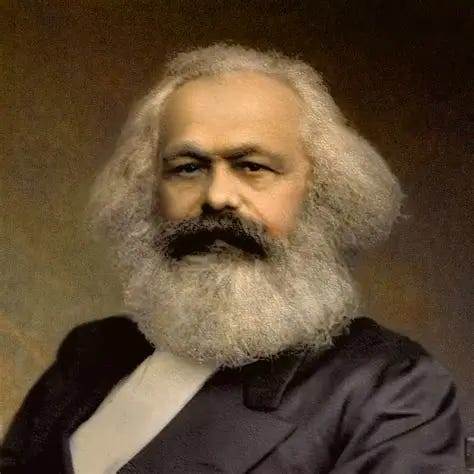
Portrait of Karl during his following the “Grateful Dead” Period
The core Marxist insight
Capital concentration is not just an economic issue—it is a moral, political, and existential one.
THE NEW LORDS OF NECESSITY
Capital, AI, and the American Future
A Trueman–Triola Newsletter Essay
Epigraph
“The free development of each is the condition for the free development of all.” — Karl Marx, 1848
I. The Old Problem in Its New Clothes
Every generation believes its crises are unprecedented. And yet, when we look closely, the patterns feel familiar. A tiny fraction of Americans now controls a share of national wealth that would have startled even the Gilded Age barons. The top 0.1% owns more than the bottom 80%. Three individuals possess as much wealth as half the country. These are not just statistics; they are the architecture of our civic life.
Marx, writing in the 19th century, argued that capital has a gravitational pull — it gathers, concentrates, centralizes. What he could not have foreseen is the speed and scale with which digital capitalism would accelerate that process. Today, capital doesn’t just accumulate; it compounds through algorithms, data monopolies, and global platforms that operate at a velocity no human institution can match.
And so we find ourselves in a familiar story told at an unfamiliar scale.
II. The Bezos Problem (and Why It Matters)
Jeff Bezos suggests that workers should “be so happy” about AI taking their jobs. It’s a sentiment that lands differently depending on whether you own the means of automation or are likely to be automated.
This is not about Bezos as a villain. It’s about what happens when the worldview of the ultra‑wealthy becomes the common sense of the age. Marx warned that the ruling class’s ideas become the ruling ideas — not through conspiracy, but through the quiet, constant seep of influence: media ownership, philanthropy, political donations, cultural prestige.
When a billionaire says job displacement is good news, it is framed as visionary optimism. When a warehouse worker says the same, it is framed as naïveté.
The asymmetry is the point.
III. Historical Parallels: The Gilded Age Revisited
The United States has been here before. The late 19th century saw:
monopolies in rail, steel, oil
political corruption tied to industrial fortunes
labor movements crushed by private armies
vast wealth beside vast poverty
But the Gilded Age had one advantage we lack: the economy was still tangible. You could see the factory, the mine, the railroad. Today’s capital is abstract — data, derivatives, intellectual property, cloud infrastructure. Its power is harder to visualize, harder to regulate, harder to resist.
The old robber barons controlled steel and oil.
The new ones control attention, information, logistics, and the infrastructure of thought.
IV. The Civic Consequences of Concentrated Capital
When wealth concentrates, so does power. And when power concentrates, democratic life thins out.
We see this in:
the collapse of unions
the stagnation of wages despite rising productivity
the influence of major donors on legislation
the erosion of trust in institutions
the rise of grievance politics
the sense that the future is something done to us, not with us
Marx’s insight was not that capitalism is evil; it was that capitalism, left to its own logic, produces a society where the many live within constraints designed by the few. Freedom becomes formal rather than substantive.
You can vote, but you cannot afford a home.
You can speak, but you cannot be heard.
You can dream, but you cannot risk.
V. AI as the New Means of Production
AI is not just a tool; it is a new mode of organizing labor. And like every major technological shift, its benefits will flow to those who own it.
If the 19th century was about factories, and the 20th about corporations, the 21st is about platforms and models — and the capital required to build them is measured in billions. This means the owners of AI will be fewer, richer, and more globally influential than any industrialist in history.
The question is not whether AI will change work. It already has.
The question is who will shape the terms of that change.
VI. An Ethical Frame: What Do We Owe One Another?
The Trueman–Triola voice always returns to this: What does a society owe its people? What does freedom mean when the economic ground beneath us is shifting faster than our civic institutions can adapt?
We cannot answer these questions with nostalgia or with technocratic optimism. We need a renewed civic imagination — one that sees economic structures not as natural laws but as human choices.
Marx’s value today is not in his prescriptions but in his diagnosis:
a society that allows capital to concentrate without limit will eventually find its politics, its culture, and its moral vocabulary reshaped in its image.
The antidote is not revolution but responsibility — democratic, ethical, imaginative responsibility.
VII. Closing Reflection: The Work of Repair
We live in a moment when many Americans feel powerless, precarious, and unseen. But the work of civic repair begins with naming the forces that shape our lives and refusing to accept them as inevitable.
Capital is powerful, but it is not destiny.
Technology is transformative, but it is not fate.
Inequality is entrenched, but it is not eternal.
The future is not something we inherit; it is something we build.
And the first step in building it is reclaiming the belief that we can.