
(A companion meditation to The Fever of the Arena (https://trueman-triola.stories.email/p/the-fever-of-the-arena)
There is a small, almost innocent equation that economists use to describe how we make decisions under uncertainty. They call it expected value: the sum of all possible futures, each weighted by its probability. It is tidy, rational, and strangely hopeful—because it assumes a world where the future can be estimated, where outcomes can be compared, where patience is rewarded.
But a society must believe in the future before it can calculate one.
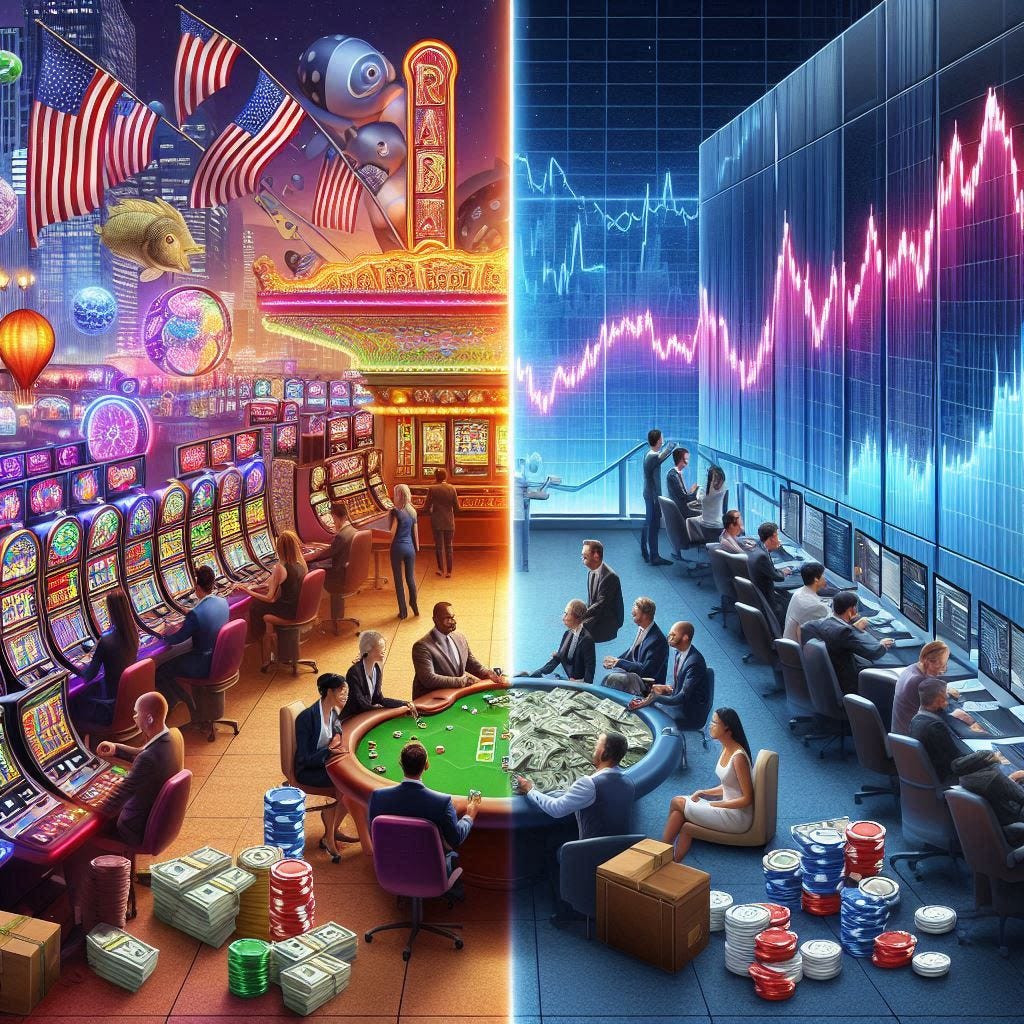
And this, perhaps, is where the American mood has shifted most dramatically. The same civic exhaustion that drives people into stadiums—seeking clarity, unity, and emotional coherence—also drives them toward a new relationship with risk. (https://trueman-triola.stories.email/p/the-fever-of-the-arena) The future no longer feels like a landscape to be cultivated. It feels like a roulette wheel.
When civic trust thins, when institutions wobble, when the public square feels more like a storm system than a shared project, the distinction between investing and gambling begins to dissolve. Not because the math changes, but because the mood does. A healthy civic imagination allows people to see a range of outcomes and assign them reasonable probabilities. It makes long-term commitments feel sane. It makes patience feel like a virtue rather than a sucker’s bet.
But a society trained by spectacle—by the stadium, the screen, the algorithm—learns to weight outcomes not by likelihood but by emotional vividness. The thrilling replaces the probable. The dramatic replaces the true. The same psychic machinery that turns sports into a civic religion turns financial risk into entertainment, identity, even self‑expression.
This is how a culture of spectacle becomes a culture of wagers.
The expected value formula collapses into something more primitive:
What gives me a jolt right now? What makes me feel alive?
The future becomes a place where luck matters more than agency, where volatility feels like destiny, where the long term is a luxury for people who trust the world more than the world has earned.
And beneath it all is a deeper ache: the sense that the future is no longer a place where effort reliably turns into reward.
A society that cannot imagine a stable future cannot distinguish between a wager and an investment. It cannot tell the difference between risk as a tool and risk as a thrill. It cannot build the long-term structures—economic, civic, moral—that make collective life possible.
So the question becomes: what would it take to rebuild the moral imagination of risk?
Not just better financial literacy or stricter regulations, though those matter. But a cultural shift: a renewed belief that the future is navigable, that institutions can be trusted, that patience is not naïveté, that the slow work of building still counts for something.
Expected value, in this sense, becomes more than a formula. It becomes a metaphor for civic repair.
The probabilities are our trust in institutions.
The outcomes are our visions of what life could be.
The sum is the shared horizon we’re willing to work toward.
A society that can imagine its future can invest in it.
A society that cannot will gamble with it.
And right now, America is deciding which kind of society it wants to be.